
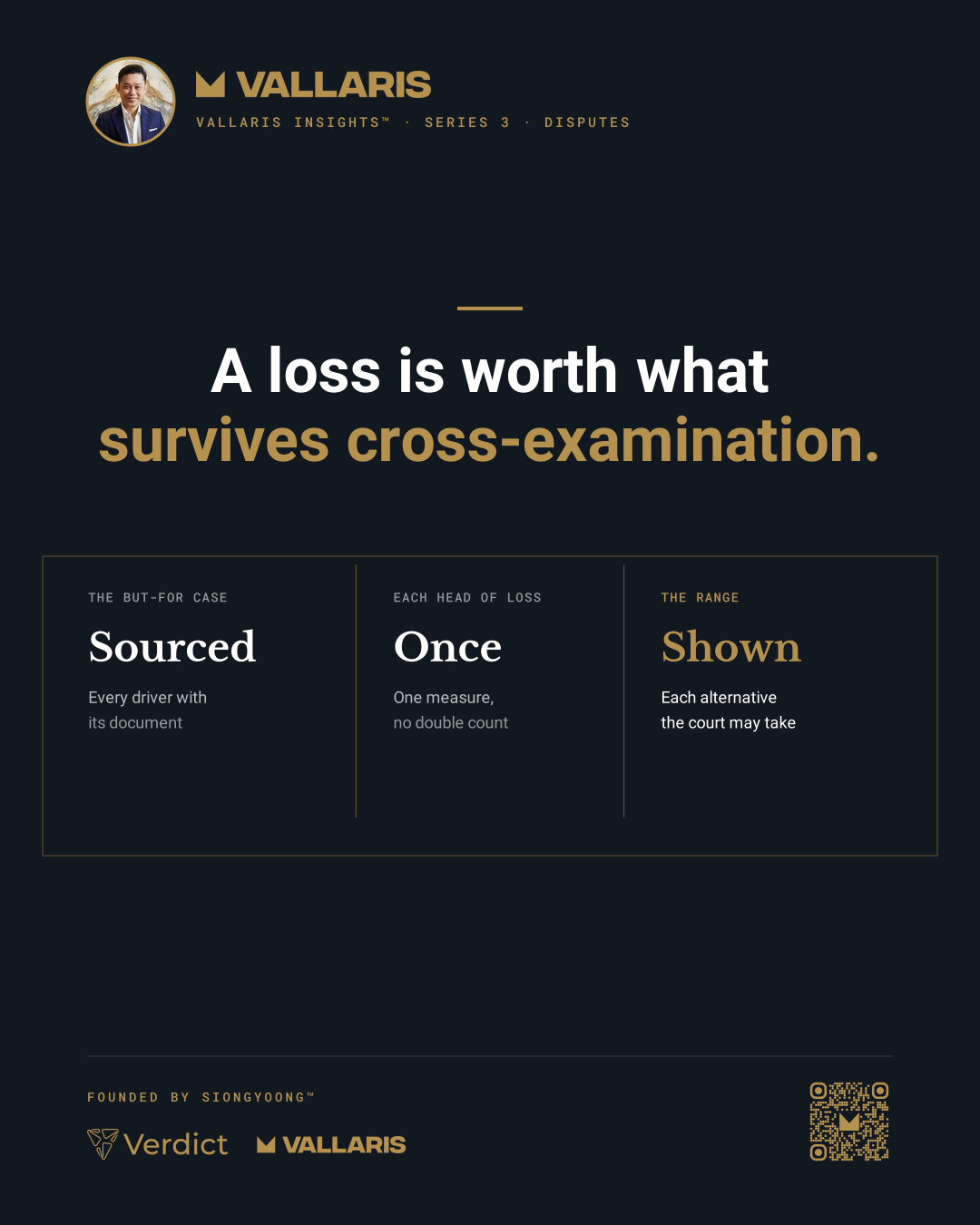
In short: In a Singapore dispute, a claimant must prove both the fact and the amount of its loss, and the other side’s expert will test every line. So a loss is worth what survives cross-examination: a but-for case that changes only the breach, avoided costs taken off, mitigation shown, each head counted once, future losses discounted, and a lost chance valued rather than assumed won. Liability, causation, remoteness and interest are for the court; the expert measures the loss and shows the range.
You have a claim, or a claim has been made against you. The lawyers are arguing liability. Sooner or later, someone has to put a number on the loss.
The first number on the page is usually the largest one anyone will see. Revenue that stopped. A contract that ended early. A deal that did not close.
Then the other side’s expert reads it. They ask how each figure was built, what was left out, and which documents stand behind it. The judge or the tribunal hears both answers.
What is awarded is what holds up under that questioning. A loss is worth what survives cross-examination. So the number is built from the first day as if it will be cross-examined, because it will be.
This guide shows how that is done in Singapore.
What the court needs before it awards a dollar
Five rules from Singapore’s Court of Appeal decide what a damages figure has to show. Each one is a question the other side’s expert will ask.
- The fact of loss, and its amount. A claimant must satisfy the court “both as to the fact of damage and as to its amount”. Where the amount cannot be assessed, the award may be nominal (Robertson Quay Investment Pte Ltd v Steen Consultants Pte Ltd [2008] SGCA 8 at [27], quoting McGregor on Damages).
- Precision where the evidence allows it. The court does not demand certainty where certainty is impossible, and will do the best it can. But “where precise evidence is obtainable, the court naturally expects to have it” (the same case, at [28] and [30]).
- Causation comes first. Whether the breach caused the loss is “logically distinct from and anterior to” the measure of damages. Even where liability and quantum are tried separately, a claimant must show it suffered loss caused by the breach (Tan Woo Thian v PricewaterhouseCoopers Advisory Services Pte Ltd [2021] SGCA 20 at [7]–[8]).
- The loss is not too remote. In contract, the two limbs of Hadley v Baxendale govern remoteness in Singapore. Special knowledge counts only if it was communicated at or before the time the contract was made (MFM Restaurants Pte Ltd v Fish & Co Restaurants Pte Ltd [2010] SGCA 36 at [84] and [89]).
- Avoidable loss is not recovered. A claimant cannot recover loss it could have avoided. The burden of proving that more could have been done to reduce the loss is on the party in breach, it is “not easily discharged”, and the standard of reasonableness expected of the innocent party is not a high one (The “Asia Star” [2010] SGCA 12 at [24] and [31]).
Liability, causation, remoteness and whether mitigation was reasonable are for the court. The expert measures the loss on each assumption the instructions give, and shows what changes if the court decides otherwise.
Four questions the other expert asks first
When I read a damages claim, these are the first four questions I ask. The expert on the other side will ask them too.
- What would have happened without the breach? The but-for case changes one thing only: the breach is replaced by the proper conduct. Every driver (volume, price, margin, growth) has its document beside it. A forecast that changes more than one thing measures more than the breach.
- What costs were saved? Lost profit is the revenue lost, less the costs not incurred because those sales never happened: goods not bought, freight not paid, commission not earned. Revenue on its own is not a loss.
- What was done to reduce the loss? A replacement customer, a new product line, premises let again. Each head of loss is shown after mitigation, with the alternatives if the court sees mitigation differently.
- Is anything counted twice? Each head of loss has one measure. Lost profits and the lost value of the same business, for the same period, are alternatives, never a sum. Money already repaid or recovered appears as its own line, with its dates, never netted out of sight.
Then test every forecast against what actually happened after the breach. The other expert will.
Lost profits or lost value: one measure for each period
Two measures cover most commercial claims.
- Lost profits. The earnings lost over a period, where the business carries on. Measured period by period, as lost revenue less avoided costs, after mitigation.
- Lost value. The fall in the value of the business or asset as a whole, at a stated date. It fits where the business was destroyed, sold or permanently impaired, and it is measured like any valuation: on a basis and at a date the report states.
Which one applies is a choice your lawyers make, because it follows the legal basis of the claim: breach of contract, a shareholder dispute, an IP infringement. The legal measure (what the award is meant to put right) is an instruction to the expert. The expert quantifies on that measure and says so in the report.
The date the loss is measured at is also a legal choice. Where it is still open, I show both: every loss discounted back to the date of breach, and losses valued at the date of trial with past losses carried forward. The court chooses. The report shows the effect of each.
A worked example
Illustrative figures, for the arithmetic only. The discount rate is chosen to show the arithmetic, not as a market rate.
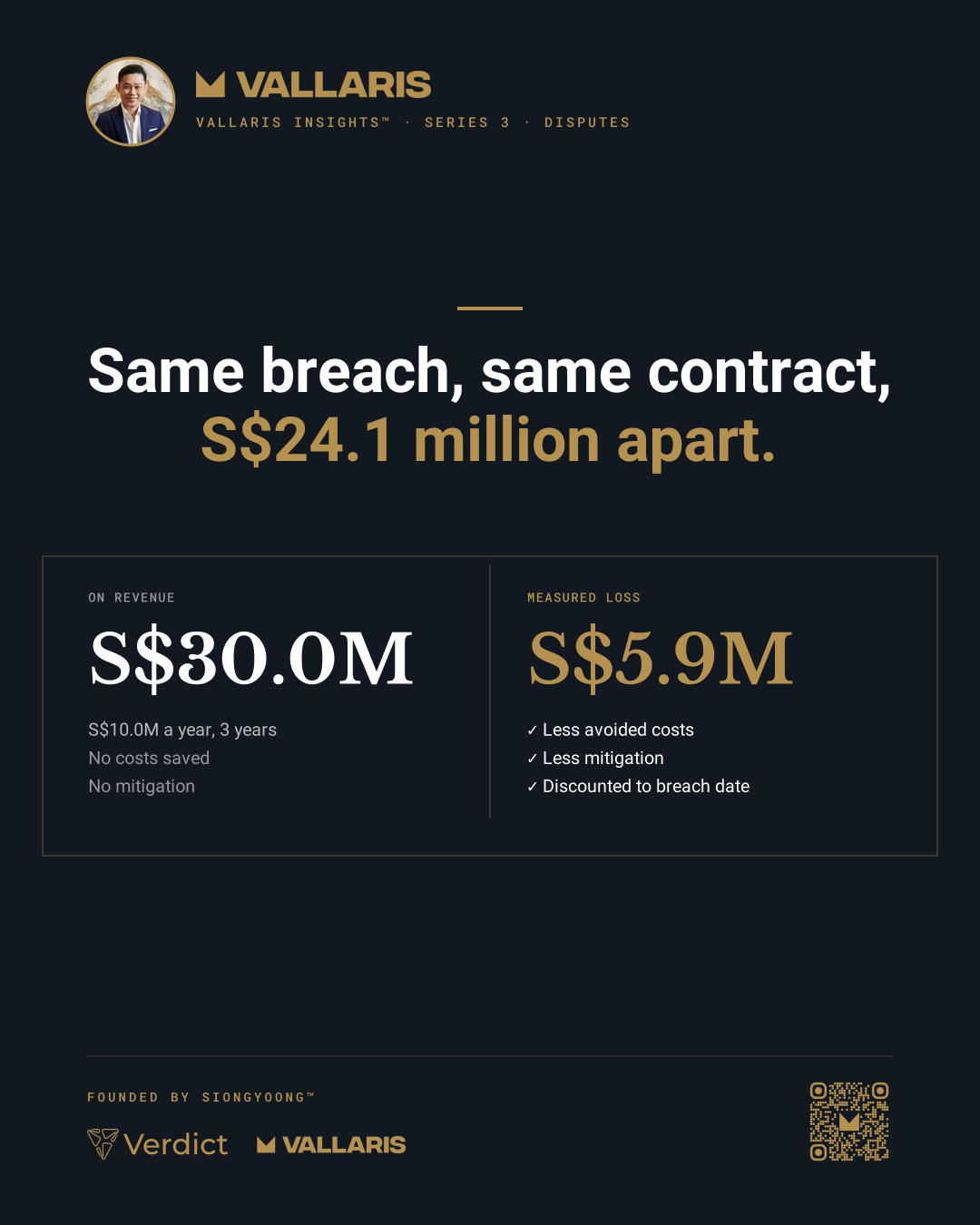
A Singapore distributor holds an exclusive contract to sell a supplier’s products. With three years left to run, the supplier ends the contract in breach. The distributor’s first figure is the revenue it expected: S$10.0 million a year, S$30.0 million in all.
Here is how the number is rebuilt, so that it can be defended.
- Avoided costs. Without the sales, the distributor no longer buys the goods, pays the freight or pays the sales commission: S$7.0 million a year. Lost profit is S$3.0 million a year, S$9.0 million over three years.
- Mitigation. From year 2, a replacement product line earns S$1.0 million a year in profit. The loss after mitigation is S$3.0 million in year 1 and S$2.0 million in each of years 2 and 3: S$7.0 million.
- Discounting. Measured at the date of breach, each year’s loss is discounted for early receipt and for risk. At an illustrative 10% a year, S$7.0 million becomes S$5.9 million.
- The first figure, on revenue: S$30.0 million.
- The measured loss, at the date of breach: S$5.9 million.
Same breach, same contract, S$24.1 million apart.
The S$5.9 million is the lower number. It is also the one with an answer to each of the four questions, and so the one built to survive cross-examination. A claim that leads with S$30.0 million gives the other expert the first S$24.1 million of the cross-examination. Interest, if the court awards it, is added separately.
Loss of chance: valuing what might have been
Some losses were never certain. A tender the claimant was shortlisted for. A licence that might have been granted. A deal that might have closed.
Singapore’s Court of Appeal has set out how such a loss is approached (Asia Hotel Investments Ltd v Starwood Asia Pacific Management Pte Ltd [2004] SGCA 37 at [135]–[142]):
- The chance must be real or substantial, not speculative.
- It need not be more likely than not. The claimant does not have to show, on a balance of probabilities, that it would have succeeded.
- Valuing the chance is part of the assessment of damages, and the chances and their value are for the judge or the Registrar to decide. The court relied on the English Court of Appeal’s view that it is not helpful to lay down, in percentage terms, the lower and upper ends of the bracket.
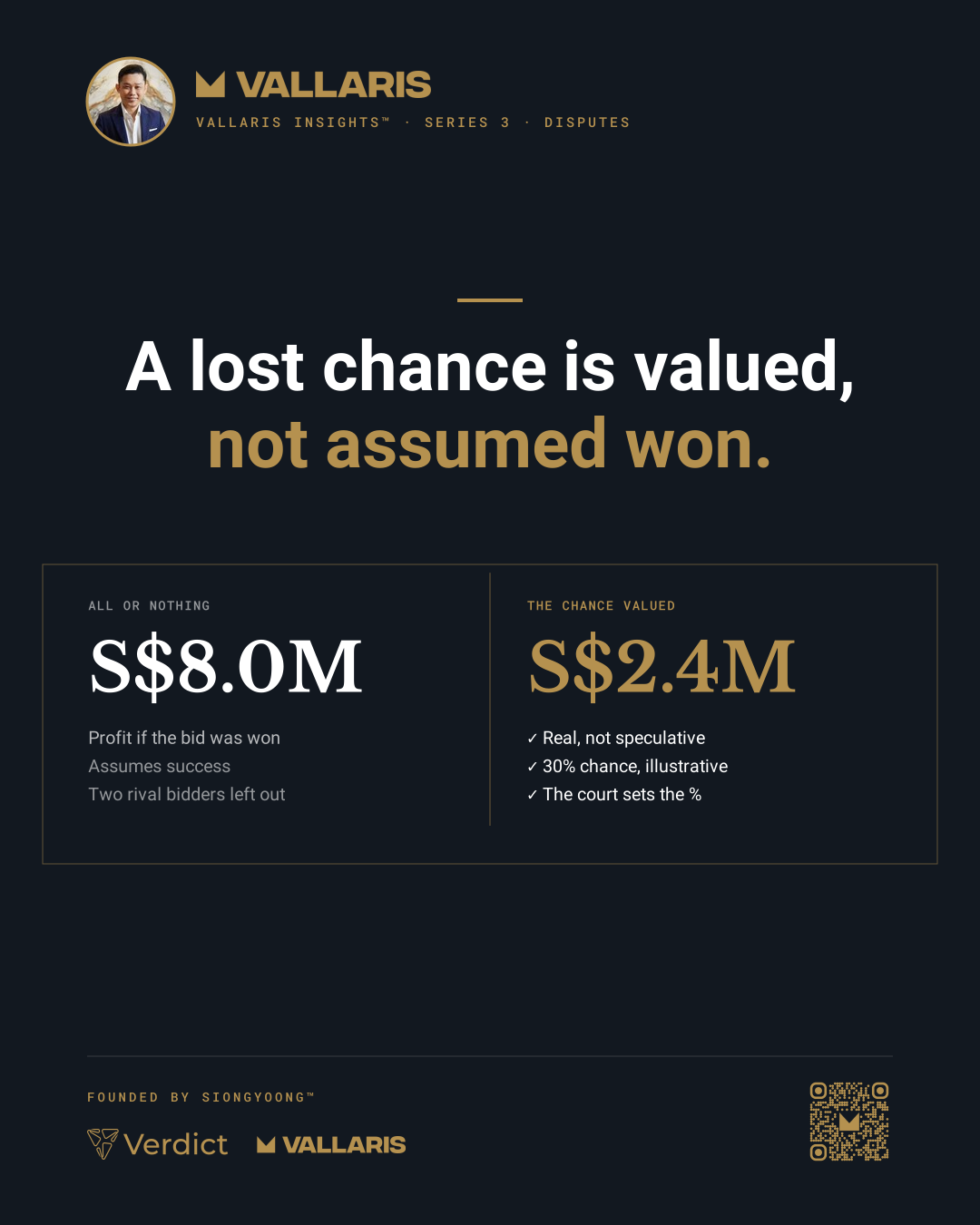
Continuing the method of the worked example: a claimant was one of three shortlisted bidders for a contract that would have earned S$8.0 million of profit, after avoided costs and discounting. If the evidence puts its chance of winning at 30%, the value of the chance is S$2.4 million. The all-or-nothing figure, S$8.0 million, assumes the bid was won.
A lost chance is valued, not assumed won. The report shows the profit if the bid had been won, the evidence on the chance, and the value at more than one percentage, so the court can choose.
Interest is the court’s call
Under section 12(1) of the Civil Law Act 1909, a court may include interest in a judgment for damages “at such rate as it thinks fit”, on the whole or any part of the damages, for the whole or any part of the period between the date the cause of action arose and the date of judgment. Section 12(2)(a) does not authorise interest upon interest.
So interest is a decision for the court, not the expert. I compute it only on the basis, rate and period the instructions set, show it apart from the loss, and leave the rate to the court. Where the instructions ask for simple and compound interest, the two sit side by side.
What the expert decides, and what the court decides
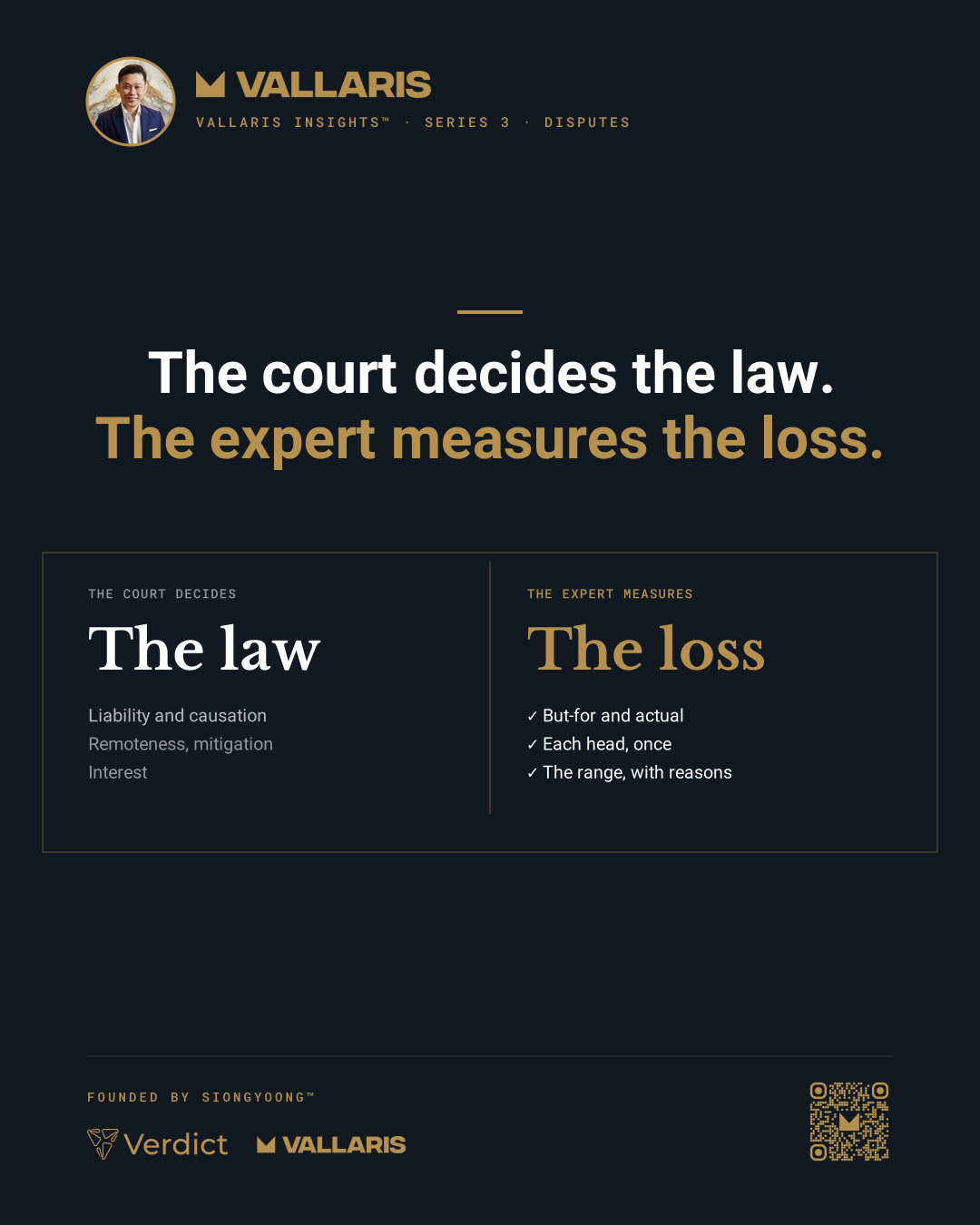
The court decides the law. The expert measures the loss.
In the Singapore courts, Order 12 of the Rules of Court 2021 sets the frame:
- The duty runs to the court. An expert must assist the court on the issues referred, and that duty “overrides any obligation to the person from whom the expert receives instructions or by whom the expert is paid” (O 12 r 1(2)–(3)).
- The court approves expert evidence. No expert evidence may be used without the court’s approval, which is given only if the evidence will contribute materially to deciding an issue. The court may reject evidence from an expert who lacks the specialised knowledge or lacks impartiality (r 2(1), (3) and (4)).
- One common expert, as far as possible. Parties must, as far as possible, agree on one common expert, and except in a special case, with the court’s approval, a party may not rely on more than one expert for any issue (r 3(1)–(2)).
- Agreed issues, one set of facts. The parties agree, and the court approves, the list of issues and the common set of agreed or assumed facts. Unless the court orders otherwise, the expert evidence is confined to those issues and relies on those facts only (r 4(1)–(2)).
- What the report contains. Among other things: the expert’s qualifications; a statement that the duty to the court overrides any obligation to the instructing or paying party; the issues and the facts relied on; where there is a range of opinion, a summary of it and the reasons for the expert’s own; a statement of belief of correctness; and the conclusions, with the reasons for them (r 5(2)).
In arbitration, the tribunal’s procedural orders and the rules the parties chose set the process. I write the same duty, owed to the tribunal, into every arbitration report.
Two rules of practice follow. A method suggested by a party is treated with care: if I adopt one, the report says so, and why. And every assumption on liability, causation or mitigation is stated as an instruction (“I have been instructed to assume that…”), with the effect of the alternatives shown beside it.
How an instruction runs, and how long it takes

- Conflict check. Every party is searched before the letter is signed: your side, the other side, their lawyers and their expert.
- Instructions in writing. Through your lawyers: the legal measure, the date of assessment, the heads of loss, the facts to assume, the mitigation facts, and the basis for interest, currency and tax.
- Working exhibits. The figures, each sourced, with every gap named and every document still awaited listed. No opinion yet. In our practice, about four weeks from the signed letter, so the numbers are ready for mediation or settlement talks.
- The expert report, signed and exhibited in the expert’s affidavit, with the contents O 12 r 5(2) requires, by the date the court or tribunal sets.
- Experts’ meeting. The court may order the parties, their solicitors and the experts to meet before, during or after the reports, to narrow the dispute and agree in writing what they can. A written agreement may be used in court; the other discussions may not, unless the parties agree (O 12 r 6(1)–(2)).
- Reply report, answering the other expert line by line.
- The hearing. Cross-examination. Where there is more than one expert, the court may order them to testify as a panel, give their views on the issues and comment on one another’s views (O 12 r 7(1) and (4)). Under the Singapore Courts’ concurrent expert evidence procedure, used where all parties consent and the court approves, the judge may ask either expert questions at any point.
The court sets the dates. The numbers are ready first. The court’s or the tribunal’s timetable governs everything from the expert report onwards, so the working exhibits are built to be ready before the first date that matters.
Claimant or respondent: the same model, both sides
The expert’s duty is the same whoever gives the instruction, so the model is the same too.
For a claimant, the four questions are the build: a but-for case with its documents, avoided costs taken off, mitigation shown, each head counted once.
For a respondent, the four questions are the critique. Where a claim counts revenue as loss, leaves out mitigation, adds two measures for one period or is not discounted, the reply shows each point and how far it moves the number. A reconciliation of the two experts’ figures, line by line, shows the court exactly where the gap sits.
Some instructions start before any report is due: a review of the other side’s lost-profit forecast, or advice before proceedings begin. Where that work shapes case strategy, it is done by a separate consulting expert under a separate letter, never by the professional who will give evidence.
Questions clients ask
What are economic damages?
The financial loss caused by a breach of contract, a tort, a shareholder dispute or an IP infringement: lost profits, the lost value of a business or asset, wasted costs or increased costs. Quantifying them means comparing what would have happened without the breach with what actually happened.
What is a but-for analysis?
A model of what would have happened if the breach had not occurred, changing only the breach itself. The loss is the but-for position less the actual position, after avoided costs and mitigation, at the date the court chooses.
Should a claim be for lost profits or loss of value?
Lost profits fit where the business carries on; loss of value fits where it was destroyed, sold or permanently impaired. The legal basis of the claim decides, so your lawyers choose. The two are never added for the same period.
How is a loss of chance valued?
The chance must be real or substantial, not speculative. The expert shows the profit if the opportunity had been won, the evidence on the chance, and the value at more than one percentage. The court decides the percentage.
Can the same expert act for a claimant or a respondent?
Yes. The expert’s duty is to the court or tribunal and overrides any obligation to the party that gives the instruction or pays (O 12 r 1(3) in the Singapore courts), so the analysis is the same whichever side asks.
How long does a damages expert take?
The court’s or tribunal’s timetable governs the report. In our practice, the working exhibits take about four weeks from the signed letter, so the numbers are ready for mediation; the expert report, the experts’ meeting and the reply follow the dates the court or tribunal sets.
How is the expert paid?
On time spent, with an estimate by stage, quoted in writing after the first conversation, which has no fee. VALLARIS™ takes no fee that depends on the outcome, so the number never does either.
Sources
- Singapore Statutes Online — Rules of Court 2021, Order 12 (Expert evidence). Duty to the court overrides (r 1); court approval (r 2); common expert (r 3); agreed issues and facts (r 4); report contents (r 5); meetings (r 6); panel of experts (r 7).
- Singapore Courts — Concurrent expert evidence procedure (from 1 April 2022). Experts give evidence at the same time, with the consent of all parties and the court’s approval.
- eLitigation — Robertson Quay Investment Pte Ltd v Steen Consultants Pte Ltd [2008] SGCA 8. The claimant proves the fact and the amount of loss; the court does its best where precise evidence is not obtainable ([27]–[30]).
- eLitigation — Tan Woo Thian v PricewaterhouseCoopers Advisory Services Pte Ltd [2021] SGCA 20. Causation is logically distinct from and anterior to the measure of damages ([7]–[8]).
- eLitigation — MFM Restaurants Pte Ltd v Fish & Co Restaurants Pte Ltd [2010] SGCA 36. The two limbs of Hadley v Baxendale govern remoteness in contract ([84], [89]).
- eLitigation — The “Asia Star” [2010] SGCA 12. Avoidable loss is not recovered; the burden of proving it is on the party in breach ([24], [31]).
- eLitigation — Asia Hotel Investments Ltd v Starwood Asia Pacific Management Pte Ltd [2004] SGCA 37. Loss of chance: a real or substantial chance; valuing it is part of the assessment of damages ([135]–[142]).
- Singapore Statutes Online — Civil Law Act 1909, section 12. Interest on damages at the rate the court thinks fit, from the cause of action to judgment; no interest upon interest.
General information only, not legal advice. Worked figures are illustrative. The legal measure, the date of assessment, causation, remoteness, mitigation and interest are for your lawyers and the court or tribunal.