
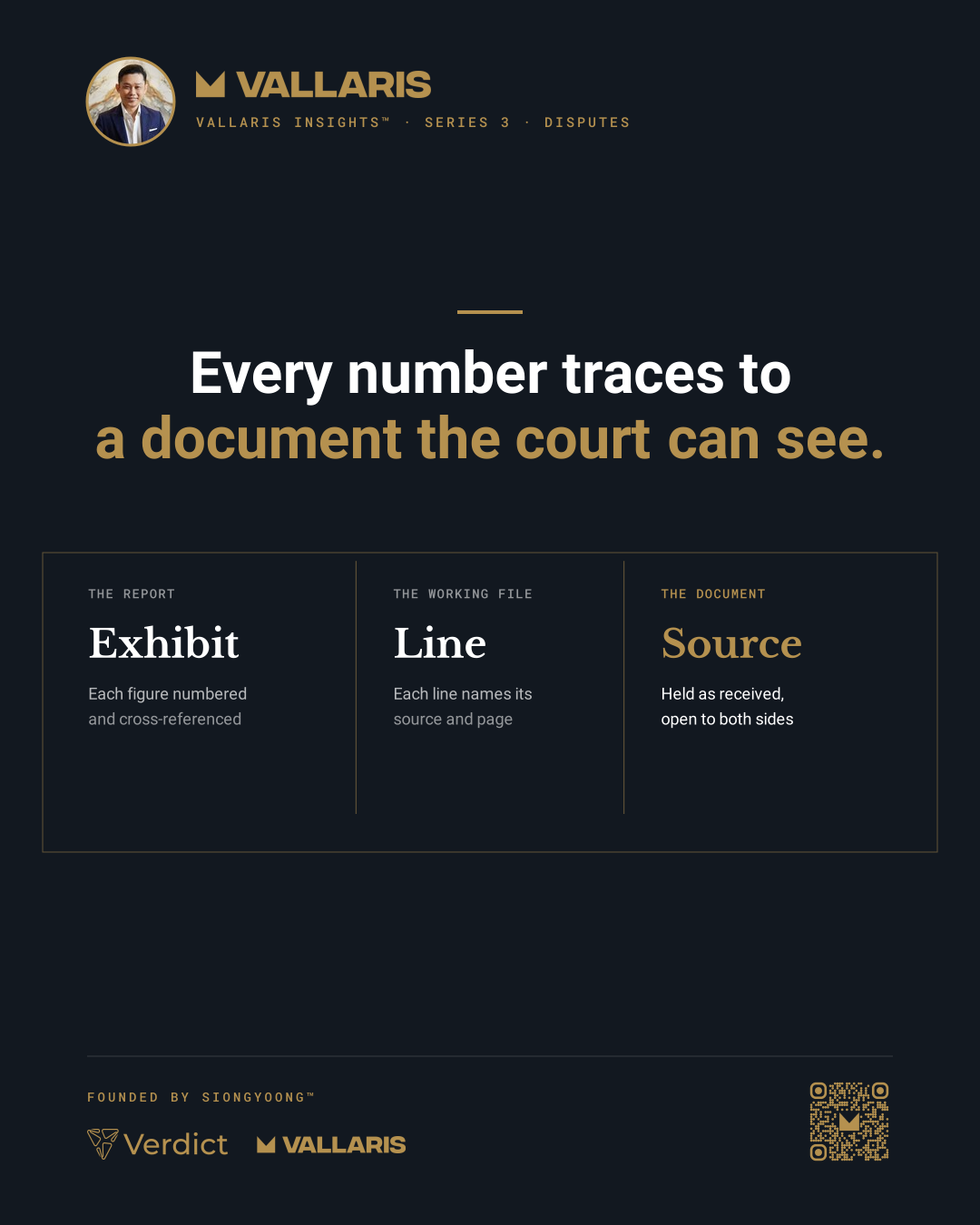
In short: In a dispute, the figures that hold are the ones anyone can follow back to a document: the report gives an exhibit, the exhibit points to a line in the working file, and the line to a bank statement, invoice or ledger page. So every number traces to a document the court can see. Forensic accounting builds that trail, uses neutral words, answers only the issues the court approves under Order 12, and owes its duty to the court, not to the person who pays.
Money has moved in a way nobody can yet explain. Or a partner says the accounts understate his share. Or your lawyers tell you the case will turn on the numbers.
Each of these ends in the same room. A judge or a tribunal reads the evidence, and the other side’s lawyers and expert test every figure in it.
The figures that hold in that room share one thing. The report points to a line in the working file. The line points to a bank statement, an invoice or a ledger page. Anyone can follow the trail, including the other side.
A number without that trail is an assertion, however large it is and however sure you are of it. Every number traces to a document the court can see. That is the standard forensic accounting is built to meet.
This guide shows how that is done in Singapore.
When you need a forensic accountant
Three moments bring one in:
- A number in the accounts needs explaining. Payments without support, a balance that does not reconcile, a supplier nobody has met. You want the facts established, quietly, before you decide what to do.
- A shareholder or partnership dispute. The accounts of the business need to be taken, and the numbers agreed or decided.
- A claim heading to court or arbitration. Your lawyers need an expert whose report and testimony the court or tribunal will rely on.
Start before the documents move. Bank statements can be ordered again, but emails are deleted, staff leave and laptops are replaced. The first step is to keep what exists, unchanged, and record who holds it.
Most schemes come to light late, and through people. The Association of Certified Fraud Examiners’ Occupational Fraud 2026: A Report to the Nations covers 2,402 cases in 143 countries and territories. The median scheme ran for 12 months before it was detected. Tips were the most common way it came to light, in 43% of cases, and more than half of the tips came from employees. These are global figures, not Singapore ones. For planning, they say one thing: by the time a question reaches the board, the records behind it may span a year or more.
What it is, and what it is not
Forensic accounting applies accounting and investigation to a question that may end in a court, a tribunal or a board decision. It traces funds, tests transactions, rebuilds accounts from their records and measures amounts, to a standard the other side can test.
It is not an audit. An audit gives an opinion on whether a year’s financial statements are fairly presented. Forensic work asks a narrower question, such as where S$1.5 million went, and answers it from the documents, transaction by transaction where needed.
It also does not decide who is to blame. Whether conduct was dishonest, whether anyone intended it, and whether a law was broken are for the court. In B2C2 Ltd v Quoine Pte Ltd [2019] SGHC(I) 03, the Singapore International Commercial Court found that an expert had drawn his own conclusions on the intentions of the person who wrote a computer program: “a matter for me and not for him”, as the judge put it (para 40). An expert who stays on the evidence keeps the weight of the evidence.
So a forensic report uses neutral words, each defined where it is used. A transaction that departs from the stated policy is irregular. A figure in the accounts that does not reflect what happened is a misstatement. The word fraud appears only when the report quotes a party’s pleadings. An allegation is a party’s claim; a finding is what the documents show; an opinion is the named expert’s view. The report keeps the three apart.
Every number traces to a document
The trail has three links, and each one is built on purpose:
- The report. Each figure carries an exhibit number.
- The working file. Each exhibit points to a line, and each line to the document behind it, by its reference and page.
- The document. The bank statement, invoice, contract or ledger page, held as it was received.
Five habits keep the trail intact:
- An evidence register from day one. Every document gets a reference, a description, who gave it, when, how, and where it is stored.
- A chain of custody. Who has held each item, who has opened or copied it, and any change to it, so anything that may go to court can be accounted for at every step.
- Originals kept as received. The work is done on copies.
- System records before prepared ones. A bank statement or a system log is stronger evidence than a schedule prepared by the person whose conduct is under review.
- The population stated. Each test says whether it covered every transaction or a sample, how many, and how any sample was chosen.
Each habit answers a question the other side’s expert will ask. Where did this come from? Is it complete? Could it have changed since?
A worked example
Illustrative figures, for the arithmetic only.
A shareholder of a Singapore distribution company alleges that S$1.5 million was paid out over three years without a proper basis. The company’s lawyers instruct a forensic accountant with one question: which payments in the review period lack support, and how much do they total?
The population. Every payment from the company’s bank accounts in the three years: 1,260 payments, totalling S$18.6 million. All of them are tested, not a sample.
The test. Each payment is matched from the bank statement to the ledger, to an invoice, to an approval within the approver’s limit, and to a supplier on the approved list.
The result, in three classes, each defined before the work starts:
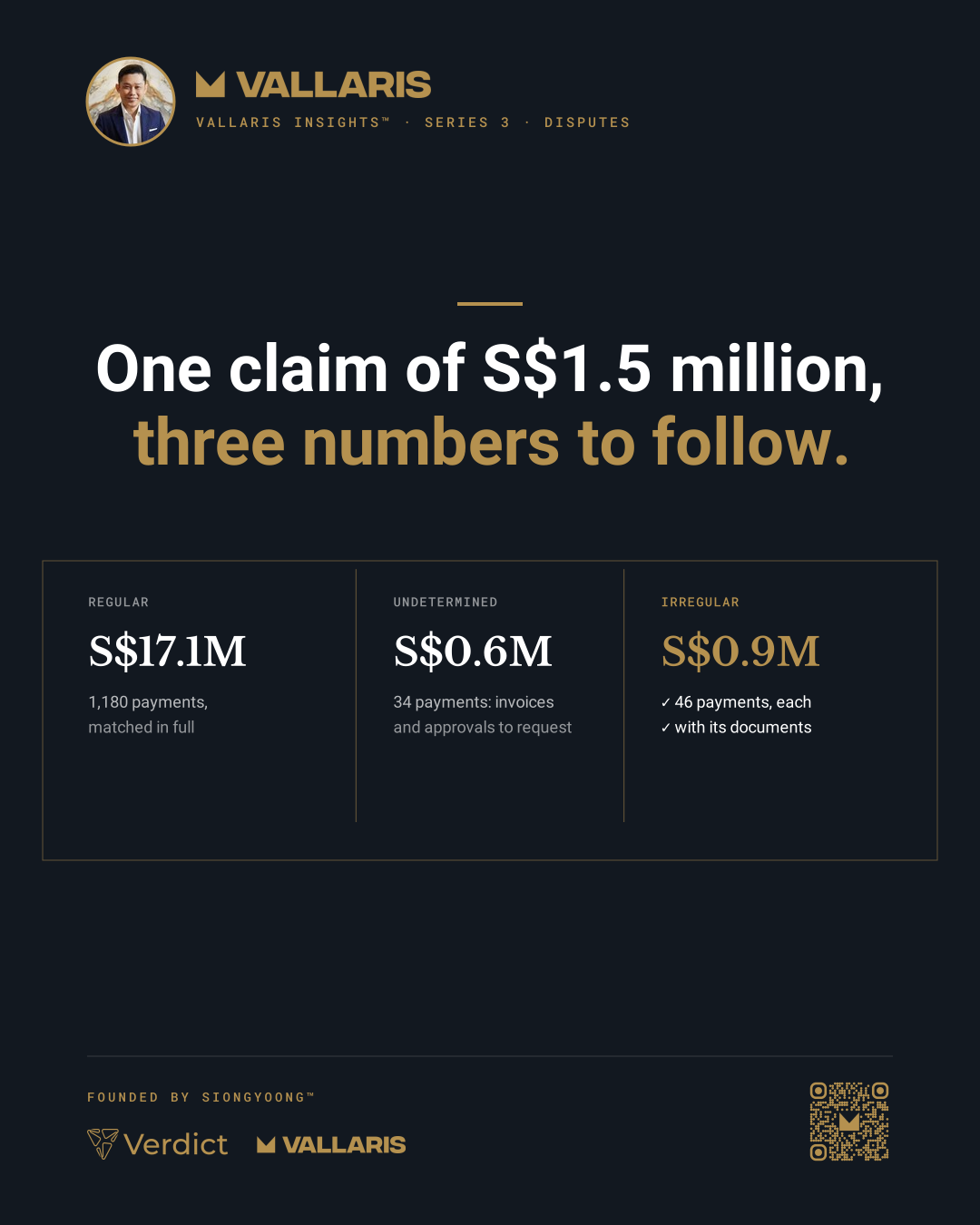
- Regular: 1,180 payments, S$17.1 million. Invoice, approval and supplier all in order.
- Irregular: 46 payments, S$0.9 million. The documents show a departure from the stated policy: paid to a supplier not on the approved list, or approved above the approver’s limit.
- Undetermined: 34 payments, S$0.6 million. An invoice or an approval has not been produced, so the documents cannot yet place them either way.
The other explanation, tested as hard. Delivery records exist for 12 of the 46 irregular payments, S$0.2 million. They stay irregular, because the policy was not followed, and the report says the goods arrived.
One claim of S$1.5 million, three numbers to follow. Each comes with its documents:
- S$0.9 million irregular, payment by payment, of which S$0.2 million has delivery records.
- S$0.6 million undetermined, with a list of the 34 invoices and approvals that would decide it.
- S$17.1 million regular, matched in full.
The S$0.6 million is not set aside. It becomes a request list your lawyers can put to the other side, or to the bank, before the hearing. Each document that arrives moves a payment into one class or the other, on the record.
When the books are incomplete
Directors must make sure the company keeps complete and accurate accounting and other records. Where those records are incomplete, direct tracing reaches its limit, and an indirect method takes over.
The most common is the net worth method. It works on a person’s wealth rather than the company’s books:
- Fix the period and its dates.
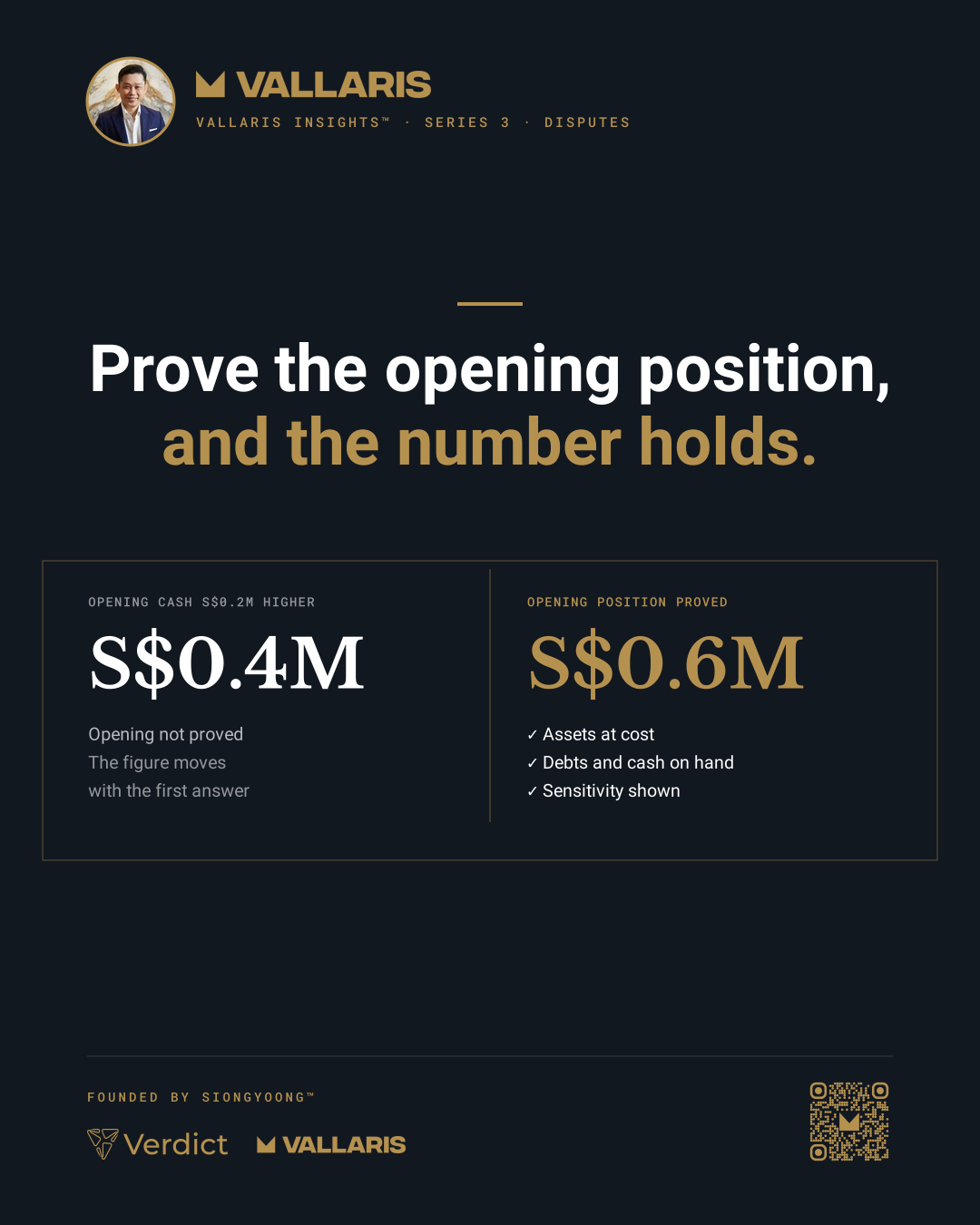
- Prove what the person owned and owed at the start, from documents: assets at cost, debts, and cash on hand.
- Prove the same at the end.
- Add what was spent on living over the period.
- Subtract the income and other sources that are known: salary, dividends, gifts, loans and inheritances.
Illustrative figures. Net worth rises from S$1.2 million to S$2.6 million over three years, an increase of S$1.4 million. Living costs add S$0.3 million, so S$1.7 million was used. Known sources total S$1.1 million. That leaves S$0.6 million.
The report calls it funds from sources not identified. It is not called hidden income until the other explanations are ruled out, and each lead the person gives is followed up.
The usual answer to a net worth figure is that there was more cash on hand at the start. So the report shows how the result moves if the opening figure changes. If opening cash was S$0.2 million higher, the S$0.6 million becomes S$0.4 million. Prove the opening position, and the number holds.
The method comes from US tax practice, and a Singapore court decides for itself what has been proved. That is one more reason to show every step and every document behind it.
What the court expects of an expert
Order 12 of the Rules of Court 2021 sets the rules for experts in the Singapore courts:
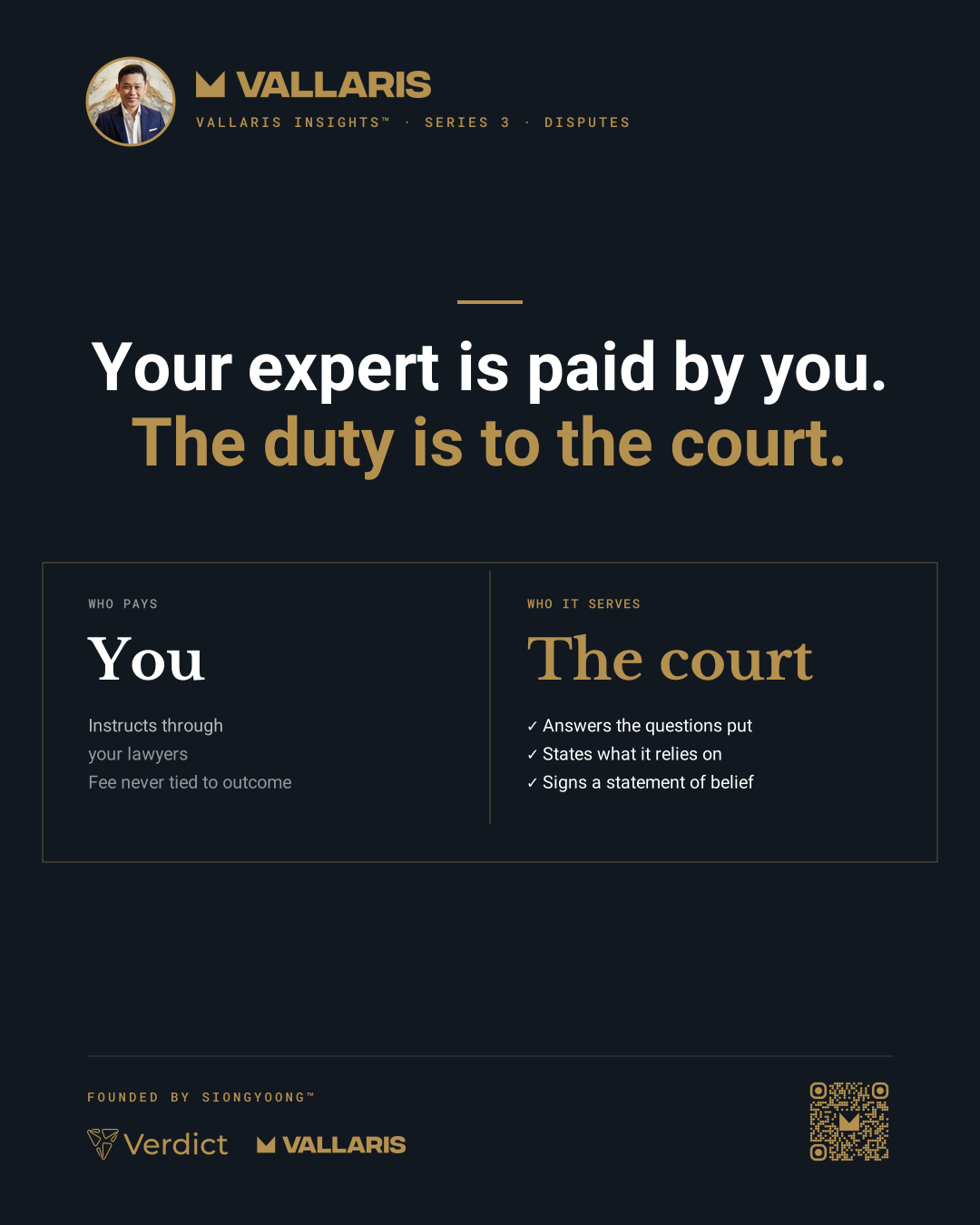
- The duty is to the court. An expert must help the court on the matters within the expert’s expertise and on the issues referred. That duty overrides any obligation to the person who instructs or pays the expert (O 12 r 1(2)–(3)).
- The court approves expert evidence first. No expert evidence may be used without the court’s approval, which is given only where it will contribute materially to deciding an issue. The court may reject the evidence of an expert who lacks the specialised knowledge, or impartiality (r 2).
- One common expert where possible. As far as possible, the parties must agree on one common expert. Except in a special case, a party may not rely on more than one expert for any issue, and in a special case the court may appoint its own expert (r 3).
- The issues and the facts are agreed first. The parties agree the list of issues and a common set of agreed or assumed facts, the court approves them, and the expert evidence is confined to those issues and those facts. As far as possible, each issue is framed as a question that can be answered yes or no (r 4).
- The report shows what it rests on. It is signed and exhibited in the expert’s affidavit, and it includes the expert’s qualifications, a statement of the duty to the court, the issues and facts relied on, a list of the materials relied on, who did any tests or data analysis, a summary of any range of opinion with reasons, a statement of belief in the correctness of the opinion, and the conclusions with reasons (r 5).
- Experts may be ordered to meet to narrow the dispute and agree in writing what they can. With the court’s approval, a party may ask an expert in writing to clarify the report (r 6).
- Experts may give evidence together. Where there is more than one expert, the court may order them to testify as a panel, give their views on the issues and comment on one another’s views (r 7).
Your expert is paid by you. The duty is to the court. That is what gives the report its weight: a judge can rely on it because it was written to answer the questions, not to win them.
The courts say so in their judgments, and the judgments are public. In [2020] SGHC 159, a dispute over partnership accounts, the High Court found that nothing new adduced in my cross-examination altered what my report said (at [144]), and preferred my evidence (at [194]). The Court of Appeal agreed in [2022] SGCA 47, finding the evidence “more credible and objective”, with conclusions “well-reasoned and supported by the evidence” (at [64]). On appeal, the appellant also accepted my figures for two items of the accounts (at [66]). Evidence that traces to documents is evidence the other side can test, and when it is tested, it holds.
The rules reward an expert who answers the questions put and stops there. In B2C2, the court said expert evidence “ought to be directed and only directed to specific defined issues” (para 63), and struck out the passages on an issue it had not settled (para 65). If your expert finds something new, the move is to tell your lawyers, who decide whether to ask the court for permission.
In arbitration, the tribunal’s rules and directions take the place of Order 12. The same discipline carries across: my expert reports have gone to the Supreme Court of Singapore, the Family Justice Courts and arbitral tribunals (SIAC), on the same standard.
Choose the role before the work starts
A forensic accountant can take one of six roles:
- Party expert. Gives independent evidence to the court, instructed by one side.
- Common or court expert. Reports to the court for all parties, and advises neither side on strategy.
- Shadow expert. Advises your lawyers privately and does not give evidence.
- Investigator for a board or committee. Reports findings allegation by allegation, with the limits of the work stated.
- Inspecting accountant. Inspects a company’s records for a shareholder, under a court order.
- Private reviewer. Reviews the books for your own decisions, without court language.
Choose one at the start and keep it. A board report written in court language, or a court report that carries advice for one side, hands the other side its first question.
Four more decisions belong at the start:
- Instruct through your lawyers. Where you want the work protected by legal privilege, your lawyers instruct the forensic accountant, and drafts go only to the people the letter names. Ask your lawyers how privilege applies before anything is written or shared.
- Check every party for conflicts, not only the client: the other side, its lawyers, its expert and the companies at the centre of the dispute. Any earlier dealing with a party is disclosed.
- Put proposed criticisms to the people concerned. In a board investigation, anyone the report criticises sees the criticism first and is given a date to respond, and the response is reported. Ask your lawyers first whether a law enforcement investigation is known or suspected.
- Keep the methods documentary. VALLARIS™ does not use false identities, surveillance, or access to personal devices or accounts without the owner’s consent or a court order. Where email, servers or devices are in scope, a named digital forensics specialist collects them and records how each item was collected and checked.
How it runs, and how long it takes
- Role and questions, agreed with your lawyers in writing.
- Conflict check of every party.
- Documents preserved and registered. The evidence register opens on day one.
- Testing, with the population, the method and every exception explained.
- Draft report, answering only the questions put.
- Comments. In board and private roles, from the people the report criticises. In court roles, the review of the other side’s report, and any meeting of experts the court orders.
- Final report, signed, with the declaration the court requires.
- Testimony, where the matter goes to a hearing.
The engagement letter sets the timetable, milestone by milestone, counted from the signed letter and the receipt of the documents the questions need. In court and arbitration work, the court’s or tribunal’s directions fix the dates for the reports and the hearing, and the work is planned back from them. The court sets the dates. The documents set the pace. What moves it is how complete they are, and how quickly the other side or the bank produces what is asked for. Each milestone in the letter says whether it runs from the start or from complete documents, so everyone knows what moves it.
Questions lawyers and boards ask
When should I bring in a forensic accountant?
As soon as a number needs explaining, or when a dispute will turn on financial evidence. Early is better: the documents can be kept as they are, and your lawyers can instruct the work.
How is forensic accounting different from an audit?
An audit gives an opinion on whether a year’s financial statements are fairly presented. Forensic accounting answers a specific question, such as where a sum went, from the documents, to a standard the other side can test.
Will the report say whether someone committed fraud?
The report sets out what the documents show, in neutral words, and quantifies it. Whether conduct was dishonest or intended is for the court to decide.
What does an expert witness owe the court?
Under Order 12, rule 1 of the Rules of Court 2021, the expert helps the court on matters within the expert’s expertise, and that duty overrides any obligation to the person who instructs or pays the expert.
What if the records are incomplete?
Direct tracing goes as far as the documents allow. Beyond that, an indirect method such as the net worth method measures funds from sources not identified, with the opening position proved and the sensitivity shown.
Can you review the other side’s expert report?
Yes. A review of its data, method and assumptions often narrows the issues before the hearing, and helps your lawyers prepare their questions.
How long does forensic accounting take?
It depends on the questions and the documents. The engagement letter sets each milestone and what it depends on; in court and arbitration work, the court’s or tribunal’s directions fix the dates for the reports.
How much does a forensic accountant cost?
The fee follows the questions, the period and the volume of documents. VALLARIS™ quotes the fee in writing after the first conversation, which has no fee. Fees never depend on the outcome.
Sources
- Singapore Statutes Online — Rules of Court 2021, Order 12 (Experts). The duty to the court (r 1), court approval (r 2), common and court experts (r 3), issues and common facts (r 4), report contents (r 5), meetings and clarification (r 6), panels of experts (r 7).
- Singapore International Commercial Court — B2C2 Ltd v Quoine Pte Ltd [2019] SGHC(I) 03. An expert’s view on a party’s intention is for the court (para 40); expert evidence directed only to defined issues (paras 63 and 65).
- High Court of Singapore — [2020] SGHC 159. Partnership accounts dispute; nothing new in cross-examination altered the expert’s report (at [144]); his evidence preferred (at [194]).
- Court of Appeal of Singapore — [2022] SGCA 47. The expert’s evidence more credible and objective, its conclusions well-reasoned and supported by the evidence (at [64]); figures accepted on appeal (at [66]).
- Association of Certified Fraud Examiners — Occupational Fraud 2026: A Report to the Nations, key findings. 2,402 cases in 143 countries and territories; median scheme 12 months before detection; 43% detected by tips. Global figures.
- ACRA — Financial reporting duties for directors. Directors make sure the company maintains complete and accurate accounting and other records; page updated 26 February 2026.
General information only, not legal, accounting or tax advice. Worked figures are illustrative. Take legal advice on privilege, procedure and any duty to report before the work starts.