
In short: ESOP design sets the pool, the form of award, the vesting and the leaver terms before the first grant. In Singapore those terms decide whether the plan is measured once as equity or every year as a liability under SFRS(I) 2 or FRS 102, and whether the company can claim the YA 2026 tax deduction. Price the cash and the shares as one package, then let your lawyer draft the plan rules.
You want to hire people you cannot yet pay fully in cash. Shares close the gap.
But a share plan is pay, not a gift. Every grant is a cost in your accounts, measured on the day you grant it.1 The terms you choose now decide whether that cost is set once or measured again every year, and how much of the company the founders give up.
So design comes before the grant, and the lawyer drafts after the design. This guide walks through the decisions in the order a Board meets them.
How big should our ESOP pool be?
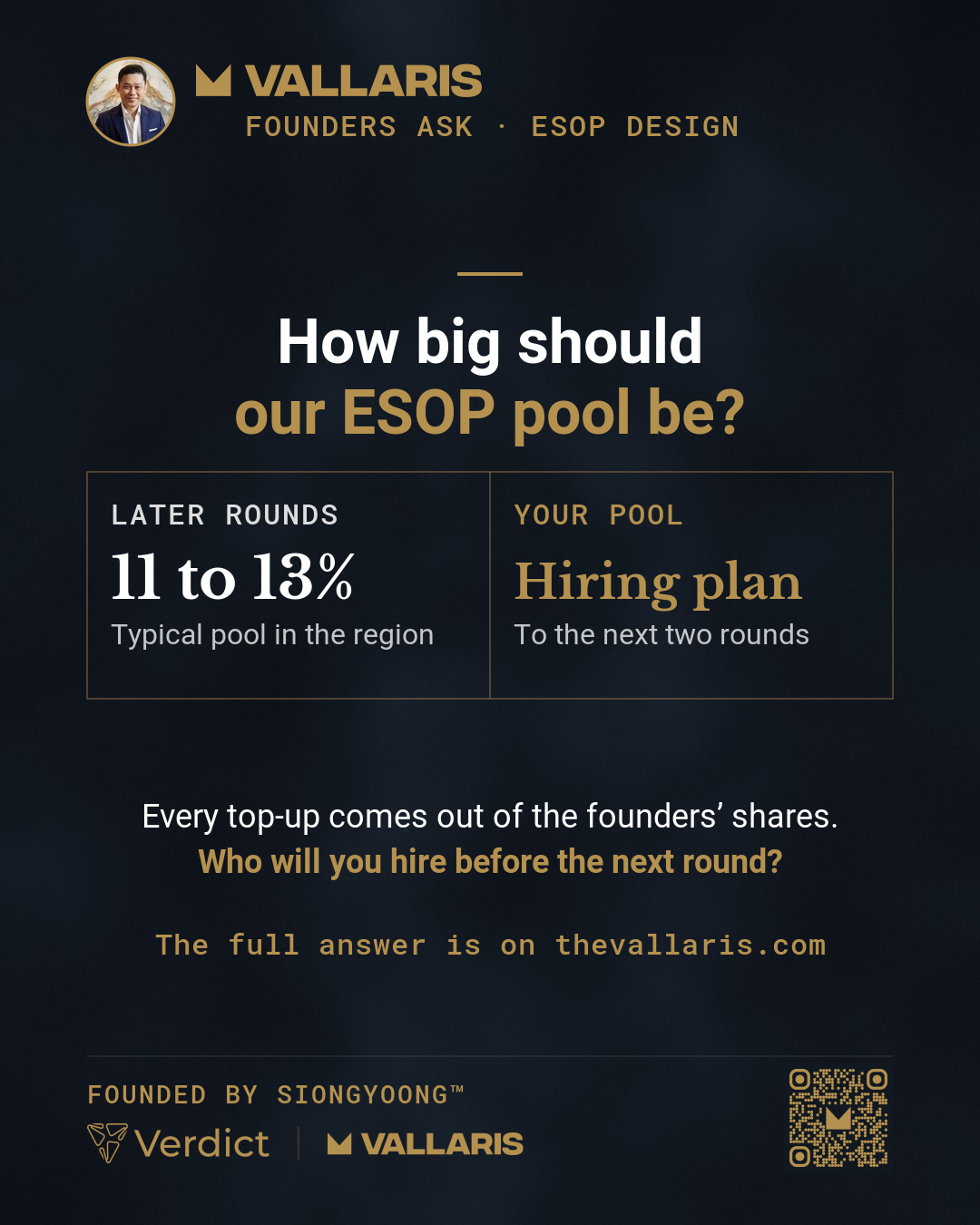
Size the pool from the hiring plan to the next two rounds: who you will hire, at what level, and how much of each package will be shares. Add room for refresh grants to people already on the team.
For a reference point, Carta’s data on startups in Asia-Pacific and the Middle East shows pools of 7% of fully diluted equity at pre-seed, 11% at seed, and 11 to 13% at later rounds.2 An average is a check, not a target. A pool sized from your own plan is topped up less often.
Will phantom shares hit our profit every year?
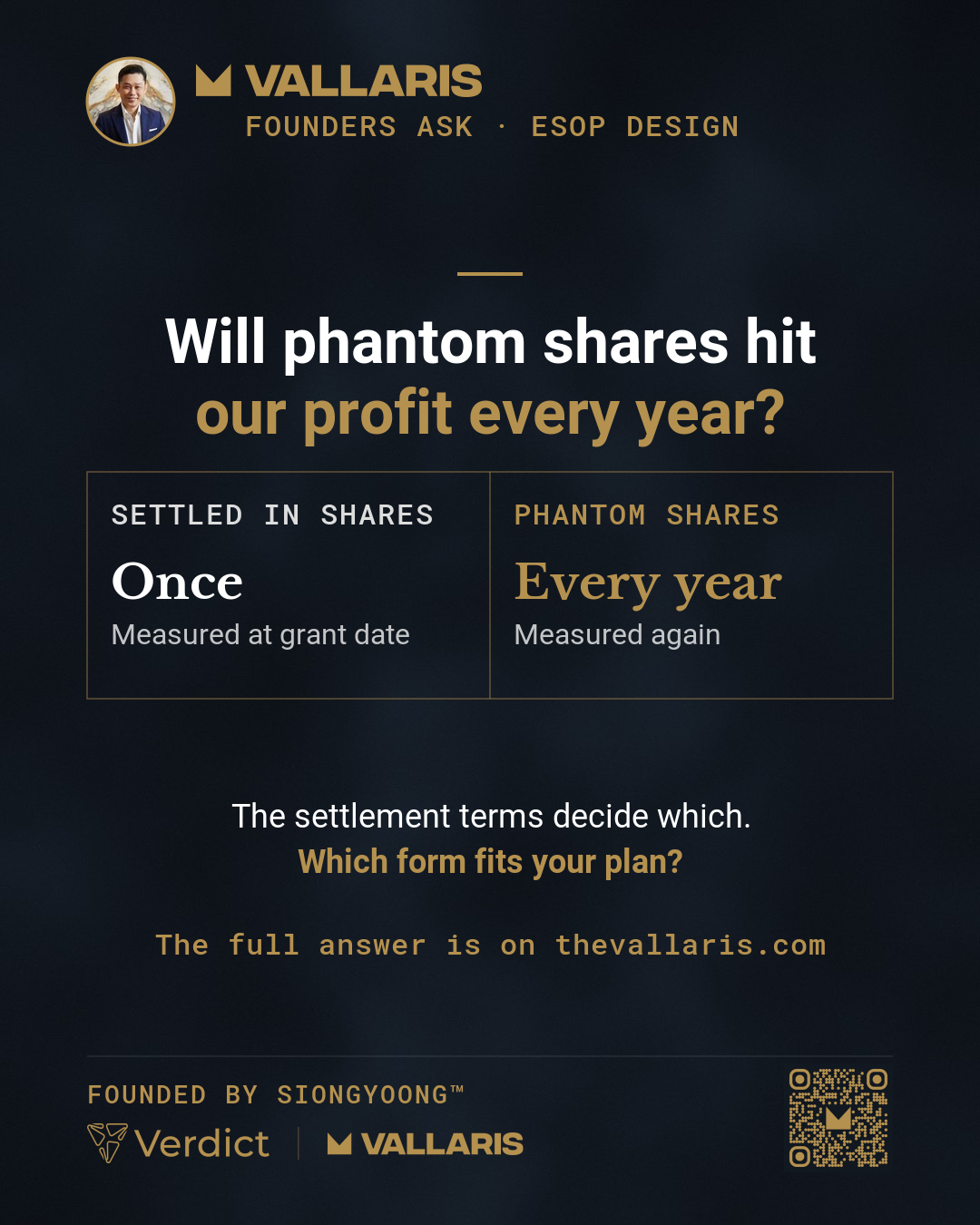
Three common forms, each with a different cost profile:
- Share options. The right to buy shares at a set price. Settled in shares, so the fair value is measured once, at the grant date, and spread over the vesting period.1
- Share awards (restricted or performance shares). Shares delivered when conditions are met, with nothing or little to pay. Also settled in shares, and also measured once.1
- Phantom shares. A cash payment that tracks the share price. Settled in cash, so the plan is a liability, measured again at every reporting date and at settlement, with each change in profit or loss.1
Phantom shares suit a company that cannot or will not issue new shares. The trade-off is a cost that moves with the share price every year.
Can the company claim a tax deduction for the shares?
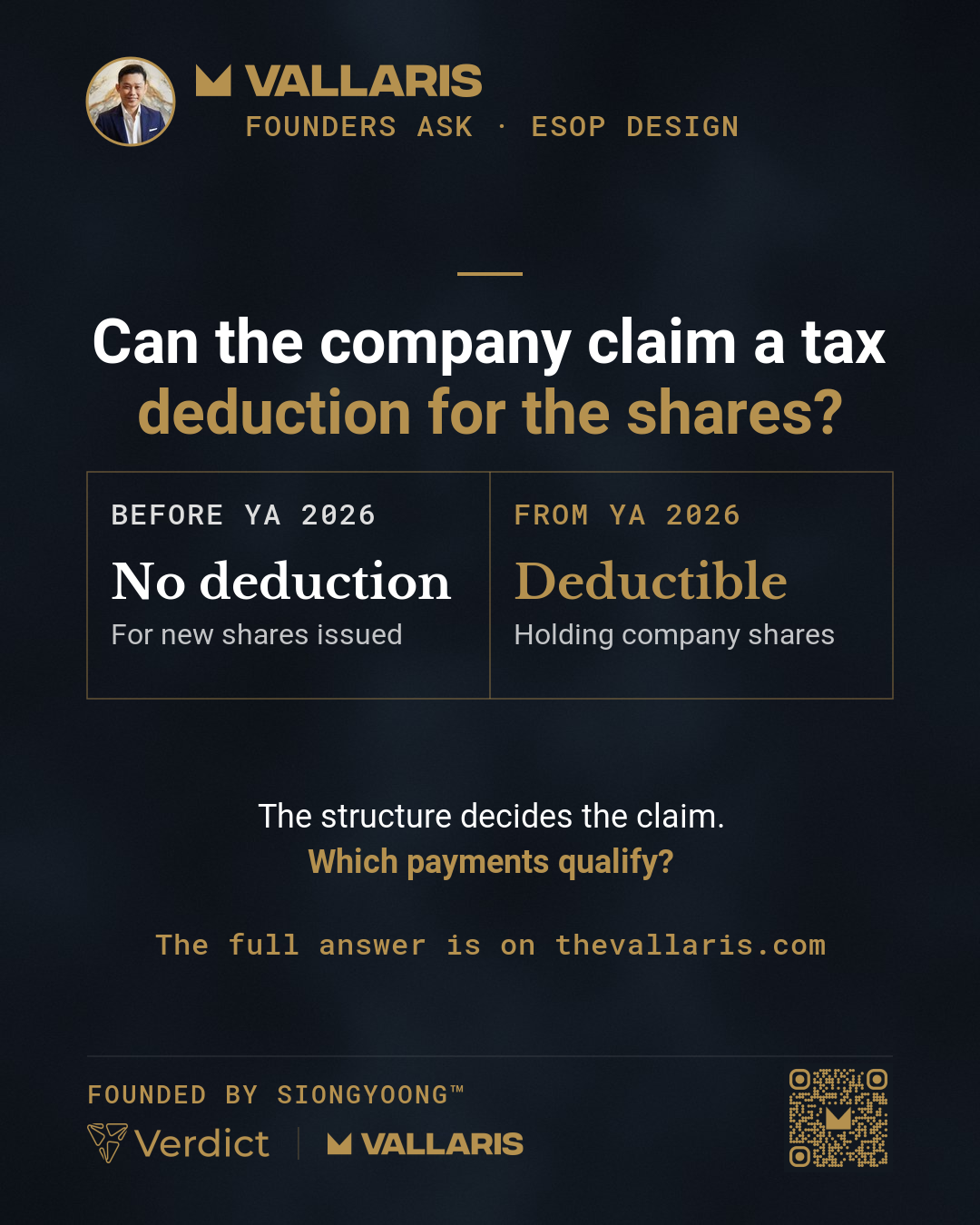
Two tax questions shape the design.
- For your people. In Singapore, gains from share plans are generally taxed as employment income. Foreign employees, and permanent residents leaving Singapore permanently or posted overseas, can be taxed under the deemed exercise rule when they leave, on gains they have not yet realised.3 Tell senior hires this before they sign.
- For the company. From YA 2026, a Singapore company can claim a tax deduction for payments to its holding company or a special purpose vehicle for new shares of the holding company issued under the plan. The deduction is the lower of the amount paid and the shares’ fair market value, or net asset value, when they are issued, less what employees pay.4,5 The group structure decides whether the claim is available, so set it before the first grant.
When you need one
Four moments, in the order companies usually meet them:
- Your first plan. You are making offers that mix salary and shares. The pool, the vesting and the leaver terms need setting before the first offer letter.
- A round is coming. Investors often ask for the pool to be sized, or topped up, before they price the round. Every top-up comes out of the existing shareholders’ stakes.2
- The plan no longer fits. Repricing, extending or replacing awards is a modification. Any extra fair value it adds is charged on top of the original cost.1
- A sale is in sight. Change-of-control and leaver terms decide who stays through the sale and what they keep. A buyer reads them in diligence.
Start from the cash market rate
Begin with what each role costs in cash. Benchmark the salary for the role, the level and the industry, because that is the number a candidate compares your offer against.
Then decide how much of that cash the company will replace with shares. The gap you fill with shares is the cash-equivalent value the plan has to deliver, and it is the number the hire will judge.
An illustration, for the arithmetic only. A role’s cash market rate is SGD 180,000 a year. You offer SGD 150,000 in salary and options with a fair value of SGD 120,000 at grant, vesting over four years. Spread evenly, the options are worth SGD 30,000 a year at grant, so the package is worth SGD 180,000 a year on day one. Whether it is worth more later depends on what the company becomes.
The same fair value is the cost your accounts carry. Price the package once, and the offer letter and the accounts start from one number.
Equity or liability: decide it on purpose
The settlement terms decide the accounting. An award the company settles in its own shares is equity. An award settled in cash is a liability. Where the company or the employee can choose how it is settled, the standard has its own rules, and the terms decide which apply.1
Leaver terms matter here too. A clause that lets the company buy back shares for cash, or lets a leaver require it, can turn an award that looks like equity into a liability. Write these terms with the accounting in front of you, not after.
Conditions: in the price, or in the count
Every award carries conditions, and the standard splits them in two.1
- Market conditions are tied to the share price, such as total shareholder return. They go into the fair value at grant. If the target is missed but the service is given, the expense stays.
- Non-market conditions are service, and targets such as revenue or profit. They change how many awards the company expects to vest, re-estimated at every year end.
Choose the condition that fits what the Board wants the plan to do: keep people, reward results, or prepare for a sale.
What your lawyer needs from the design
The lawyer drafts the plan rules. What the lawyer needs first is a design the Board has approved:
- the aim of the plan, and who is eligible;
- the pool, and how it is topped up;
- the form of award, the exercise price and the vesting;
- the leaver, change-of-control and settlement terms;
- the cost in the accounts, by year, and how it changes with each choice.
With these in a Board paper and a term sheet, the plan rules are drafted once and hold when the auditor reads them.
Questions founders ask
Do we design the plan before the lawyer drafts it?
Yes. The pool, the form of award, the vesting and the leaver terms decide the cost in your accounts and the tax. Settle them in a design the Board approves, then the lawyer drafts plan rules from it.
Once the plan is designed, does each grant still need a valuation?
Yes. Each grant is measured at fair value on its grant date. Where VALLARIS™ designed the plan, the valuation report says so.
Sources
- IFRS Foundation — IFRS 2 Share-based Payment, issued text (2026 edition). The text SFRS(I) 2 mirrors: grant date and fair value (Appendix A), equity-settled awards measured at grant (para 10), market and non-market conditions (paras 19–21), cash-settled remeasurement (para 30), settlement choices (paras 34–43), modifications (para 27). Accessed 15 November 2026.
- Carta — 2025 Startup Equity & Workforce Report: APAC & ME. Published 28 April 2025: ESOPs in APAC and ME expand from 7% of fully diluted equity at pre-seed to 11% at seed, and remain in the 11–13% range at later rounds. Accessed 20 November 2026.
- Inland Revenue Authority of Singapore (IRAS) — Tax Treatment of Employee Stock Options and Other Forms of Employee Share Ownership Plans (Sixth Edition). e-Tax Guide, published 30 January 2026: when gains are taxed (para 5), deemed exercise rule (paras 11–12).
- Inland Revenue Authority of Singapore (IRAS) — Tax treatment of business expenses (A–F). From YA 2026, a company may claim a tax deduction on payments to its holding company or an SPV for the issuance of new shares of the holding company under an employee equity-based remuneration scheme. Accessed 20 November 2026.
- Ministry of Finance — Budget 2025, Annex H-2: tax changes. Item 6: the deduction is the lower of the amount paid by the company and the fair market value, or net asset value, of the shares, less any amount payable by employees. Accessed 20 November 2026.
General information only, not valuation, accounting, legal, or tax advice. Worked figures are illustrative. Management and the auditor decide the accounting classification; your lawyer drafts the plan rules.