

In short: Financial due diligence tests a target’s adjusted EBITDA, net debt and normal working capital before you sign. A finding on its own is a comment; it earns its place when it changes the price, the completion mechanism, a warranty, an indemnity or a condition. So every finding lands in the price or the contract, with a sign, an amount and a source behind it.
You have agreed a price in principle. The seller is keen, the lawyers have a first draft of the sale and purchase agreement, and the board wants a date.
What you have agreed is a multiple of earnings someone else prepared.
Financial due diligence tests those earnings before you sign. It finds what should come off the price on the way from enterprise value to the cheque, and the working capital the business needs to keep running the day you take over.
A finding on its own is a comment. It earns its place when it changes something you sign: the price, the completion mechanism, a warranty, an indemnity or a condition. Every finding lands in the price or the contract.
This guide shows how that is done in Singapore.
When you need it
Three moments bring it to the table:
- You are buying a company. The price is agreed in principle and the binding offer is next. Diligence sits between the two.
- You are selling, and a buyer’s team is coming. Vendor due diligence lets you see the questions first and answer them with the evidence ready.
- You are investing or lending. Your investment committee or credit team wants an independent view of earnings and cash before it commits.
Start before the binding offer. Once the price is in a signed agreement, a finding can only be argued back through warranties and claims. Before signing, it goes straight into the number.
What it is, and what it is not
Financial due diligence is an independent review of a company’s earnings, assets and cash before a deal. It works in four parts:
- The business platform. Who keeps the accounts, which accounting policies are written down, and which systems produce the numbers.
- Quality of earnings. Reported profit, adjusted to the earnings the business will keep making under a new owner.
- Quality of assets. The balance sheet, line by line, and the net debt and debt-like items that come off the price.
- Quality of cash flows. Working capital: how much the business needs through the year, and the normal level the price assumes.
It is not an audit. An audit gives an opinion on whether past accounts are fairly stated. Due diligence asks what those accounts mean for the price, and for what you will own after completion.
The difference matters in Singapore. A private company that meets at least two of three tests for the past two financial years (revenue of S$10 million or less, total assets of S$10 million or less, 50 employees or fewer) may be exempt from audit under ACRA’s small company rules. A target can be worth well over US$10 million and still sit inside that test. The accounts you are buying on may never have been audited.
The scope is what the engagement letter says, so write it entity by entity: which companies are in, which are out, which years, and whether the accounts for each are audited, management only, or not yet prepared.
Three numbers that set the price
Most private deals are priced on a multiple of earnings, cash-free and debt-free, with a normal level of working capital. Diligence tests each of the three:
- Adjusted EBITDA (earnings before interest, tax, depreciation and amortisation). What the business earns in a normal year, under a new owner.
- Net debt and debt-like items. Everything that comes off enterprise value to reach equity value.
- Normal working capital. The level the business needs, which becomes the peg the completion mechanism measures against.
Adjusted EBITDA is built in labelled steps, year by year: reported EBITDA from the accounts, then management’s adjustments, then the diligence team’s own. Stand-alone costs, and savings only the buyer can make, sit below adjusted EBITDA as a separate line, never inside it.
Every adjustment carries a sign, an amount and a basis. “Adjusted” on its own tells the reader nothing. “We have subtracted S$0.3 million of FY2025 bonus that was earned but not accrued” tells the reader exactly what moved.
A worked example
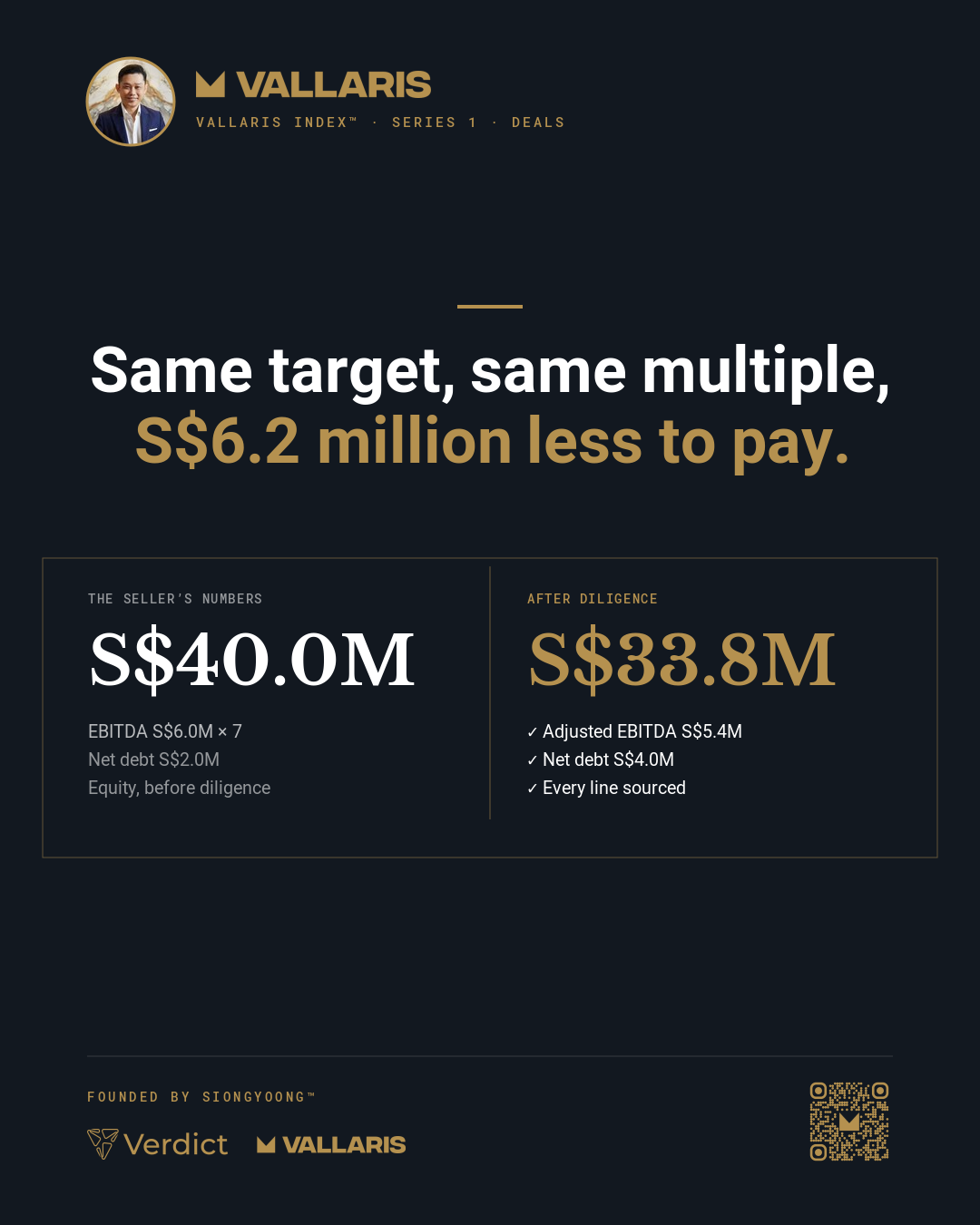
Illustrative figures, for the arithmetic only. The multiple is chosen to show the arithmetic, not as a market rate.
A buyer agrees in principle to pay 7 times EBITDA for a Singapore services company, cash-free and debt-free.
The seller’s numbers. EBITDA of S$6.0 million, so an enterprise value of S$42.0 million. Net debt of S$2.0 million: a bank loan of S$3.0 million, less S$1.0 million of cash. Equity value: S$40.0 million.
What diligence finds in the earnings, each with its source:
- Bonus and unused leave earned in the year but not accrued: subtract S$0.3 million.
- A one-off gain on selling equipment, booked in other income: subtract S$0.4 million.
- A finance role filled by a family member without pay, at a market salary: subtract S$0.1 million.
- The founder’s pay above a market salary for the role: add back S$0.2 million.
Adjusted EBITDA is S$5.4 million. At 7 times, enterprise value is S$37.8 million.
What diligence finds in the balance sheet:
- A dividend declared and still unpaid: S$0.8 million.
- Income tax for the years before completion: S$0.5 million.
- Lease liabilities on the premises: S$0.7 million.
Net debt is S$4.0 million. Equity value is S$33.8 million.
Same target, same multiple, S$6.2 million less to pay.
S$4.2 million of it comes from the earnings, because every dollar of EBITDA is worth seven dollars of price. The other S$2.0 million comes from the balance sheet, a dollar for a dollar. Each of the seven findings now has a number. The next question is where each one goes.
Where each finding goes
A diligence report earns its place in the deal through one table. Each row names a finding, its effect in money, and where it goes in the documents:
- The price. The earnings findings change the base the multiple is applied to.
- The completion mechanism. With completion accounts, a disputed bonus accrual becomes a specific accounting policy for bonus and leave, so it is measured the same way on the day. With a locked box, the dividend becomes leakage the seller promises not to take, or a deduction agreed in advance.
- An earn-out on audited numbers. Where part of the price depends on future profit, tie it to audited accounts and completion accounts, not to management accounts.
- A warranty or an indemnity. Pre-completion tax whose final amount is not yet known is a candidate for a specific tax indemnity.
- A condition before completion. Bank debt to be repaid on the day, or a consent needed from a major customer.
- After completion. Operational points, such as putting a bonus policy in writing, go on a separate list, so the deal points stand out.
The report recommends the mechanism. Your lawyers draft it. Choose between completion accounts and a locked box before the binding offer, so the diligence is scoped for the one you use; our M&A advisory guide sets the two side by side.
Net debt: what comes off the price

Net debt is where the most money moves for the least argument, provided every item is on the list before the price is signed. What comes off the price is listed before you sign.
Each candidate item falls in one of three bands:
- Debt. Bank loans, overdrafts, accrued interest, break costs and income tax payable.
- Usually debt-like. Shareholder and related-party loans, deferred payments for past acquisitions, change-of-control payments, overdue suppliers and taxes, and transaction costs.
- May be debt-like. Deferred income, bonuses, customer deposits, legal claims and capital spending below plan.
Two questions decide the third band. Was the cost left out of the EBITDA behind the price? And how likely, and how soon, is the cash to go out? Where the cost was left out and the cash is going out soon, the item comes off the price.
Deferred income needs the most care. Under SFRS(I) 15 (IFRS 15), cash a customer pays before the work is done is a contract liability: the business owes the work, and the new owner will deliver it. Research cited in the ICAEW Corporate Finance Faculty’s best-practice guideline on completion mechanisms (October 2016) found deferred income the most debated value item in price adjustments. Settle its treatment early.
Three more points carry weight:
- Cash comes in three kinds. Cash the buyer can use, cash that is trapped (held for customers, or ring-fenced), and cash-like items such as a refundable deposit.
- Debt repaid at completion still comes off the price. The buyer usually funds the repayment on the day, so it is deducted all the same.
- Leases are their own line. Under SFRS(I) 16 (IFRS 16), a tenant records a lease liability for the payments it is committed to make, and that liability sits in net debt.
Working capital and the peg

A buyer pays for a business that can keep running on day one. That needs a normal level of working capital: receivables and stock, less payables, with cash and anything already in net debt left out, so nothing is counted twice.
The normal level comes from monthly balances, ideally over the same 12 months as the EBITDA behind the price. A single year-end is one date, and it may fall in the quiet season.
Continuing the example: working capital at the financial year-end was S$2.5 million. The monthly average over 12 months was S$3.1 million, and the peak was S$3.8 million. Set the peg at the year-end figure and the buyer receives a business that needs S$3.1 million in a normal month, and funds the S$0.6 million difference itself. The buyer funds the peak, not the year-end.
The peg itself is agreed by the parties, and it may differ from the definition in the report. Diligence gives its basis and its range, so the negotiation starts from evidence.
What the buyer’s team checks first
When I lead due diligence, these are the first places the work goes. If you are the seller, check them before the buyer’s team does.
- Monthly accounts tie to the annual accounts, and both tie to the tax filings. Some targets keep one set of books for tax and another for management; both are reconciled before either is relied on.
- Revenue traces to cash. Contracts, invoices and bank receipts, for the largest customers first.
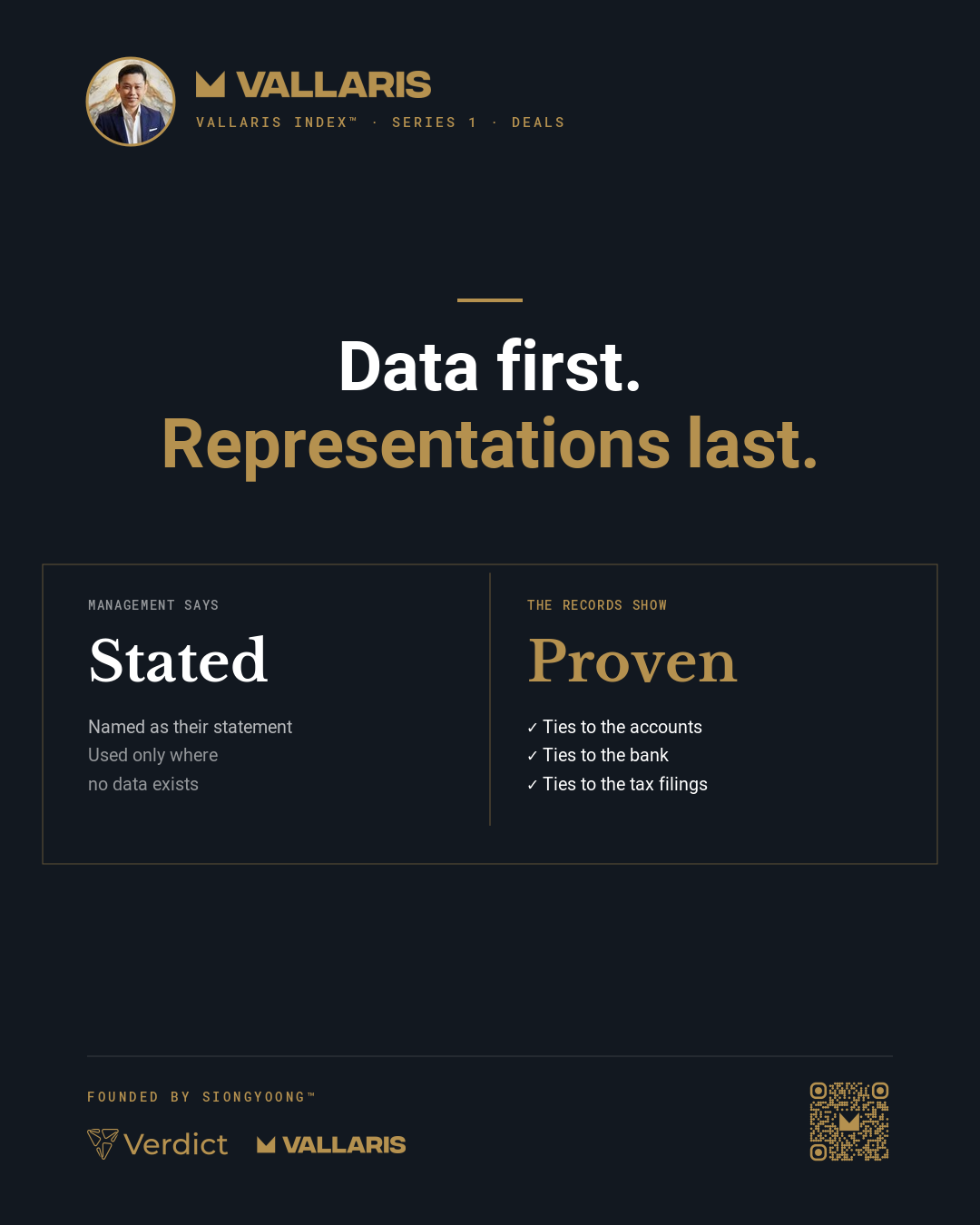
- Every adjustment is signed and based on data. A management representation is used only where no data exists, and it is named as theirs: “Management represents…”, not “the company states”.
- Unrecorded costs are found. Bonus, leave and claims that were earned or arose before completion but are not yet in the accounts.
- A large write-off is followed up. Who the counterparty was, why it was written off, and whether it will happen again.
- Every vendor and affiliate balance is identified, and each is either settled before completion or deducted.
- Policies are recorded as written or oral. An oral policy is recorded as someone’s statement, with a recommendation to put it in writing.
Data first. Representations last. Each answer the records can give is one the buyer does not have to price as risk.
Selling? Do it first
Vendor due diligence is commissioned by the seller before the sale. It gives every buyer the same independent starting point, shortens the buyers’ own diligence, and lets you deal with each finding before it reaches the price.
The work is the same as buy-side diligence. The difference is timing: the findings arrive while you can still act on them. A bonus accrual put through the accounts before the sale is a fact. One found by the buyer is a deduction.
Buyers, and their lenders, may rely on a vendor report under a reliance letter.
How it runs, and how long it takes
- Scope. The questions that matter for this deal, the entities in and out, the years, and the completion mechanism.
- Data room. The information request list, with the date each item was asked for and answered, and 12 to 24 months of monthly management accounts for working capital.
- Early findings. Where the deal needs them, a short, dated red-flag report lists only what could stop the deal or move the price, each with an amount and what is still outstanding.
- Weekly updates. Findings so far, the key themes table as it stands, what is outstanding, and the week ahead.
- Draft report. The key themes table first, with adjusted EBITDA and net debt beside it.
- Representation letter. Management confirms the information it gave.
- Final report, signed.
About three weeks from a complete data room to the draft report, then about a week to finalise it. The data room sets the pace: how complete it is, and how quickly management answers questions.
Where tax or legal due diligence is in scope, each is done by a named adviser under a stated letter, and the financial report cross-refers to their findings rather than repeating them.
The standards behind the numbers
- The engagement letter sets the scope. It names who may rely on the report and states what it does not cover, so no one reads the report as a promise that every issue has been found.
- SFRS(I) 15 Revenue from Contracts with Customers (IFRS 15), for deferred income and contract liabilities.
- SFRS(I) 16 Leases (IFRS 16), for lease liabilities in net debt.
- ACRA’s small company test for audit exemption, which decides whether the accounts you are buying on were audited at all.
- After completion, SFRS(I) 3 Business Combinations (IFRS 3) requires the buyer to allocate the price across everything it acquired, at fair value. The net debt and working capital work feeds straight into it; our purchase price allocation guide shows how.
Questions owners ask
What is financial due diligence?
An independent review of a company’s earnings, assets and cash before a deal. It tests adjusted EBITDA, net debt and debt-like items, and normal working capital, and ties each finding to the price or the sale and purchase agreement.
How is due diligence different from an audit?
An audit gives an opinion on whether past accounts are fairly stated. Due diligence asks what those accounts mean for the price: the earnings the business will keep making, what comes off enterprise value, and the working capital it needs.
What is a quality of earnings review?
The part of due diligence that adjusts reported EBITDA, line by line, for one-off items, unrecorded costs and costs at non-market terms, to show what the business earns in a normal year under a new owner.
How long does financial due diligence take?
About three weeks from a complete data room to the draft report, then about a week to finalise it. How complete the data room is, and how quickly management answers questions, sets the pace.
What is vendor due diligence?
Due diligence the seller commissions before the sale. It gives buyers a common, independent starting point and lets the seller deal with each finding before it reaches the price.
Who can rely on the report?
The party that engaged the adviser. Lenders and co-investors may rely on it under a reliance letter, and buyers may rely on a vendor report the same way.
How much does financial due diligence cost?
The fee follows the number of entities, the years in scope and the state of the data room. VALLARIS™ quotes the fee in writing after the first conversation, which has no fee.
Sources
- ACRA — Audit exemptions: small company concept. Private company meeting two of three tests (revenue and total assets of S$10M or less, 50 employees or fewer) for the past two financial years; page updated 3 February 2026.
- Accounting Standards Committee — SFRS(I) 2026 volume: SFRS(I) 3, 15 and 16. Contract liabilities (SFRS(I) 15); lease liabilities (SFRS(I) 16); allocation of the price after an acquisition (SFRS(I) 3).
- IFRS Foundation — IFRS 16 Leases. A lessee recognises a lease liability for its obligation to make lease payments.
General information only, not accounting, legal, tax or valuation advice. Worked figures are illustrative. Confirm the deal terms with your lawyer and the tax position with your tax adviser.