
In short: Financial instrument valuation measures the fair value of convertibles, warrants, preference shares, and options that have no quoted price. In Singapore it follows SFRS(I) 9, 13, and 1-32 and IVS 500. The clause decides what is measured and how often, so the work starts with the terms, not the model.
Your auditor will read the valuation with the agreement open beside it.
So the model is never the starting point. The clause is. Who holds the right, when it can be used, at what price, and for how many shares. Change one line of the terms and you change the accounting, the model, and the number.
A valuation that is signed off first time is one where every term carries its clause number, every input its source and date, and every conclusion, including “nil”, its calculation.
This guide shows how that is done in Singapore.
When you need one
Five moments, in the order CFOs usually meet them:
- You raised money on a convertible note or a SAFE. The note may need splitting into debt and equity on day one, or valuing as a derivative at every reporting date after.
- You issued preference shares or warrants to an investor. Redemption rights, liquidation preferences, and anti-dilution terms each change what is being measured.
- Year-end is coming. The auditor wants support for a Level 3 fair value, and you want it in hand before fieldwork starts.
- You hold an unquoted stake or a loan at fair value. SFRS(I) 9 measures equity investments at fair value, unquoted ones included.
- A deal or a dispute turns on a put, a call, or an option. A put written to minority shareholders, or a call in a shareholders’ agreement, needs a value both sides can follow.
What it is
Financial instrument valuation measures the fair value of instruments with no quoted price: convertible notes, warrants, preference shares, options, puts and calls, and loans.
Fair value has one meaning here. It is the price that would be received to sell an asset, or paid to transfer a liability, in an orderly transaction between market participants at the measurement date (SFRS(I) 13, paragraph 9).
The standard sorts every fair value into three levels, set by the least observable input that is significant to it:
- Level 1. A quoted price for the same instrument in an active market. No model needed.
- Level 2. A model fed by inputs you can observe: interest rates, a listed share price, quoted volatility.
- Level 3. A model that relies on inputs no market shows, such as a private company’s volatility or the date of its next round.
Most instruments a private company issues are Level 3. That brings more disclosure: the inputs, the valuation process, and how much the value moves when each unobservable input changes (SFRS(I) 13, paragraph 93).
The clause comes first
Before any model, read the terms against SFRS(I) 1-32. Three tests decide what is measured:
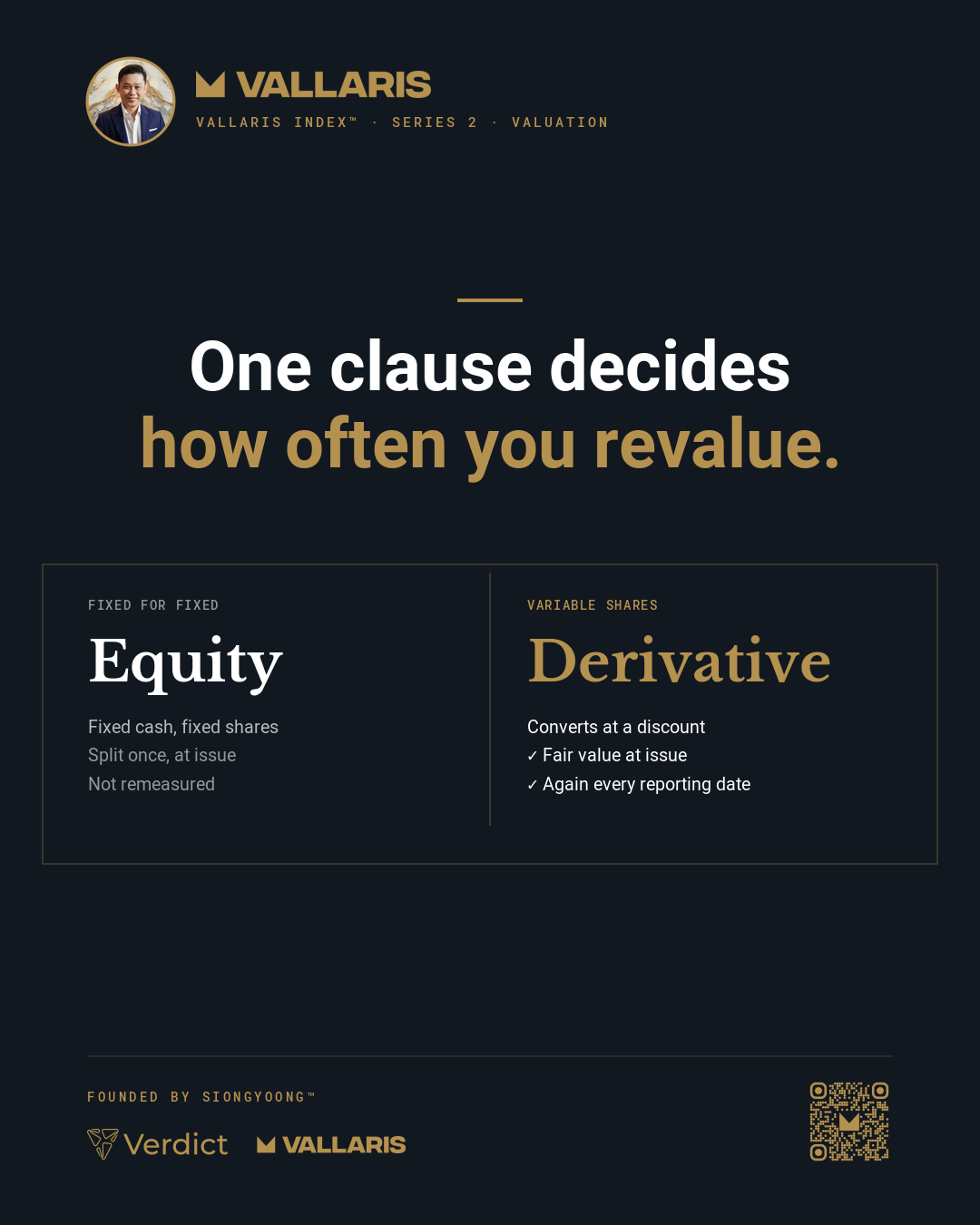
- Fixed for fixed. A warrant or conversion right is equity only if a fixed amount of cash buys a fixed number of the company’s own shares. Convert at “a 20% discount to the next round” and the share count is variable: the feature is a derivative, measured at fair value at every reporting date.
- Who can force repayment. A preference share redeemable on a set date, or at the holder’s option, contains a liability.
- What the feature sits inside. An embedded derivative in a debt host is separated only when the conditions in SFRS(I) 9 are met. Inside a financial asset, the whole contract is classified together.
One clause decides how often you revalue.
Management and the auditor decide the accounting. The valuer measures the basis they choose, and flags any doubt about the terms before the first number is run.
If the terms are still in draft, send them before you sign. A word changed then costs nothing. After signing, the same word can mean a fresh valuation at every year-end.
How it is done, step by step
- Summarise the salient terms. Issuer, holder, underlying, issue date, strike or conversion formula, exercise conditions, vesting, term, settlement, and transferability. Each term carries its clause number.
- Agree the accounting question. What is measured, under which standard, at which dates. Where the method is not obvious, an approach paper agrees it with the auditor before the work starts.
- Value what the instrument references. Most instruments hang off the company’s share value, so that comes first, often as a business valuation phase inside the same engagement.
- Match the model to the payoff. The next section shows how.
- Source every input at the valuation date. A risk-free rate matched to the instrument’s life, a credit spread, volatility from comparable companies, and the expected timing of the next round or exit. Each input carries its source and date.
- Calibrate. Where the price paid was fair value, set the model so it returns that price on day one, then carry the calibration forward to later dates (SFRS(I) 13, paragraph 64).
- Test and report. Reproduce a known case, show the sensitivity to each unobservable input, and sign a report the auditor can follow line by line.
Three models, in plain words
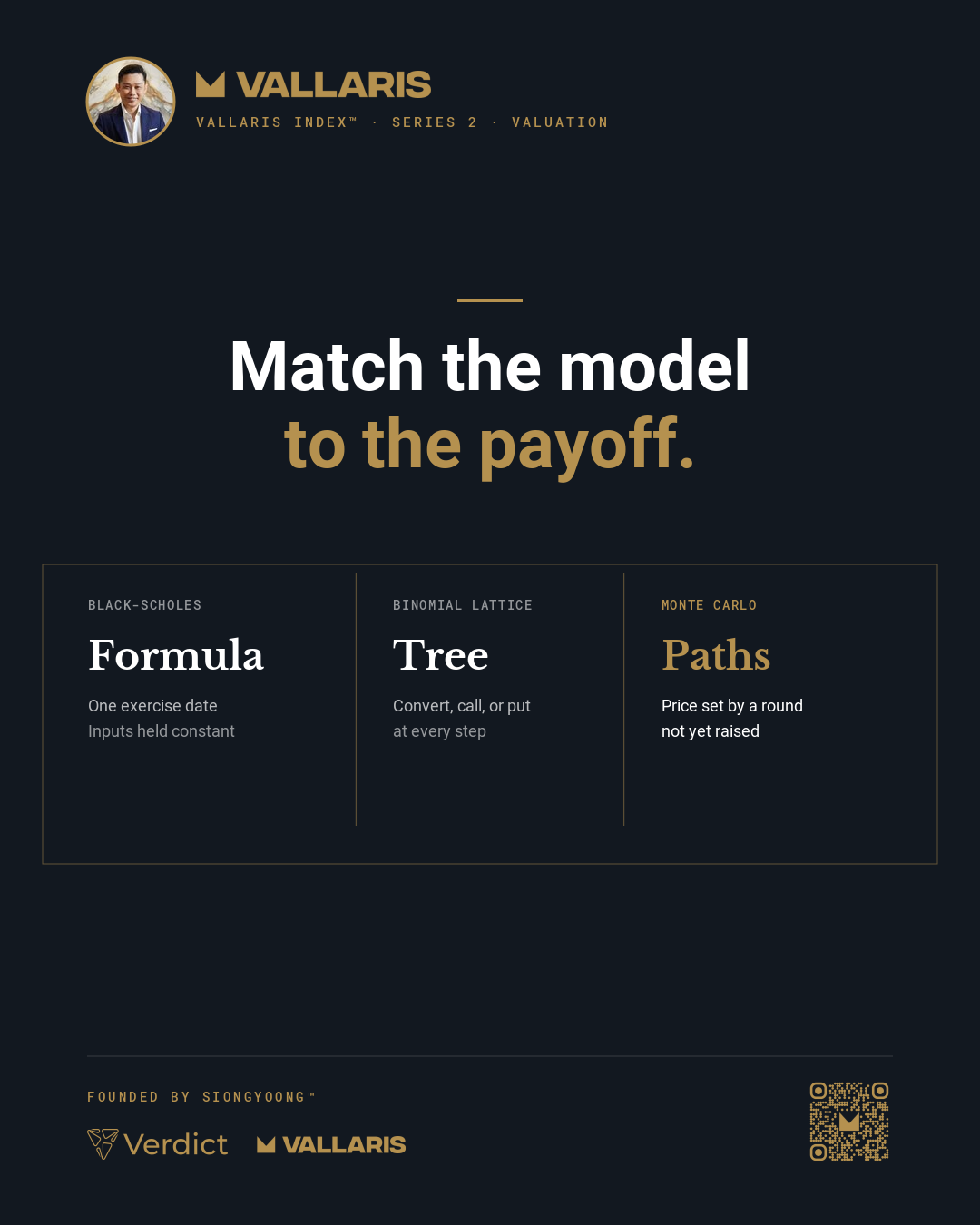
Black-Scholes. A formula. It values an option that can be used on one date, with volatility and interest rates held constant. Quick and transparent. For anything that can be exercised early, or priced by a future event, use one of the next two.
Binomial lattice. A tree. The share price steps up or down over many short periods, and at each step the model asks: convert, hold, redeem, or call? It handles early exercise, vesting, issuer calls, and holder puts. A convertible sits on one lattice, discounted with the issuer’s credit spread where conversion is uncertain. The tree must run to the last exercise date. One convertible model we reperformed stopped two steps short of maturity and understated the conversion option by about 5.6%.
Monte Carlo simulation. Thousands of possible futures, averaged. It suits payoffs that depend on the path the price takes, or a conversion price set by a financing round that has not happened yet. The report states the number of paths and the standard error.
Match the model to the payoff, then cross-check it with a second recognised method.
Where value is shared across several share classes, such as preference shares with liquidation preferences, the method follows the exit picture. The current value method if a sale is imminent. Probability-weighted scenarios where exits can be supported. An option pricing method where they cannot.
What the auditor checks first
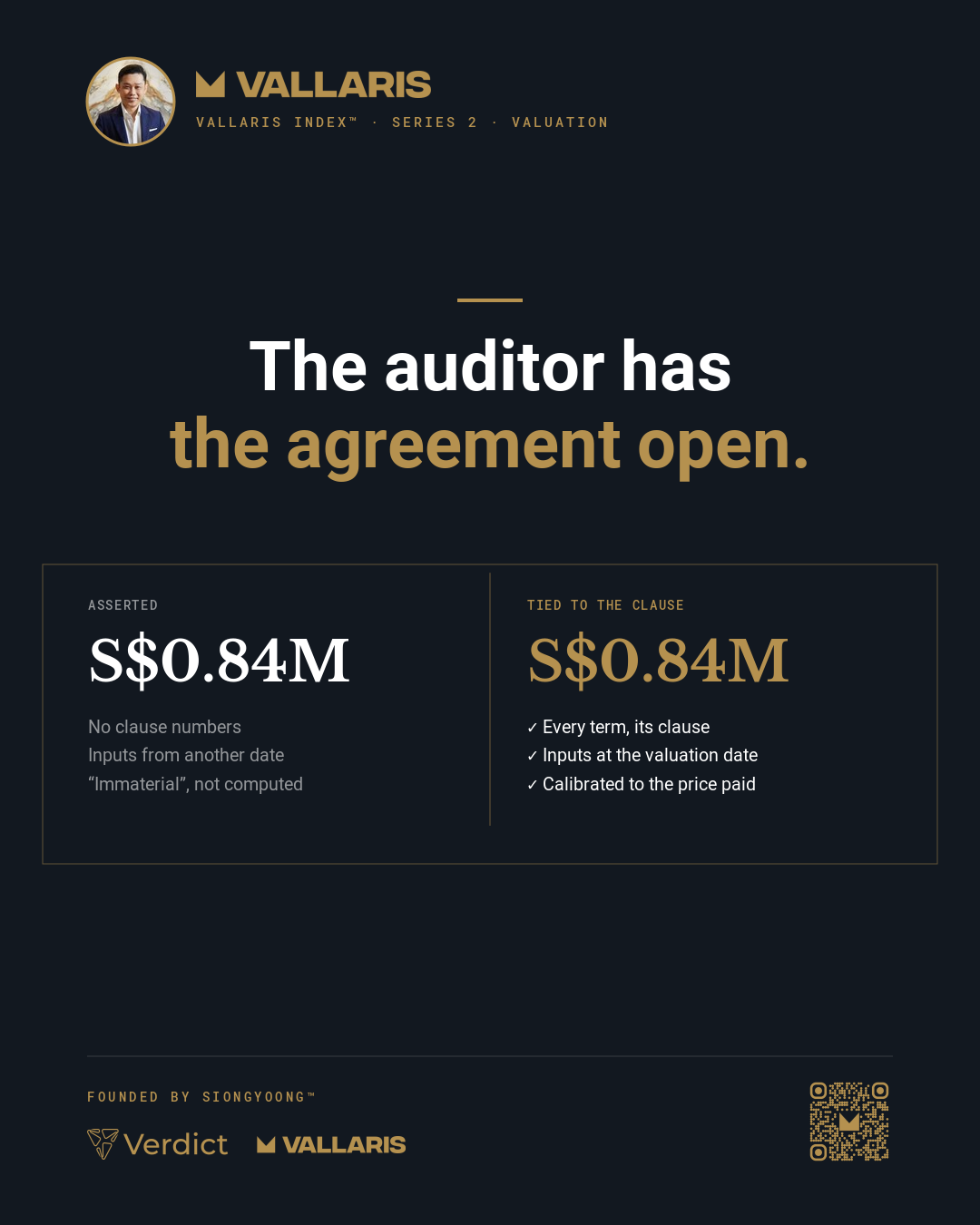
The auditor has the agreement open. These are the first places a reviewer looks. Check yours before anyone else does.
- Every modelled term matches its clause. One clause reference throughout, in the text and in the tables.
- Inputs are as at the valuation date. A rate taken on the day the report was written is not fair value at an earlier or later date. If you need a number before the date, ask for a preliminary estimate, titled as one.
- Observable evidence comes first. A recent round or share transfer is an observable input. In its Financial Reporting Surveillance Report 2024, published in March 2025, ACRA set out a case where a valuer’s share price of $0.79 fell outside the $0.95 to $1.70 range of the group’s own recent share transactions. ACRA concluded that the recent transacted prices “were observable inputs that should not have been dismissed outright.”
- The model is calibrated to the price paid on day one.
- “Immaterial” is computed, not asserted. An out-of-the-money option still has time value. Compute it with the same model and inputs, then compare it with a materiality level agreed with the auditor.
- The model reproduces a known case, and shows its value at two step counts, or its Monte Carlo standard error.
The same ACRA report sets out the common findings of its past decade of reviews. Two of them sit squarely in this work: embedded derivatives within complex financial instruments that were not identified and accounted for separately, and the accounting for compound financial instruments, those with both a liability and an equity component.
A worked example: one convertible note
Illustrative figures, chosen to show the arithmetic. A company issues a S$5,000,000 convertible note. Three years, a 5% annual coupon, convertible into a fixed number of shares at the holder’s option. A similar note with no conversion right would carry 12%.
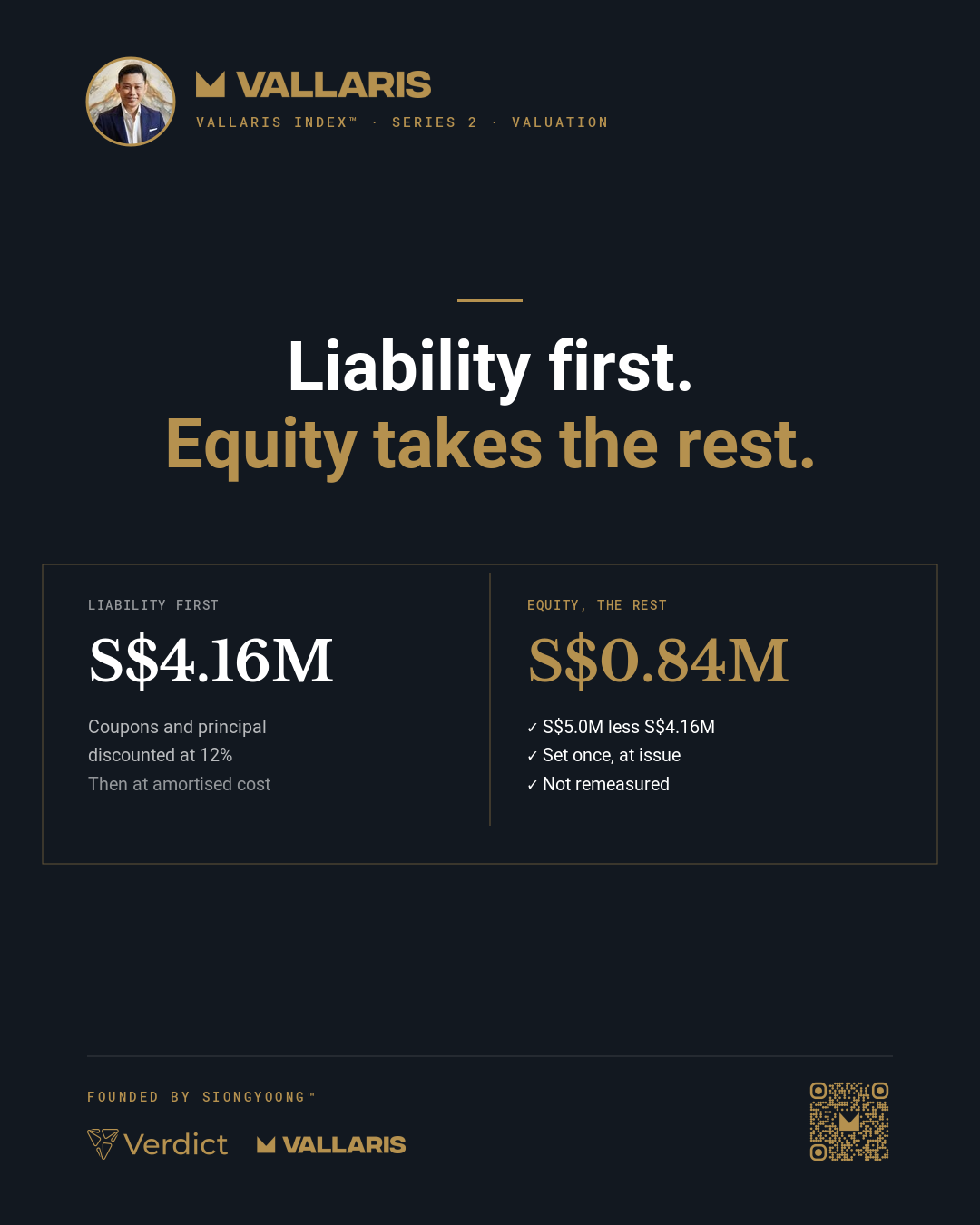
The conversion right is fixed for fixed, so the note is a compound instrument. SFRS(I) 1-32 splits it in a set order. Liability first. Equity takes the rest.
- Liability. Discount the coupons (S$250,000 a year) and the principal at 12%: S$4,159,359.
- Equity. The residual: S$5,000,000 less S$4,159,359 is S$840,641. It is not remeasured later, even if conversion becomes more likely.
Now change one clause. Convert at a 20% discount to the next round’s price, and the number of shares is no longer fixed. The conversion feature becomes a derivative at fair value through profit or loss. It is valued on day one with a model that captures the next round’s timing and probability, and valued again at every reporting date after.
Same cash. Same investor. One clause, and a different measurement for the life of the note.
What moves the result
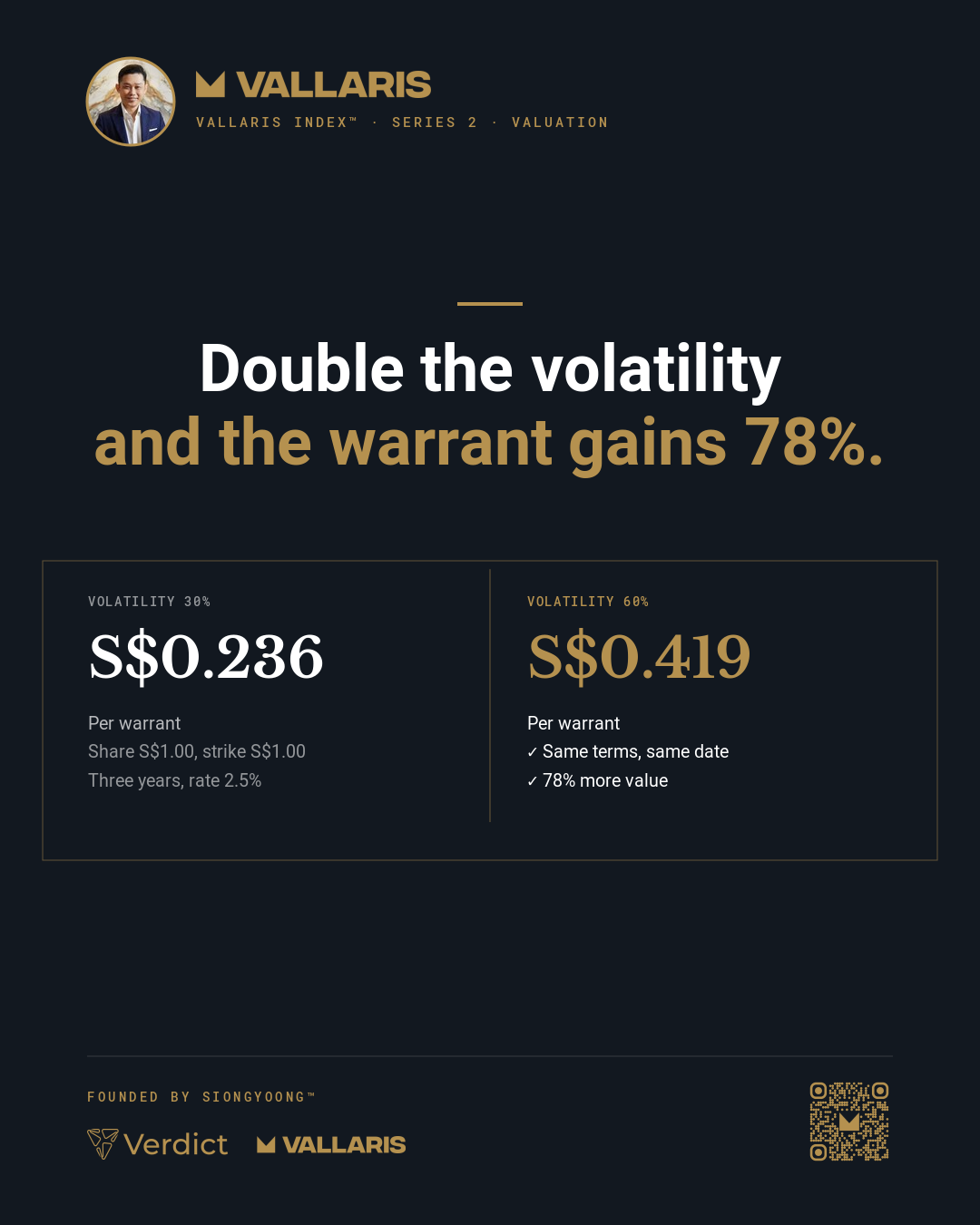
- Volatility. For most options, the largest single input. Illustrative figures: a three-year warrant on a S$1.00 share, strike S$1.00, risk-free rate 2.5%, is worth about S$0.236 at 30% volatility and S$0.419 at 60%. Double the volatility and the warrant gains 78%. Volatility comes from comparable listed companies, with the peers, window, and frequency written down.
- The credit spread. A liability’s fair value includes the issuer’s own credit risk (SFRS(I) 13, paragraph 42). A wider spread lowers the debt part of a convertible and raises the option part.
- Time to the next round or exit. For notes, SAFEs, and preference shares, the expected date and probability of the next event drive the conversion value.
- The benchmark rate. SGD SOR ceased after 30 June 2023. One-month and three-month SIBOR ceased on 31 December 2024 (ISCA Financial Reporting Bulletin 9, revised 28 June 2024). Legacy contracts run on their fallback, usually compounded SORA plus an adjustment spread. Model the rate the contract now states.
The standards behind it
- SFRS(I) 9 Financial Instruments: classification, embedded derivatives, and unquoted equity at fair value. Amendments issued in 2024, for periods from 1 January 2026, clarify how loans with contingent features, such as interest tied to an ESG target, are assessed, and add disclosures for them.
- SFRS(I) 13 Fair Value Measurement: the definition of fair value, the three levels, calibration, and the Level 3 disclosures. It is equivalent to IFRS 13, which the IASB issued on 12 May 2011.
- SFRS(I) 1-32 Financial Instruments: Presentation: debt or equity, and the split of a compound instrument.
- SFRS(I) 7 Financial Instruments: Disclosures: including any day-one difference the company defers.
- International Valuation Standards, issued by the International Valuation Standards Council (IVSC), effective 31 January 2025, including IVS 500 Financial Instruments. IVSC’s own guidance on IVS 500 says models should be tested and validated before use and over time, with “a degree of independent review and challenge.”
Listed Singapore companies report under SFRS(I). Other Singapore companies may choose SFRS(I), or report under FRS, the other set of standards Singapore’s Accounting Standards Committee issues.
Questions owners ask
What is a Level 3 fair value?
A fair value that relies on significant inputs no market shows, such as a private company’s volatility or the date of its next round. SFRS(I) 13 asks for more disclosure on Level 3, including how the value moves when each of those inputs changes.
How is a convertible note valued?
Read the conversion clause first. If a fixed amount buys a fixed number of shares, the note splits into a liability, valued first, and an equity residual. If the share count can vary, the conversion feature is a derivative, valued with a lattice or a simulation that captures the conversion, redemption, cap, and discount terms.
Does my SAFE need a valuation every year?
If it converts into a variable number of shares, usually yes. It is then measured at fair value at each reporting date, so at every year-end and any half-year. Your auditor confirms the classification, and the valuation follows it.
What is an embedded derivative?
A feature inside a contract that changes its cash flows the way a derivative would, such as a conversion right or a payment linked to an index. Some must be separated and measured at fair value. SFRS(I) 9 sets the conditions.
Who decides whether an instrument is debt or equity?
Management and the auditor. The valuer reads the terms, flags any doubt early, and measures the basis they choose.
How long does a financial instrument valuation take?
About three weeks from receiving the information to the draft report, then about a week to finalise. Start at least six weeks before audit fieldwork, so the signed terms, the equity value underneath, and the inputs as at the valuation date are in hand first.
Do SFRS(I) and IFRS differ for financial instruments?
ACRA describes SFRS(I) as equivalent to IFRS Accounting Standards, and a company that complies with SFRS(I) can state that it also complies with IFRS Accounting Standards.
Sources
- ACRA — Financial Reporting Surveillance Report 2024. Published March 2025, the latest FRSP report. Common findings of the past decade, pp. 6–9; Case 3B, pp. 26–27.
- IFRS Foundation — IFRS 13 Fair Value Measurement. Paragraphs 9, 42, 64, 72–73, 76, 81, 86 and 93.
- IFRS Foundation — IASB issues narrow-scope amendments to classification and measurement requirements for financial instruments. Issued 30 May 2024; effective 1 January 2026.
- ACRA — Singapore Financial Reporting Standards (International). SFRS(I) are equivalent to IFRS Accounting Standards.
- IVSC — International Valuation Standards, effective 31 January 2025. Includes IVS 500 Financial Instruments.
- IVSC — Financial Instruments (ValuAsiaConnect, 24 October 2024). Model testing and validation; independent review and challenge.
- ISCA — Financial Reporting Bulletin 9 (revised 28 June 2024). SOR and SIBOR cessation dates, pp. 5–6 and 16.
General information only, not valuation, accounting, legal, or tax advice. Worked figures are illustrative. Management and the auditor decide the accounting classification.