
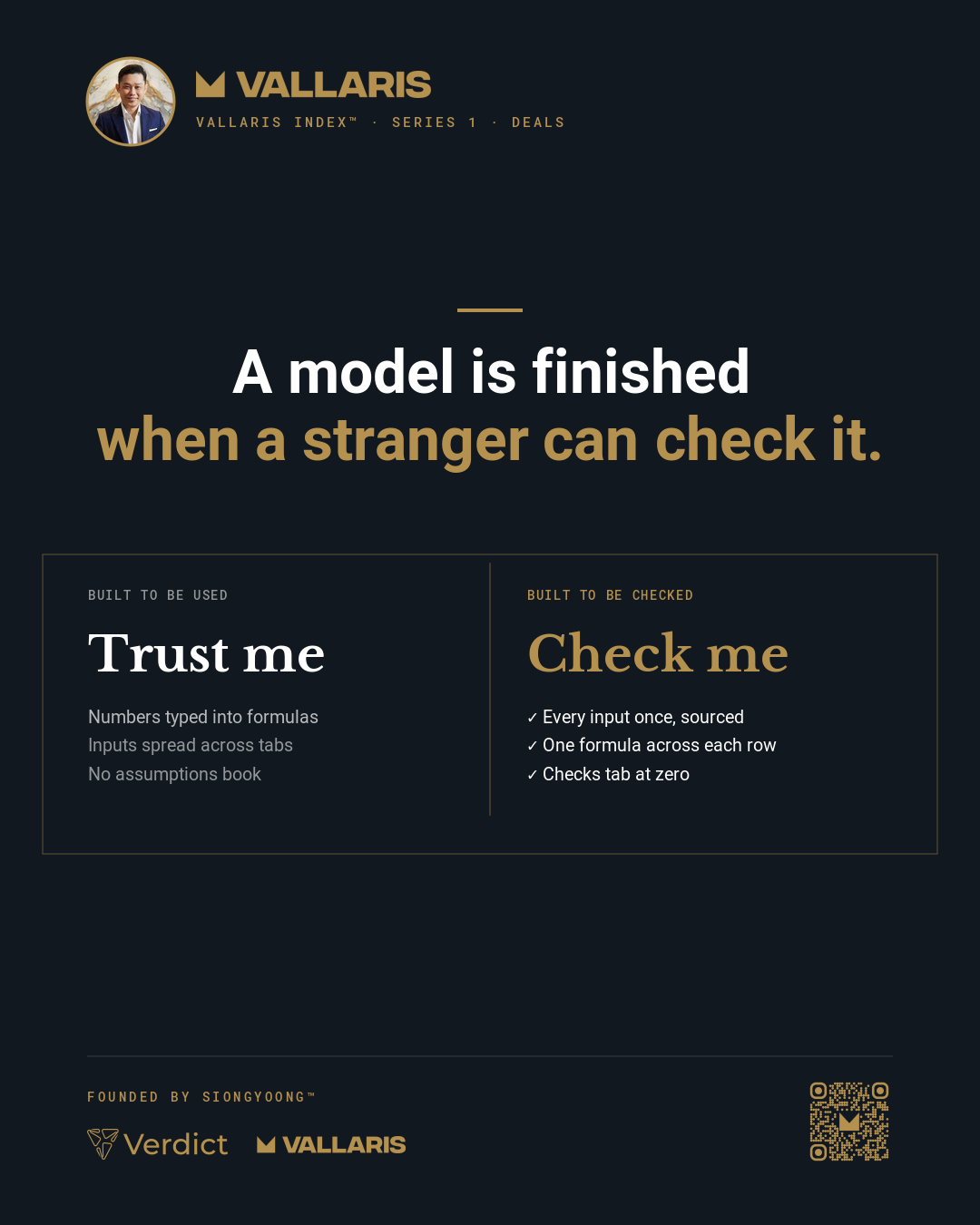
In short: A financial model is finished when someone who did not build it can follow any number from output to input. A model audit checks that the model calculates what its assumptions say: logic, formulas, scenarios, and accounting and tax. It ends in a review letter that names the exact version reviewed and every material finding, and it is not an audit opinion.
The model has been with your team for months. It answers every question the board has asked, and the people who built it know every tab.
Then it leaves the building.
A lender’s credit team opens it to set the loan. A buyer’s analyst opens it to test the price. A tender panel opens it to score the bid. None of them built it, and none of them can ask the builder what a cell means at eleven at night.
That is the test a model has to pass. A model is finished when a stranger can check it: when someone who has never seen it can follow any number from the output back to the input, without a phone call.
When you need one
Four moments put a model in front of someone who did not build it:
- A lender is about to commit. Project finance and large acquisition loans often require an independent review of the model before funds are drawn.
- You are bidding for a large contract or concession. The tender panel reads the model behind your price, and may ask for an independent review with the bid.
- You are buying or selling a company. The deal model sets the price, the funding and the returns. The other side’s advisers will test it.
- The board is approving a major investment. An independent check before the vote is cheaper than one after.
In each case a decision worth US$10M or more rests on a model built by someone the reader will never meet.
What a financial model is, and what a model audit is
A financial model projects a business’s earnings, cash flow and balance sheet from a set of assumptions, so a decision can be tested before it is made. Most deal, loan and bid models have the same core: an income statement, a balance sheet and a cash flow statement, linked so that every assumption flows through all three and the balance sheet balances in every period.
A model audit, or model review, is an independent check of a model someone else built. It asks one question: does the model calculate what its assumptions say it calculates? It reads the logic, inspects the formulas, rebuilds the key totals, runs the agreed scenarios, and checks the accounting and tax against the rules the model says it follows.
Three things a model audit is not:
- It is not a financial audit. An auditor gives an opinion on past financial statements. A model review looks at a forecast tool, and the letter that comes out of it is not an audit opinion.
- It is not a view on the assumptions. Whether revenue will grow at 8% a year is a commercial judgement, and it is yours. The review tests whether the model does what the 8% says. A separate review of the assumptions can be scoped, and it is a different piece of work.
- It is not a forecast. A model output is a calculation from its inputs. It describes what follows if the inputs hold, not what will happen.
What a stranger needs to check it
Two published codes set out how a model should be laid out so others can use it: the ICAEW Financial Modelling Code (the edition I opened is dated August 2024) and the FAST Standard (version 02c, July 2019), whose four letters stand for flexible, appropriate, structured and transparent. They agree on the essentials, and so does every lender’s reviewer I have worked with.
A model a stranger can check has these seven things:
- A one-way flow. Inputs flow down to calculations, calculations to statements, statements to outputs. Nothing flows back up. The FAST Standard separates inputs, workings, presentation and control.
- Every assumption entered once, on an input tab, with its source, its date and who owns it. A reviewer who changes the occupancy rate in one place should see it change everywhere.
- No typed numbers inside formulas. A constant typed into a formula is an assumption nobody can see. Every constant is an input.
- The same formula across each row. The FAST Standard’s rule is that formulas must be consistent along the row. A reviewer can then check the first cell of each row and know the rest follow it. A row that changes formula halfway along must be flagged and explained on the cover.
- Nothing hidden and nothing linked. No hidden tabs, rows or columns, no links to other files, and no circular references unless one is controlled by a switch and disclosed.
- A checks tab. The balance sheet balances, cash ties to the bank, sources equal uses, each check shown on the cover, all at zero.
- An assumptions book. A written record of every input: value, source, date, owner, and why. Build it with the model, not after the reviewer asks.
A worked example
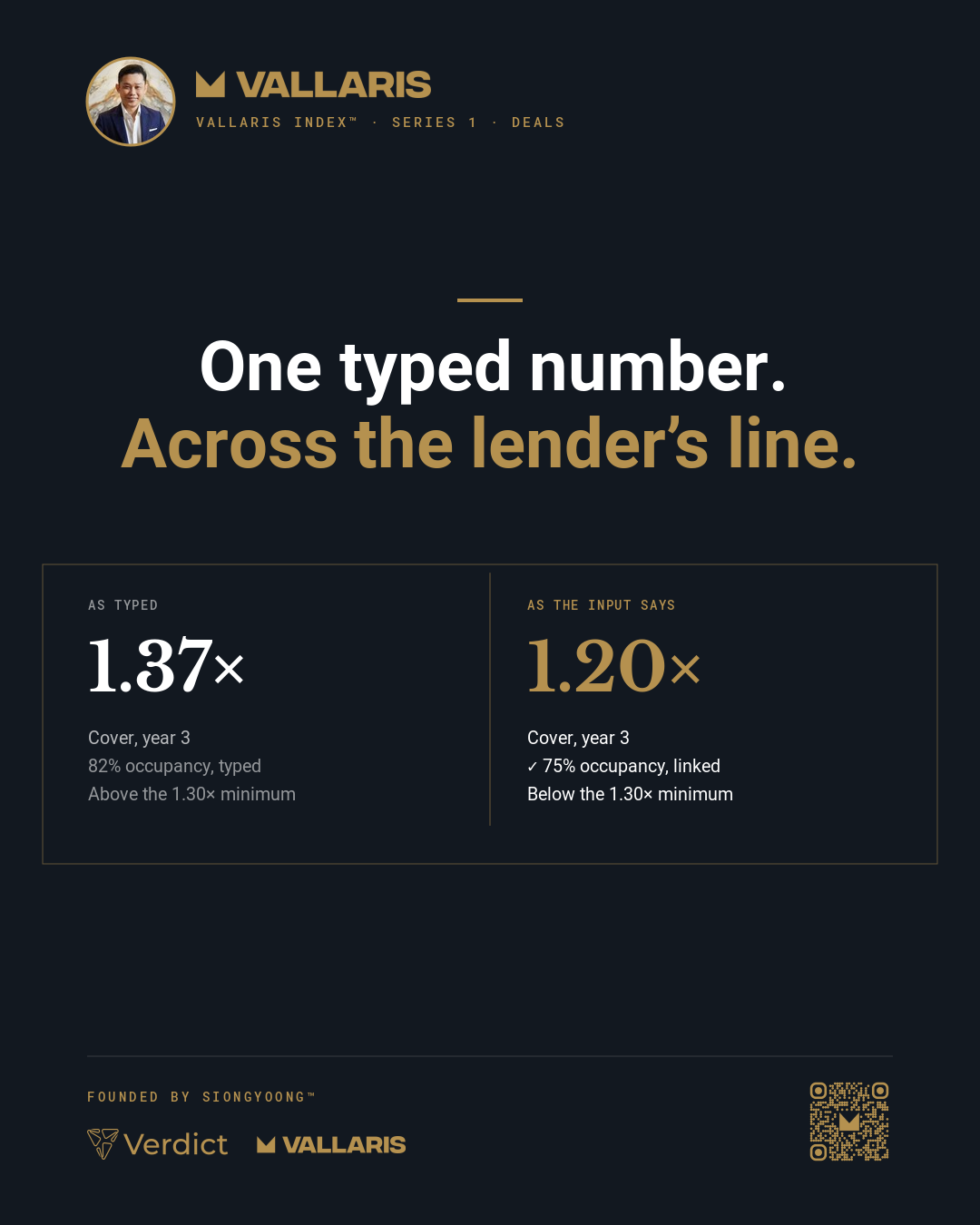
Illustrative figures, for the arithmetic only. A hotel owner is refinancing. The lender will lend only if cash available for debt service covers debt service at least 1.30 times in every year of the forecast.
- The input. The assumptions book says occupancy of 75% from year 3, for 300 rooms at an average rate of S$250 a night.
- The formula. In year 3, someone testing an upside case typed 82% into the revenue formula, and never took it out. Every other year links to the input.
- The effect on revenue. 300 rooms × 365 nights × S$250 is S$27.4 million a year at full occupancy. At 82%, revenue is S$22.4 million. At 75%, it is S$20.5 million. The typed number adds S$1.9 million.
- The effect on cash. Assume room costs of 30% of that extra revenue, or S$0.6 million. Cash available for debt service rises by S$1.3 million, from S$9.0 million to S$10.3 million.
- The effect on the loan. Debt service in year 3 is S$7.5 million. As typed, cover is 1.37 times. As the input says, it is 1.20 times.
One typed number. Across the lender’s line.
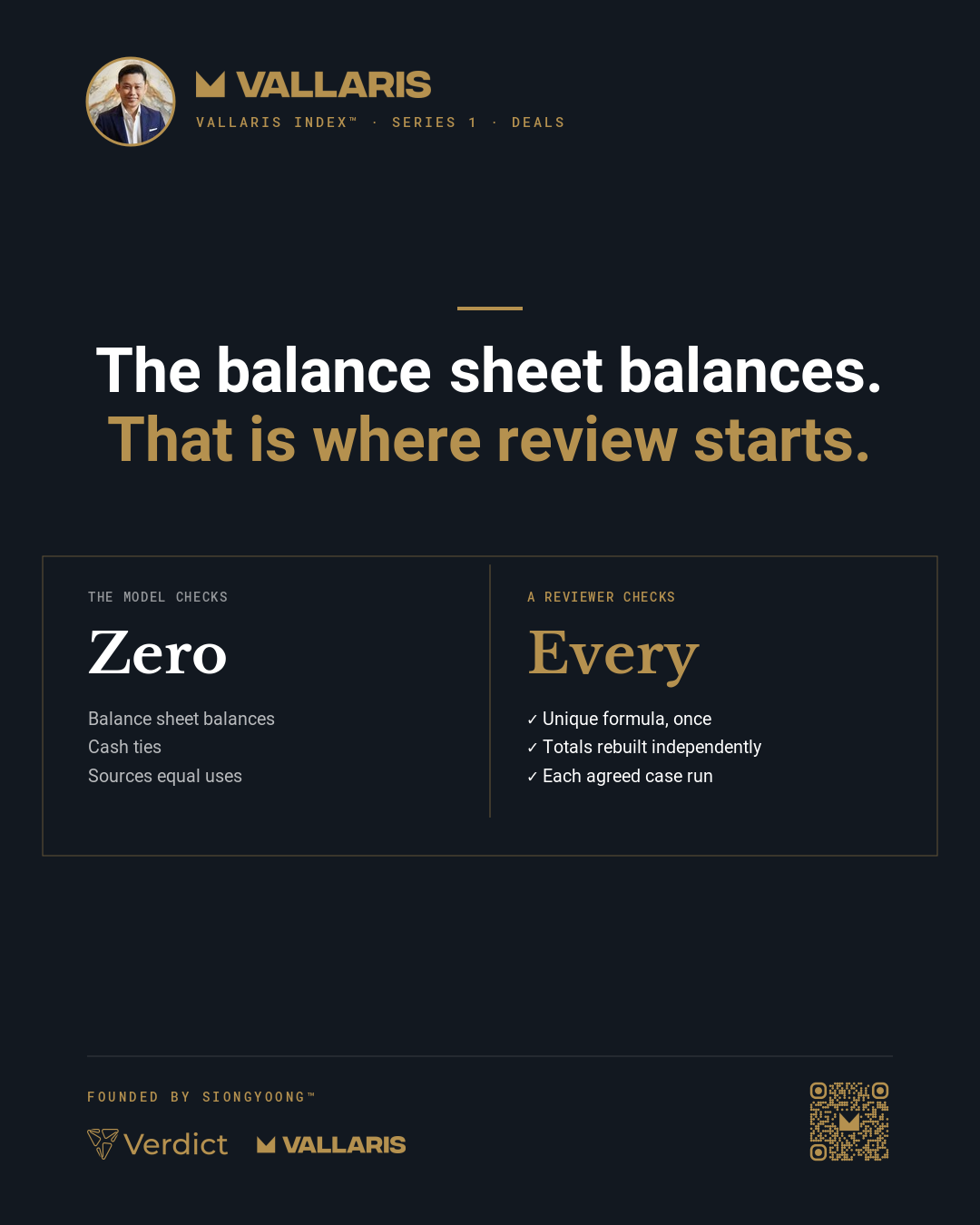
Now look at what did not change. The balance sheet still balances. Cash still ties. Every check on the checks tab still reads zero. The model is internally consistent, and the number the lender would use is still not the number the assumptions support.
That is why a review reads the formulas, not only the checks. The balance sheet balances. That is where review starts.
How a model review is done
When I review a model, the work runs in five steps, in this order:
- Read the outputs first. Before opening a formula, read the outputs against the inputs the way an experienced deal person would. Do revenue, margins, capital spending, debt service and returns make sense for this business?
- Inspect every unique formula, once. Each row repeats one formula, so each unique formula is read once. A scan finds links, error values, hidden items and typed numbers.
- Rebuild the key totals independently. Revenue, costs, cash and debt are recalculated outside the model, a proof in total, to confirm the engine works.
- Run the agreed scenarios and sensitivities. A scenario changes several inputs together; a sensitivity changes one input at a time. Each output should move in the right direction and by a sensible amount.
- Check the accounting and tax. The statements should follow the accounting standards the company reports under, and tax should be calculated at the rates and under the rules in the assumptions book. Interpreting tax law stays with your tax adviser.
Every finding goes into one issue log, with its sheet and cell, its effect on the outputs, its severity and your team’s response. Three levels of severity are enough:
- Critical. Changes a headline output (debt capacity, returns, bid price, a covenant), or the model does not work as intended. The typed occupancy in the worked example is Critical.
- Material. Changes an output in a way a reader should know, or breaks under an agreed sensitivity.
- Minor. Presentation, labelling and good practice.
No review letter is issued while a Critical issue is open.
Models change during a review. Each new version is compared cell by cell with the last one reviewed, and the log records which issues it closes and which it opens. A letter on version 3 says nothing about version 4.
What the review letter says
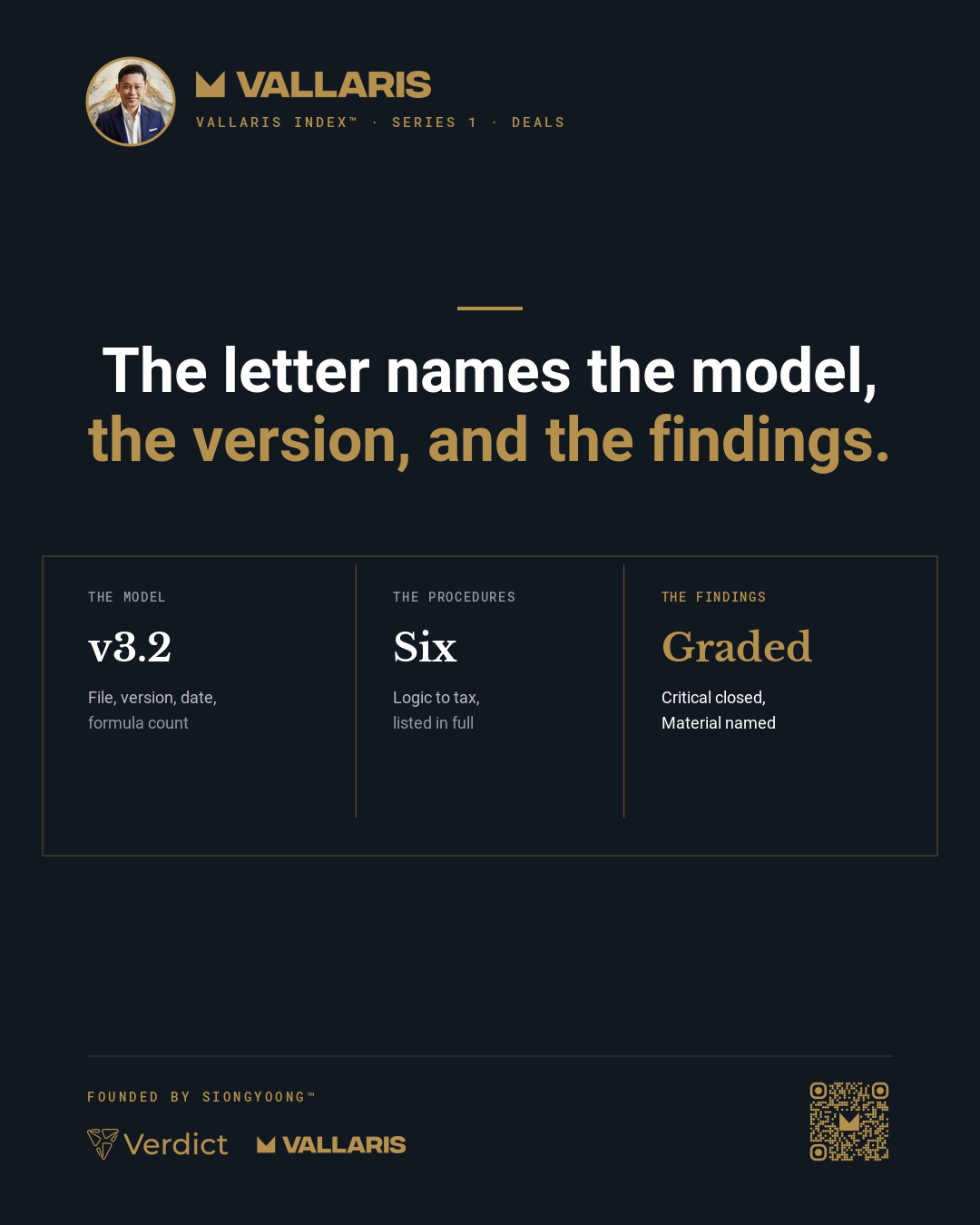
The rule for the letter is the same as the rule for the model: say exactly what was done, on exactly which model, and what was found.
The letter names the model, the version, and the findings. It sets out:
- The model: file name, version, date, worksheets and number of unique formulas.
- The documents considered: the assumptions book and each document it names.
- The procedures: logical integrity, arithmetical accuracy, other issues such as circularity and hidden data, macros, sensitivities, and accounting and tax consistency.
- The findings: the issue log, grouped and prioritised, with every Material issue still open named in the conclusion itself, not only in an appendix.
The conclusion is written in plain, limited words. It says that, on the procedures performed, nothing has come to our attention to suggest the model does not calculate in line with its assumptions book, except for the matters listed. It says the model has not been audited, and it expresses no view on whether the assumptions are reasonable or the projections achievable.
That limit is what makes the letter useful. A lender reading it knows exactly what was tested and what was not, and can rely on the part that was.
The letter is addressed to you. A lender or investor may rely on it by signing a reliance letter. Agree its form before the review starts, not at the end.
Who should check the model

Checked by someone who did not build it. That is the rule, for our own models and for anyone else’s.
The research on spreadsheets explains why. Raymond Panko’s 2015 review of the evidence, presented to the European Spreadsheet Risks Interest Group, reports that field audits found errors in 94% of the 85 operational spreadsheets inspected. In one experiment he cites, a reviewer working alone caught 63% of the errors in a spreadsheet; teams of three caught 83%.
Building a model and checking it are two different jobs. The person who wrote a formula reads what they meant; a fresh reader reads what is there.
Two rules follow:
- For an independent review a lender will rely on, the reviewer must not have built, designed or materially changed the model. If VALLARIS™ built it, VALLARIS™ does not review it.
- For a model VALLARIS™ builds, someone who did not build it reviews it under the same standard before it leaves the firm.
What moves the result
The things that most often change a headline output in a deal, loan or bid model:
- Typed numbers. A constant inside a formula, left from a test or a late change. The worked example shows how far one can move a covenant.
- Timing. Cash flows that start a period early or late, construction that ends in a different month from the contract, or a debt repayment profile that does not match the loan agreement.
- Definitions. The loan agreement defines cash available for debt service, net debt and EBITDA. The model must use the agreement’s definitions, not its own. Since SFRS(I) 16 Leases (IFRS 16), a lessee recognises most leases on the balance sheet, so rent moves out of operating costs and into depreciation and interest. EBITDA and net debt both change, and the covenant definition decides which version the lender tests.
- New presentation rules. SFRS(I) 18 Presentation and Disclosure in Financial Statements (IFRS 18) takes effect for annual reporting periods beginning on or after 1 January 2027. It introduces defined subtotals, including operating profit. Any covenant or earn-out written on “operating profit” should say which definition it means, and a model mapped to the old income statement needs its mapping updated.
- Earn-outs. In an acquisition model under SFRS(I) 3 Business Combinations (IFRS 3), an earn-out goes into the consideration at its fair value on the acquisition date. Later changes from meeting a target go to profit or loss, not to goodwill.
- Version drift. The lender reviews version 3; the board approves version 5. Keep one record of which version each party saw.
A model your team can run after we leave
Where VALLARIS™ builds the model, the deliverable is more than the spreadsheet. A model your team cannot update is a model that ages the day it is handed over.
The handover includes:
- The model, built to the seven points above, with a cover, a contents tab, a change log and a checks tab at zero.
- The assumptions book, with every input’s value, source, date, owner and reason.
- A user guide and a handover note: how to run scenarios and read the checks, and the version handed over, with any open points.
- Training, where it is bought.
Revenue is built from drivers your team can observe and update: rooms, occupancy and rate; visitors and ticket price; units and price.
Questions owners ask
What is a model audit?
An independent review of a financial model built by someone else, to check that it calculates what its assumptions say. It covers logic, formulas, arithmetic, macros, scenarios, and accounting and tax consistency, and ends with a review letter and an issue log.
Is a model audit the same as a financial audit?
No. A financial audit gives an opinion on past financial statements. A model review checks a forecast tool. The review letter sets out the procedures performed and the findings, and states that it is not an audit opinion.
Do you check whether the assumptions are reasonable?
A model review tests whether the model does what the assumptions say, not whether the assumptions will come true. The first step reads the outputs against the inputs, so anything that looks out of line for the business is raised early. A review of the assumptions themselves can be scoped separately.
Who can rely on the review letter?
It is addressed to you. A lender, investor or other party may rely on it by signing a reliance letter, in a form agreed before the review starts.
Can VALLARIS™ build the model and review it?
Not for an independent review. The reviewer must not have built, designed or materially changed the model. Every model VALLARIS™ builds is reviewed inside the firm by someone who did not build it, but a lender that needs an independent review should engage a different reviewer.
How long does a model review take?
About three weeks from receiving a stable model and its assumptions book to the draft review letter, then about a week to finalise it. The timetable assumes the model is substantially complete when it arrives and one updated version is reviewed. Agree it with the lender, so the signed letter is in hand before drawdown or bid submission.
How much does a model review cost?
The fee follows the number of unique formulas, the number of versions to review, the scenarios to run and who will rely on the letter. VALLARIS™ quotes a fixed fee in writing after the first conversation, which has no fee.
Sources
- ICAEW — Financial Modelling Code. Edition dated August 2024: seven sections, from model definition to calculation techniques.
- FAST Standard Organisation — The FAST Standard. Version 02c, July 2019: flexible, appropriate, structured and transparent; formulas consistent along the row (rule 3.02-01).
- Raymond R. Panko, EuSpRIG 2015 — What We Don’t Know About Spreadsheet Errors Today. Errors found in 94% of 85 audited operational spreadsheets (Table 2); one reviewer caught 63%, teams of three 83%, in an experiment (section 4).
- IFRS Foundation — IFRS 16 Leases. A lessee recognises assets and liabilities for leases of more than 12 months; SFRS(I) 16 is the Singapore equivalent.
- ACRA (Accounting Standards Committee) — 2024 ASC News: SFRS(I) 18 issued. Issued 4 October 2024; effective for annual reporting periods beginning on or after 1 January 2027.
- IFRS Foundation — New IFRS Accounting Standard will aid investor analysis of companies’ financial performance. IFRS 18: defined subtotals including operating profit; operating, investing and financing categories.
General information only, not accounting, legal, tax or lending advice. Worked figures are illustrative. A review letter is not an audit opinion and expresses no view on whether assumptions are reasonable or projections achievable.