
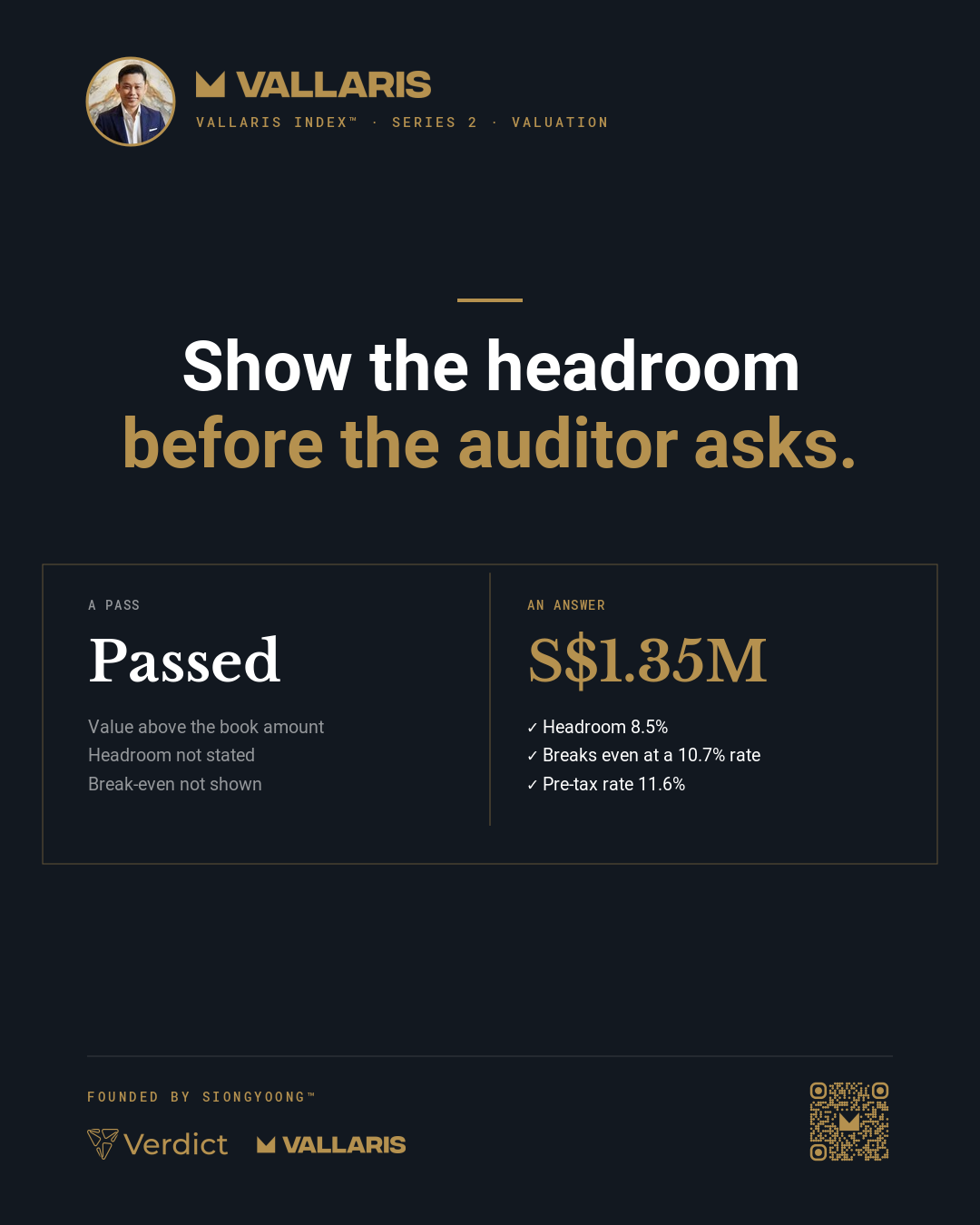
In short: An impairment test checks that goodwill and other assets are not carried above their recoverable amount: the higher of value in use and fair value less costs of disposal. In Singapore it follows SFRS(I) 1-36, equivalent to IAS 36. Goodwill is tested every year. The answer the auditor wants is the headroom, and the change in each key assumption that would remove it.
Every year-end, the same question arrives. Is the business you bought still worth what the balance sheet says?
A yes is not enough. A yes is a pass, and a pass invites more questions.
The auditor wants an answer: how far the value sits above the book amount, and what change would close that distance. That distance is the headroom.
Show the headroom before the auditor asks, and the conversation moves from your arithmetic to your judgement.
This guide shows how that is done in Singapore, under SFRS(I) 1-36 Impairment of Assets, which is equivalent to IAS 36.
When you need one
Four triggers, in the order owners usually meet them:
- You bought a business. The goodwill from the deal is tested every year, at the same time each year, whether or not anything has changed (SFRS(I) 1-36 paras 10 and 96). Goodwill from a deal this year is tested before this year ends (para 96).
- You hold intangibles with no fixed life, or not yet in use. A brand, a licence with no end date, software still being built. The same yearly rule applies (para 10).
- There is a sign. At each reporting date you look for one (para 9): results below budget, a market capitalisation below net assets, higher interest rates, a change in the market or the law, an asset idle or damaged (paras 12–14). One sign is enough to test.
- You lease. Right-of-use assets are tested under the same standard (SFRS(I) 16 para 33).
Before anything else, write down which assets are being tested, why, and at what date. That one line sets the scope.
What the test is
The test compares two numbers.
- Carrying amount is what the asset, or group of assets, stands at in your books.
- Recoverable amount is what it is worth.
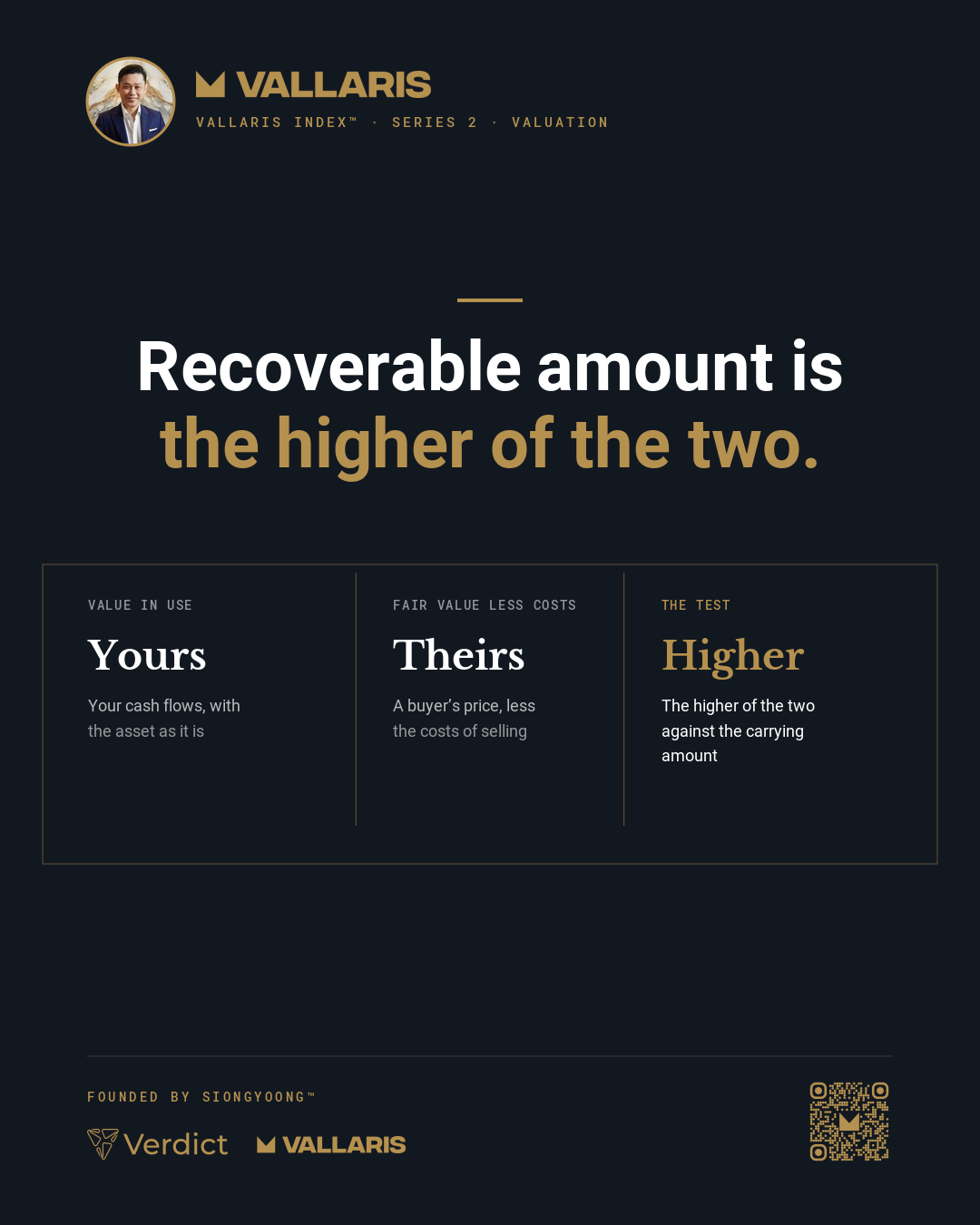
Recoverable amount is the higher of the two: value in use, or fair value less costs of disposal (paras 6 and 18). If either one is above the carrying amount, nothing is impaired, and the other need not be estimated (para 19).
Value in use is the present value of the cash the asset will produce for you, used as it stands today. It reflects factors specific to your company, which a buyer’s price would not (para 53A).
Fair value less costs of disposal is the price a market participant would pay for the asset, less the extra costs of selling it (paras 6 and 28; SFRS(I) 13). It uses the buyer’s assumptions, not yours.
Most assets do not earn cash on their own. So the test is run on a cash-generating unit: the smallest group of assets whose cash inflows are largely independent of other assets (para 68).
Goodwill is allocated to the units that benefit from the deal, at the level management monitors it, and no larger than an operating segment (para 80). The first allocation is complete by the end of the first full year after the deal (para 84).
Management identifies the units. A valuer tests the choice and writes down why. Use the same units each year, and explain any change (paras 72–73).
How it is done, step by step
- Fix the unit and the date. Name the cash-generating unit, the goodwill allocated to it and the test date.
- Build the carrying amount on the same basis as the cash flows (para 75). Include the assets that produce the cash, and leave out the liabilities (para 76). For leases, choose one pairing and state it: right-of-use assets in, lease liabilities out, lease payments out of the cash flows, and a rate that includes lease financing. Or the reverse. One pairing, used throughout.
- Take the latest forecast management has approved, five years at most unless a longer period is justified (paras 33 and 35). Compare last year’s forecast with what happened, and explain the gaps (para 34).
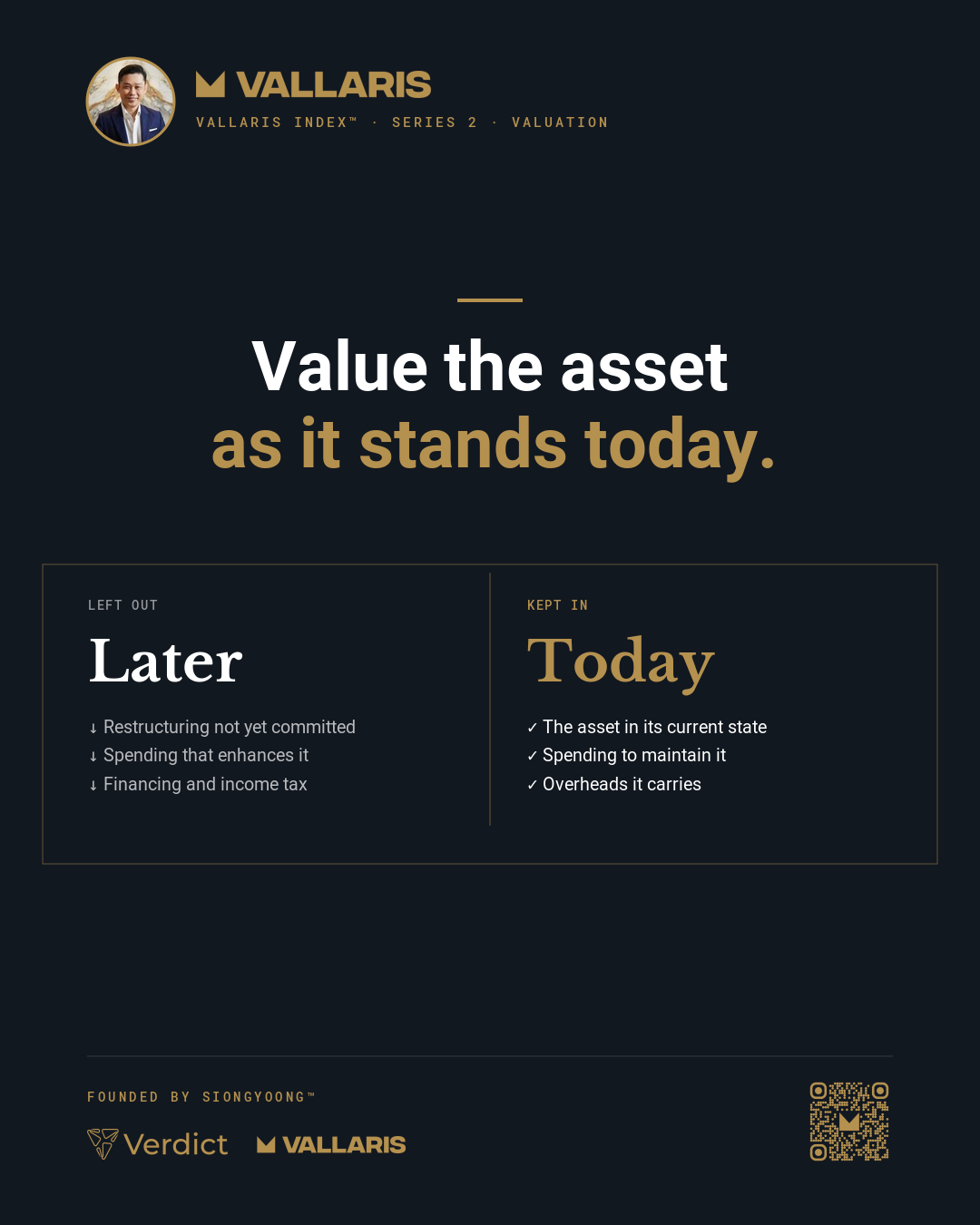
- Value the asset as it stands today. Leave out restructurings not yet committed and spending that improves performance, with the benefits they bring (paras 44–48). Keep the spending needed to maintain it (para 49). Leave out financing and income tax (para 50).
- Set terminal growth. Steady or falling after the forecast, and no higher than the long-term average growth for the country or market, unless justified (paras 33(c) and 36). Cite the source.
- Set the rate. It is pre-tax, and reflects the risks of the unit that the cash flows do not already carry (para 55). Start from a weighted average cost of capital and adjust it to the unit’s risks (paras A17–A18). The rate does not depend on how you financed the asset (para A19). Derive the pre-tax rate from the post-tax one (para A20; IASB Basis for Conclusions on IAS 36, para BCZ85).
- State the headroom, in amount and per cent, and the change in each key assumption that would bring it to nil (para 134(f)).
A worked example, for the arithmetic only
Illustrative figures, chosen to show the steps. A Singapore distribution group bought a competitor three years ago. The cash-generating unit carries S$16.0 million, including S$3.0 million of goodwill.
Management’s approved forecast shows post-tax free cash flow of S$1.30 million next year, rising to S$1.52 million in year five. Terminal growth is 2.0%. The post-tax rate is 10.0%.
- Five forecast years, discounted: S$5.32 million.
- Terminal value, discounted: S$12.03 million. That is 69% of the answer.
- Value in use: S$17.35 million.
- Headroom: S$1.35 million, or 8.5% of the carrying amount.
The pre-tax rate. With an illustrative tax rate of 17%, the rate that gives the same value on pre-tax cash flows is 11.6%. The shortcut, 10.0% divided by one minus 17%, gives 12.0%. The IASB notes that the shortcut is not always right (Basis for Conclusions on IAS 36, para BCZ85), so the test solves for the rate.
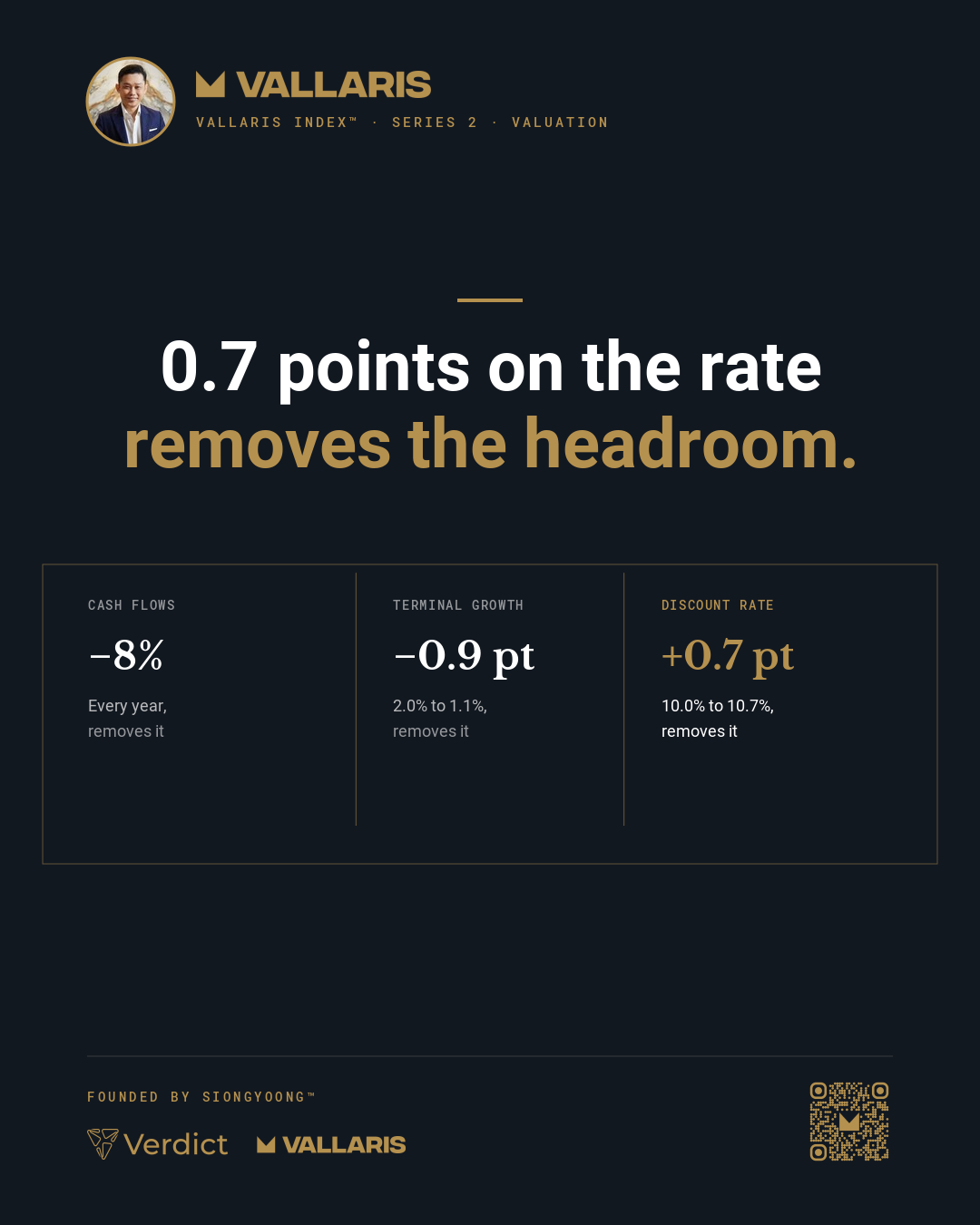
What removes the headroom. Any one of these, on its own:
- The rate rises from 10.0% to 10.7%.
- Terminal growth falls from 2.0% to 1.1%.
- Every year’s cash flow comes in 8% lower.
In this example, 0.7 points on the rate removes the headroom. That line is the one the auditor reads first.
Had the value fallen short, the loss would come off the S$3.0 million of goodwill first, then the other assets pro rata (para 104). A goodwill impairment is never reversed (para 124).
What moves the result
The same inputs move every test. From both sides of the review table:
- The terminal value. It is usually most of the answer, as in the example. Growth forever needs reinvestment forever.
- The rate. Market data dated at the test date, rounded to the nearest tenth of a per cent. A rate rounded to keep last year’s figure is the first thing a reviewer notices.
- The forecast record. A forecast that beat last year’s actual results needs a reason. Show the comparison before you are asked.
- The lease basis. Mixing the pairings in step 2 can move the headroom by more than the forecast does.
- Head office costs. Overheads are allocated to the units on a reasonable and consistent basis (para 41), and so are head office assets (para 102). Leave them out and every unit looks better than the group.
- The market. A market capitalisation below net assets is a sign to test, and a cross-check on the answer.
What the auditor checks first
Auditors test estimates under ISA 540 (Revised), in force for audits of periods beginning on or after 15 December 2019. Regulators review the result.
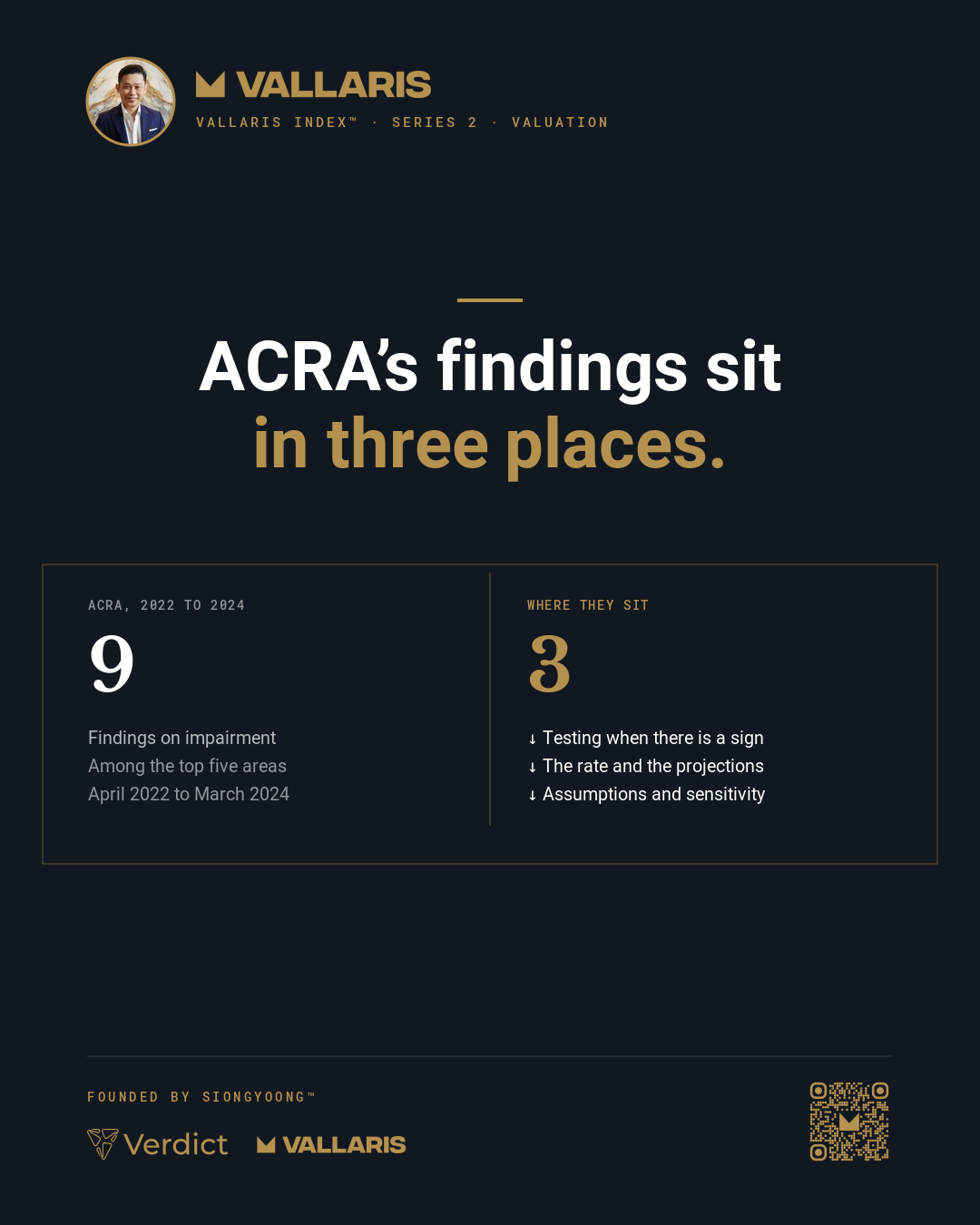
ACRA’s latest Financial Reporting Surveillance Report, the 2024 edition (published March 2025), lists impairment of assets among its top five areas, with nine findings in reviews from April 2022 to March 2024. Across a decade of reviews, ACRA’s findings sit in three places:
- Testing when there is a sign: an impairment assessment where indicators are present.
- Working out recoverable amount: the discount rate and assumptions, and cash flow projections, such as cash flows for an asset with a finite life extended into perpetuity.
- Disclosures: key assumptions and sensitivity.
In one case ACRA describes, a 0.8% rise in the discount rate would have led to a material impairment. ACRA called that headroom marginal, and said a sensitivity analysis for the discount rate should have been disclosed.
For FY2025 financial statements, ACRA again names impairment of assets as an area of review focus (Financial Reporting Practice Guidance No. 1 of 2025, 12 November 2025). It asks that discount rates reflect current market conditions and entity-specific risks, and that disclosures for units holding goodwill go beyond the discount rate and terminal growth rate.
When I review an impairment test, these are the first places I look. Check yours before anyone else does.
- Cash flows before financing, discounted at a rate for the unit, not at a cost of equity.
- No marketability discount or control premium in value in use.
- A pre-tax rate, derived, with both calculations side by side and agreeing to rounding.
- A carrying amount that reconciles to management’s figures, on the same basis as the cash flows.
- The terminal value counted once.
- Headroom and break-even changes for each key assumption.
- Every scenario below the carrying amount, explained.
Auditors also commonly ask about forecasts that depart from history, the weight given to each approach when the values differ widely, and the reason for any change of method from last year (Appraisal Foundation, Valuation Brief 2025-1, May 2025). Answer them in the report, before they are asked.
The standards behind an impairment test
- SFRS(I) 1-36 Impairment of Assets, equivalent to IAS 36. SFRS(I)s apply to Singapore-incorporated companies whose shares or debt trade in a public market in Singapore, for annual periods beginning on or after 1 January 2018 (ASC, Statement on Applicability). Companies on FRS use FRS 36, and Malaysian groups MFRS 136, both built on IAS 36.
- SFRS(I) 13 Fair Value Measurement for fair value less costs of disposal. A discounted cash flow measure that rests on unobservable inputs, such as your own forecast, is a Level 3 measurement (SFRS(I) 13 paras 73 and 86).
- SFRS(I) 16 Leases, with IVAS GN-001 Impact of IFRS 16 on Valuation Analysis (14 October 2022) on how leases change the valuation.
- The International Valuation Standards (IVS), effective 31 January 2025. Value in use is a basis of value required for financial reporting and defined by the accounting standard, not by the IVS (IVS 102 para 20.03), and the report names the basis it uses.
- What is coming. SFRS(I) 18 replaces SFRS(I) 1-1 for annual periods beginning on or after 1 January 2027 and changes the subtotals a forecast starts from, such as operating profit. Check yours against it. The IASB’s March 2024 proposals to change the IAS 36 test are still being redeliberated (IASB meeting, 23 September 2026). Until they are final, the rules above stand. The IVSC has consulted on a new edition of the IVS, to be issued in January 2027 and effective from January 2028.
Questions owners ask
How often do I need an impairment test?
Goodwill and intangibles with no fixed life: every year, at the same time each year. Every other asset: whenever there is a sign of impairment at a reporting date. Last year’s calculation may be carried forward only if all the conditions in SFRS(I) 1-36 para 99 are met, and the reasons are written down.
Who prepares the test, management or the auditor?
Management. The estimate belongs to the company: management identifies the units, approves the forecast and books any loss. Many companies ask an independent valuer to build or review the test. The auditor then tests it.
What is headroom, and how much is enough?
Headroom is recoverable amount minus carrying amount. No figure is enough on its own. If a reasonably possible change in a key assumption would remove it, you disclose the headroom, the assumption and the change needed (para 134(f)).
Why does the test need a pre-tax discount rate?
The standard asks for one (para 55), and you disclose it (para 134(d)(v)). Work out value in use with post-tax cash flows and a post-tax rate, then solve for the pre-tax rate that gives the same answer. Dividing by one minus the tax rate is a shortcut that is not always right.
Can an impairment be reversed?
For goodwill, never (para 124). For other assets, yes, if the estimates behind the loss have changed (para 114), and no higher than the carrying amount the asset would have had without the loss (para 117).
My market capitalisation is below net assets. Is the goodwill impaired?
Not necessarily. It is a sign that a test is needed (para 12(d)), not the answer. The test may still show headroom. Explain the gap between the two in the report.
When should the work start, and how long does it take?
Before year-end. From receiving the information, the draft report takes about three weeks, then about a week to finalise. Agree the units, the carrying amount and the forecast with your auditor early, so the test answers their questions before the audit fieldwork begins.
Sources
- ACRA — Financial Reporting Surveillance Report 2024. Published March 2025; reviews from 1 April 2022 to 31 March 2024.
- ACRA — Financial Reporting Practice Guidance No. 1 of 2025: Areas of Review Focus for FY2025 Financial Statements. Issued 12 November 2025.
- Accounting Standards Committee — SFRS(I) Statement on Applicability. SFRS(I)s for annual periods beginning on or after 1 January 2018; revised January 2024.
- Accounting Standards Committee — SFRS(I) 1-36 Impairment of Assets (2026 volume). Applicable for annual reporting periods beginning on 1 January 2026.
- IAASB — ISA 540 (Revised), Auditing Accounting Estimates and Related Disclosures. Effective for audits of periods beginning on or after 15 December 2019.
- IFRS Foundation — Goodwill and Impairment project. Exposure Draft March 2024; redeliberations continuing at 23 September 2026.
- IVSC — New edition of the International Valuation Standards (IVS) published. IVS effective 31 January 2025.
General information only, not valuation, accounting or audit advice. Worked figures are illustrative. Paragraph references are to SFRS(I) 1-36, which is equivalent to IAS 36.