
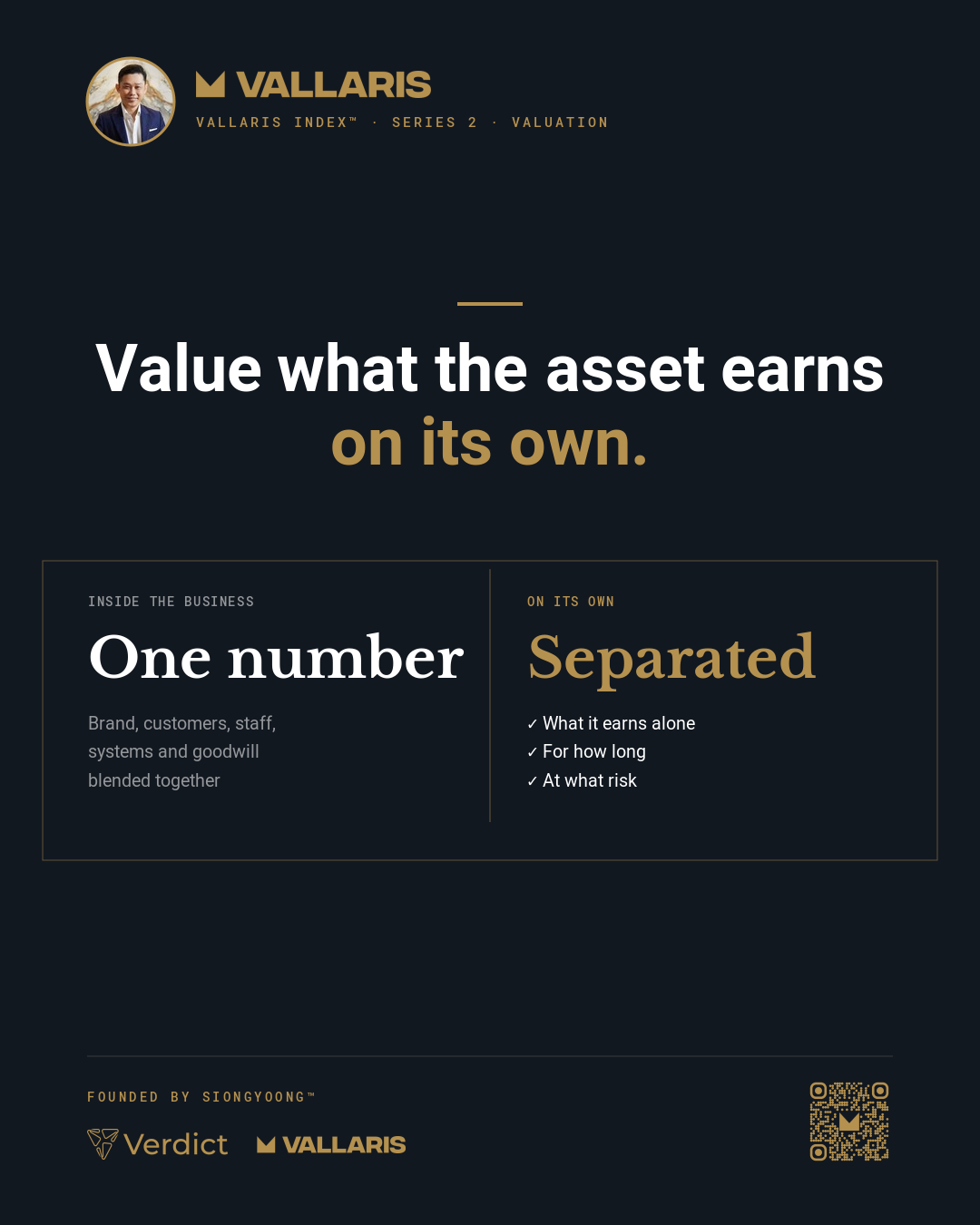
In short: An intangible asset valuation sets what a brand, patent, piece of software or customer base is worth on its own, for a stated purpose, at a stated date. In Singapore it follows IVS 210 and IVAS guidance, usually by relief from royalty, excess earnings or with and without. The royalty and the life move the value most, so that is where the evidence has to be.
Your brand earns money. So do your customer relationships, your software, and the know-how your team carries.
Inside a business, all of it arrives as one number. A buyer, an auditor or IRAS needs something narrower: what one asset earns, for how long, and at what risk.
So value what the asset earns on its own. Separate it from everything around it, then prove what it earns.
This guide shows how that is done in Singapore.
When you need one
Six moments, in the order owners usually meet them:
- You bought a company. Under SFRS(I) 3, the brand, customer relationships and technology you acquired are identified and valued apart from goodwill. Your auditor will read the numbers.
- You are licensing, selling or borrowing against IP. The fee, the price or the loan size starts from what the asset earns.
- You are moving IP inside the group. Transfer pricing needs an arm’s-length value, and the tax authority will ask who develops, protects and exploits the asset.
- You are claiming writing-down allowances under section 19B. Acquired IP rights can be written off for tax. Above set thresholds, IRAS requires an independent valuation report.
- Impairment. A brand with an indefinite life is tested every year.
- A dispute. Infringement, a licence disagreement or a shareholder exit can turn on what the IP is worth, or what its use was worth.
Name the purpose before anything else. It fixes the basis of value, the standard, the reader and the method. An intangible has no price until someone decides what it is for.
Most of the value is off the balance sheet
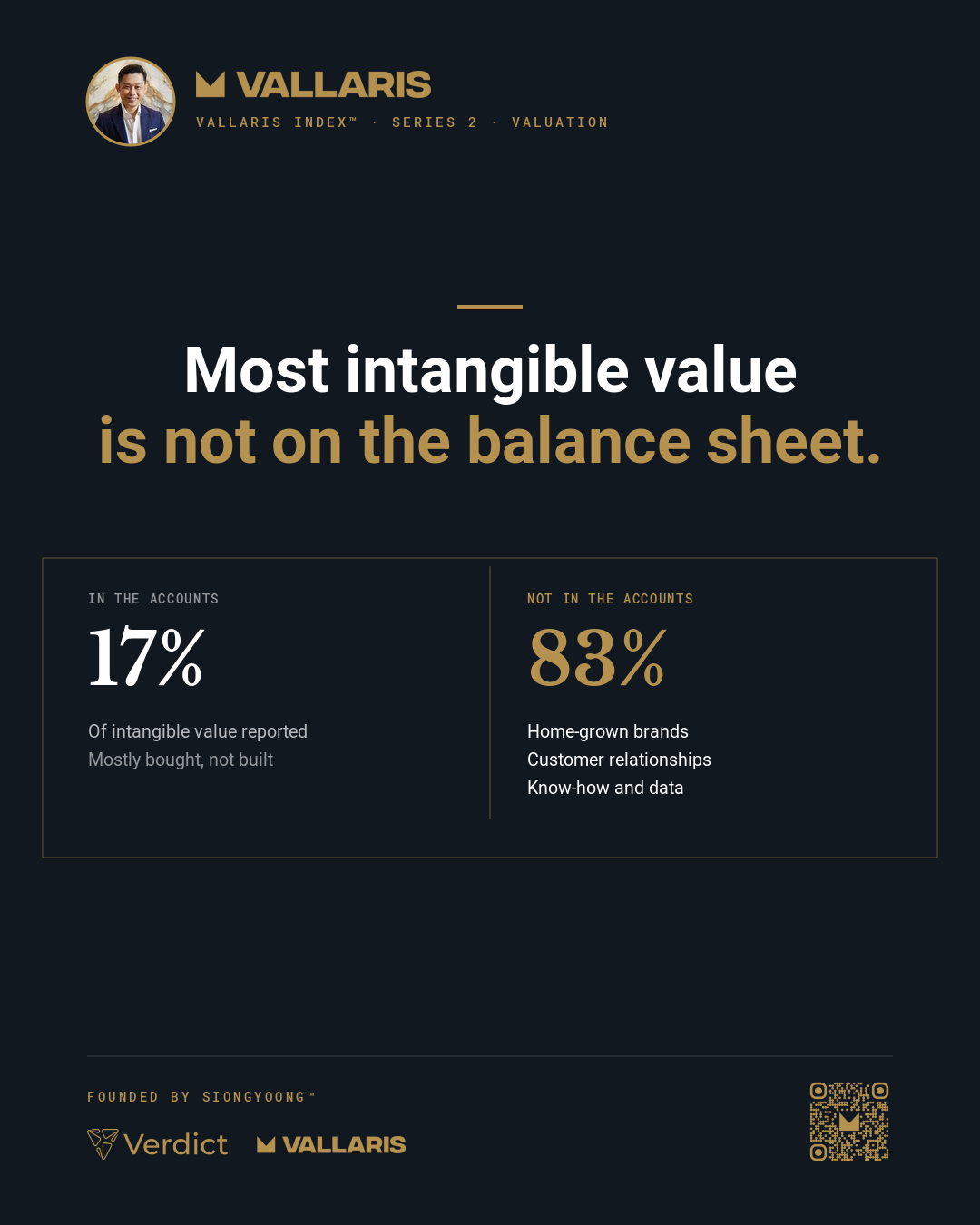
Brand Finance estimates that the intangible assets of the world’s largest companies reached US$97.6 trillion in 2025, and that 83% of that value is not reported in company financial statements (Global Intangible Finance Tracker 2025, 5 November 2025).
Most intangible value is not on the balance sheet. There is a reason for it.
Under SFRS(I) 1-38, a brand, masthead, publishing title or customer list you built yourself cannot be recognised as an asset. Buy the same kind of asset in an acquisition and it goes on at fair value.
So what your brand is worth is rarely a figure you can read from your accounts. It has to be built.
The accounting standard for acquisitions groups intangibles in five families:
- Marketing: trade marks, trade names, domain names, mastheads and non-compete agreements.
- Customer: customer lists, contracts, relationships and order backlog.
- Technology: patented and unpatented technology, software, trade secrets and databases.
- Artistic: books, music, pictures, film and other creative works.
- Contract: licences, franchises, permits, and service or supply contracts.
Brand is not the trade mark. The trade mark is the legal right. The brand is the right plus the reputation, design and customer habit around it. A valuation says which one it values. IVAS guidance on section 19B says brand value should not be taken as trade mark value without further work.
Four ways to value it, step by step
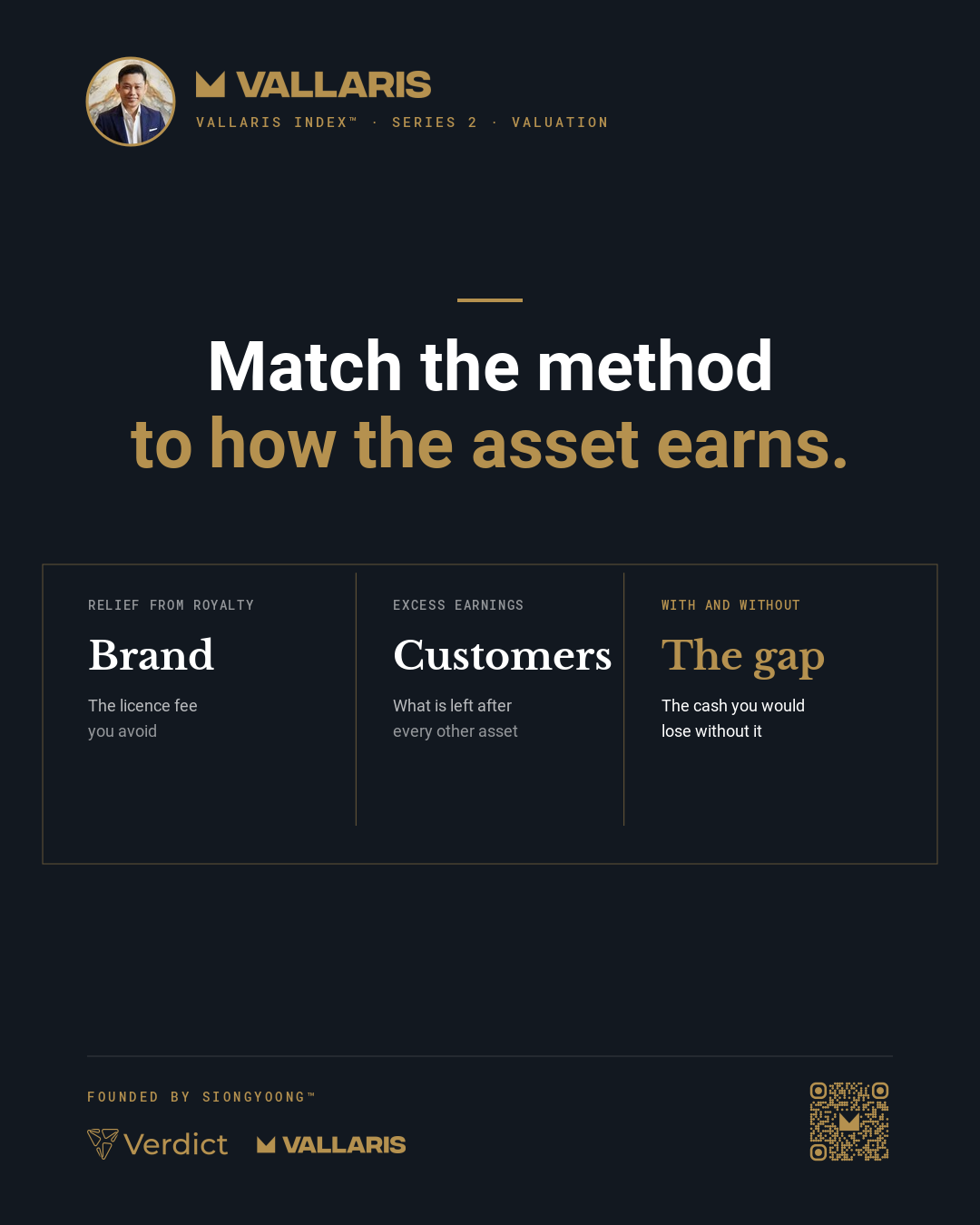
The International Valuation Standards use three approaches: market, income and cost. Four methods within them do most of the work in practice.
Match the method to how the asset earns.
Relief from royalty. For brands, trade marks, patents and software. Ask what you would pay to license the asset if you did not own it. The value is the royalty you avoid.
- Forecast the revenue the asset supports.
- Set a royalty rate from at least two sources: comparable licences, a split of the profit the asset earns above a routine margin, or a return on what it cost to build. Reconcile them in words. Never average them.
- Take tax off the royalty saved.
- Discount it over the asset’s remaining economic life, at a rate for the asset’s own risk.
Multi-period excess earnings. For customer relationships, or the one asset that drives the business.
- Forecast revenue from the customers you have today, not the ones you hope to win.
- Take off the costs to serve them.
- Charge a fair return for every other asset that helps earn it: working capital, equipment, the brand, the workforce.
- What is left belongs to the customers. Run it down by attrition measured from your own customer history, and discount it.
Use it for one asset per revenue stream. Two excess-earnings models on the same revenue count the same cash twice.
With and without. For non-compete agreements, licences, and assets that protect a margin. Forecast the business with the asset and without it. The value is the difference in the cash flows, weighted for the chance the loss would happen anyway.
Cost. For recently built software, internal data, and assets that earn no income of their own. Price a replacement built today, not a copy, with a profit margin and less obsolescence. Use it only where no other approach works well. Cost is not value. It is the spending a buyer would avoid.
Two steps apply to all four:
- Life from evidence. Estimate the remaining economic life from the legal term, competing technology, demand and your own plans. Never assume forever by default.
- The tax benefit. For financial reporting under the income approach, add the tax amortisation benefit a buyer would get.
A worked example: a brand, by relief from royalty
Illustrative figures, chosen to show the arithmetic. A Singapore consumer company sells S$10,000,000 a year under its own brand. Revenue is held flat to keep the steps visible.
- Royalty rate: 3% of revenue, taken as net of the brand spending the owner already carries. Royalty saved: S$300,000 a year.
- Tax at 17%, Singapore’s corporate income tax rate: S$249,000 a year after tax.
- Remaining economic life: 10 years.
- Discount rate for the brand: 14%.
- Present value: S$249,000 × 5.216 = about S$1.30 million, before any tax amortisation benefit.
The royalty, life and rate are chosen for the arithmetic. They are not a market royalty or a discount rate for any sector. In a signed valuation, each one cites its evidence.
What moves the result
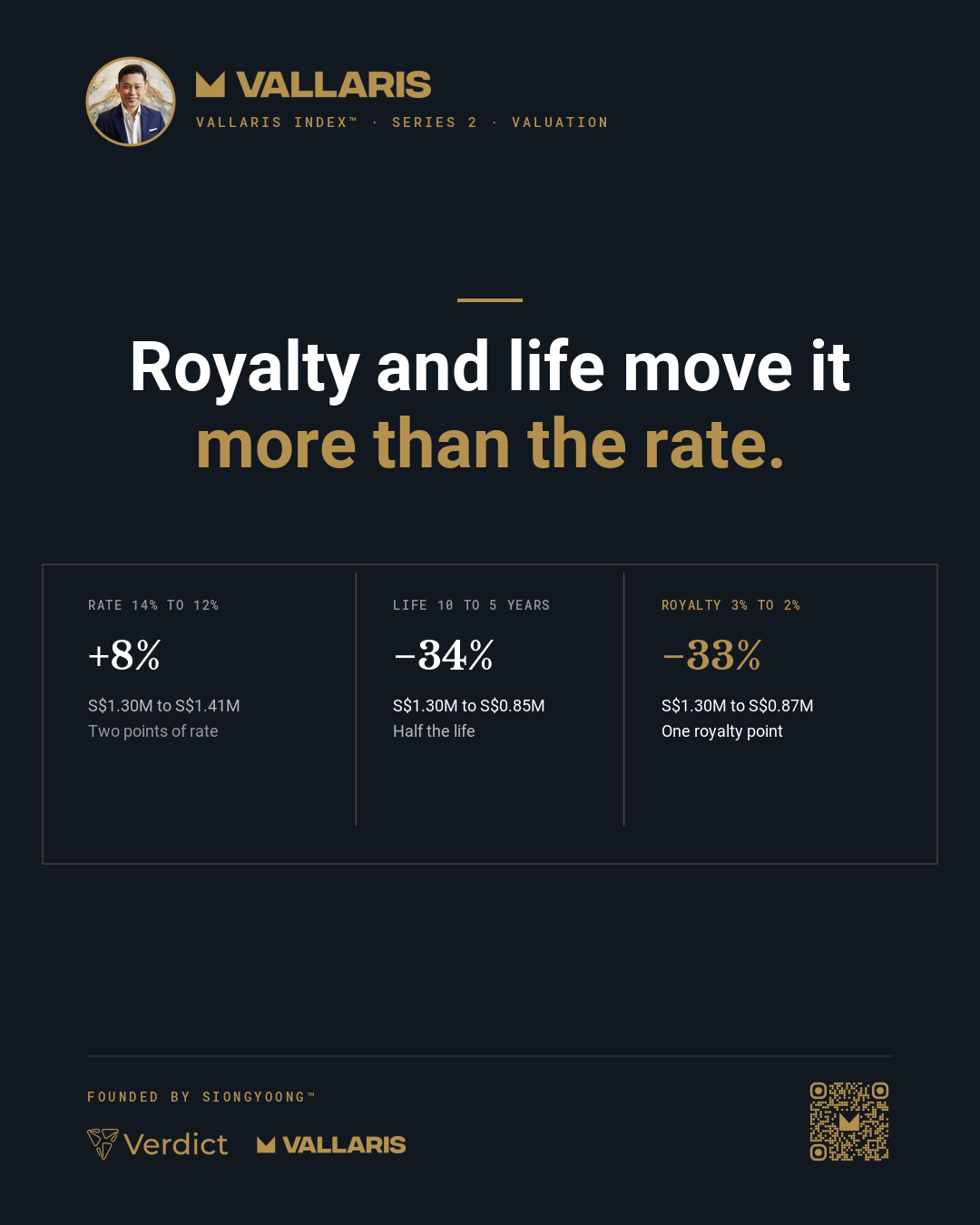
Run the same example three ways:
- Discount rate from 14% to 12%: value rises 8%, to S$1.41 million.
- Life from 10 years to 5: value falls 34%, to S$0.85 million.
- Royalty from 3% to 2%: value falls 33%, to S$0.87 million.
Royalty and life move it more than the rate. One royalty point moved it a third.
That is where an auditor, a buyer or the other side’s expert spends their time. It is also why IVAS guidance asks for sensitivity ranges set by the risk in each input, not arbitrary ones.
What lifts the royalty and the life, from both sides of the table:
- Protection you can show. Granted patents, marks registered in each market you sell in, and trade-secret controls on paper.
- Earnings that follow the asset, not the founder. If customers buy because of you personally, a buyer prices that in.
- History. Customer cohorts by year, licence terms on file, development costs recorded as they were spent.
- Upkeep. A brand called indefinite needs the spending that keeps it alive, and that spending sits in the cash flows.
What the auditor or buyer checks first
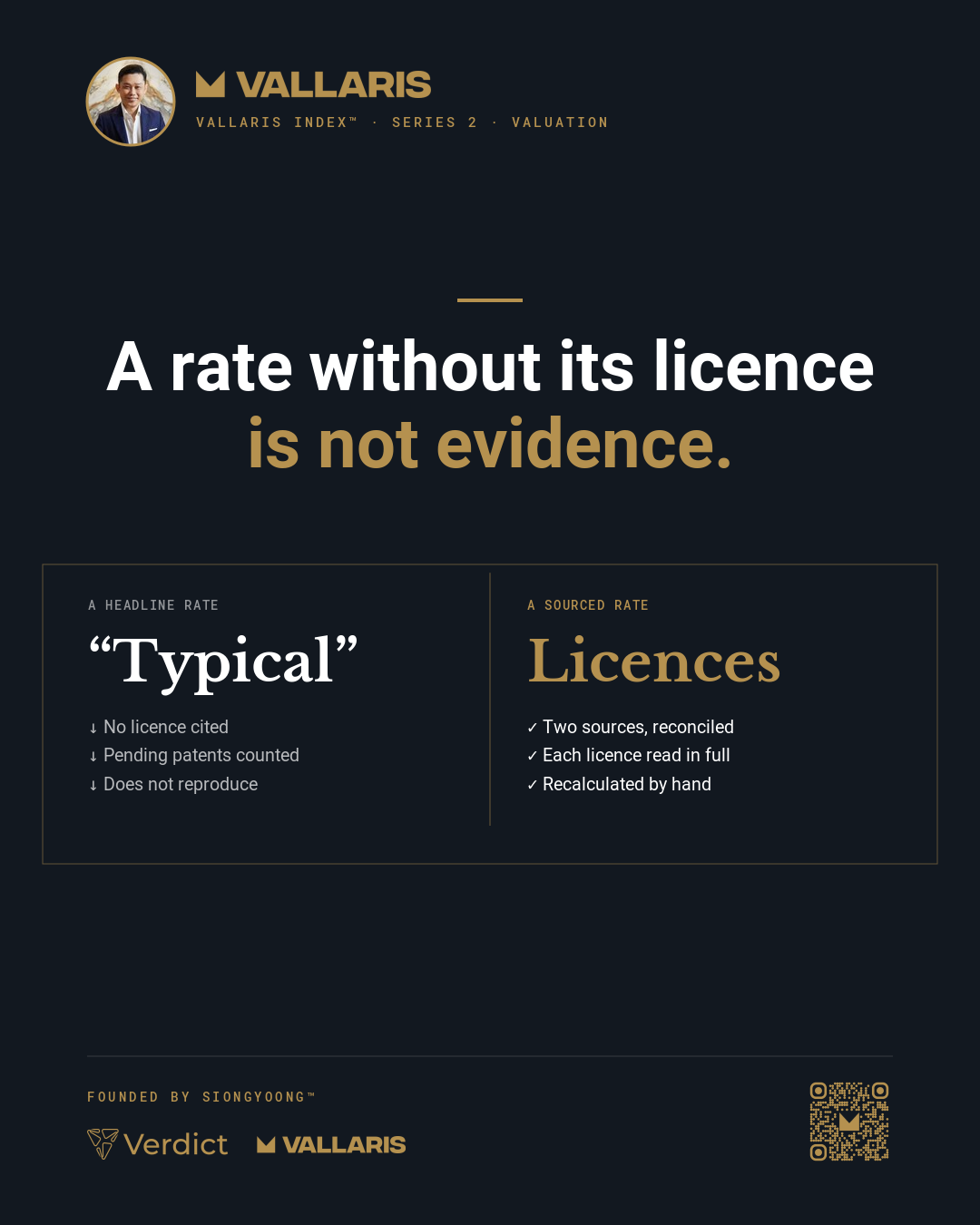
When I review an intangible asset valuation, these are the first places I look. Check yours before anyone else does.
- The royalty cites the licences it came from. Each comparable records what the fee is charged on, the territory, exclusivity, duration and any upfront payment. A rate without its licence is not evidence.
- No rule of thumb. A US appeal court rejected the “25% rule” in 2011 (Uniloc v Microsoft). One-third of profit is not a royalty either.
- Pending patents are shown as pending. An application is not a granted right.
- The life is earned, not assumed. Legal term, technology and demand, read together. Indefinite only when all three IVAS tests are met: a track record, nothing that limits the life, and upkeep worth paying for.
- The discount rate is reasoned against the company’s cost of capital, higher, lower or equal, with the reason given. Where every asset in a deal is valued, the rates reconcile back to the whole.
- It reproduces. One row of each method can be recalculated by hand.
The standards behind it
- IVS 210 Intangible Assets, part of the International Valuation Standards issued by the International Valuation Standards Council (IVSC), effective 31 January 2025.
- IVAS GN-003, Valuation of Intangible Assets: Key Focus Areas and Guidance, announced on 26 August 2026. Chartered Valuers and Appraisers comply or explain any departure.
- IVAS GN-002, on valuing IP rights for section 19B (7 August 2026), read with the IRAS e-Tax Guide on section 19B valuation reports (second edition, 30 January 2026). From Year of Assessment 2026, an independent report is required where the capital spending on qualifying IP rights is S$10 million or more from a related party, or S$40 million or more from an unrelated one.
- IVAS PN-001, minimum requirements for valuations and reports (1 December 2021), which covers intellectual property and other intangibles.
- SFRS(I) 1-38 Intangible Assets, SFRS(I) 3 Business Combinations and SFRS(I) 13 Fair Value Measurement for values in financial statements.
- The OECD Transfer Pricing Guidelines and the IRAS Transfer Pricing Guidelines for IP that moves inside a group.
Questions owners ask
How much is my brand worth?
What it earns or saves you on its own, over the years it will keep doing so, at a rate for its risk. Relief from royalty is the usual starting point: the fee you would pay to license the brand if you did not own it. Published brand rankings are not evidence of value.
Can I put my own brand on the balance sheet?
Not if you built it. SFRS(I) 1-38 does not allow internally generated brands, mastheads, publishing titles or customer lists to be recognised. If you bought it, in an acquisition or on its own, it goes on at fair value. A valuation for another purpose, such as a licence or a tender, can still be done, and it says it is not for the balance sheet.
Is there a standard royalty rate for my industry?
No. An industry median is a starting point at most. Where your asset sits depends on its legal protection, its stage, the territory and exclusivity, and on licences close to yours, each read in full.
Do I need a valuation report for section 19B?
Above the thresholds, yes: S$10 million or more from a related party, or S$40 million or more from an unrelated party, from Year of Assessment 2026. Below them, IRAS can still ask how the price was set, so keep the evidence.
How long does an intangible asset valuation take?
About three weeks from receiving the asset register, forecasts and licence data to the draft report, then about a week to finalise it. Longer for patent portfolios, transfer pricing and disputes.
Who should sign an intangible asset valuation in Singapore?
For a report an auditor, IRAS or a court will read: an independent valuer with a recognised valuation qualification, who follows IVS 210 and the IVAS guidance, and signs in their own name.
Sources
- Brand Finance — Global Intangible Finance Tracker (GIFT™) 2025: US surpasses Denmark to become most intangible market globally. Released 5 November 2025. US$97.6 trillion; 83% not reported in financial statements.
- International Valuation Standards Council — International Valuation Standards, effective 31 January 2025 (includes IVS 210 Intangible Assets). Redline edition hosted by ICAEW; IVSC is the issuer. Effective date: IVS 100 para 50.01.
- ACRA — IVAS issues Guidance Note to support robust, transparent and consistent intangible asset valuations. Announced 26 August 2026.
- IVAS — GN-003 Valuation of Intangible Assets: Key Focus Areas and Guidance. Comply or explain for CVA holders; para 6.3 licence terms; para 7.11 indefinite life; para 8.4 sensitivity.
- IVAS — GN-002 Valuation of Intellectual Property Rights for Section 19B of the Singapore Income Tax Act 1947. Dated 7 August 2026; comply or explain for CVA holders; para 12.7 brand and trade mark.
- IVAS — PN-001 Minimum Requirements for Performing Valuations and Issuing Business Valuation Reports. Dated 1 December 2021; para 3.1.1 covers intellectual property and other intangibles.
- IRAS — IPRs Valuation Report for Purposes of Section 19B of the Income Tax Act 1947 (Second Edition). Second edition, published 30 January 2026; para 5.1.2 thresholds, from YA 2026 (updates table).
- IRAS — Corporate Income Tax Rate, Rebates and Tax Exemption Schemes. Corporate income tax rate 17%.
- ACRA — Singapore Financial Reporting Standards (International). SFRS(I) 1-38 (para 63), SFRS(I) 3, SFRS(I) 13; equivalent to IFRS Accounting Standards.
- IFRS Foundation — IFRS 3 Business Combinations, Illustrative Examples (identifiable intangible assets). Five classes of intangible: IE18 (marketing), IE23 (customer), IE32 (artistic), IE34 (contract), IE39 (technology). Hosted by the AASB.
- Holland & Knight — Federal Circuit rejects “25 percent rule of thumb” in calculating patent damages (Uniloc v Microsoft). Case note, 7 January 2011.
General information only, not valuation, legal, tax or accounting advice. Worked figures are illustrative and are not market royalty or discount rates.