
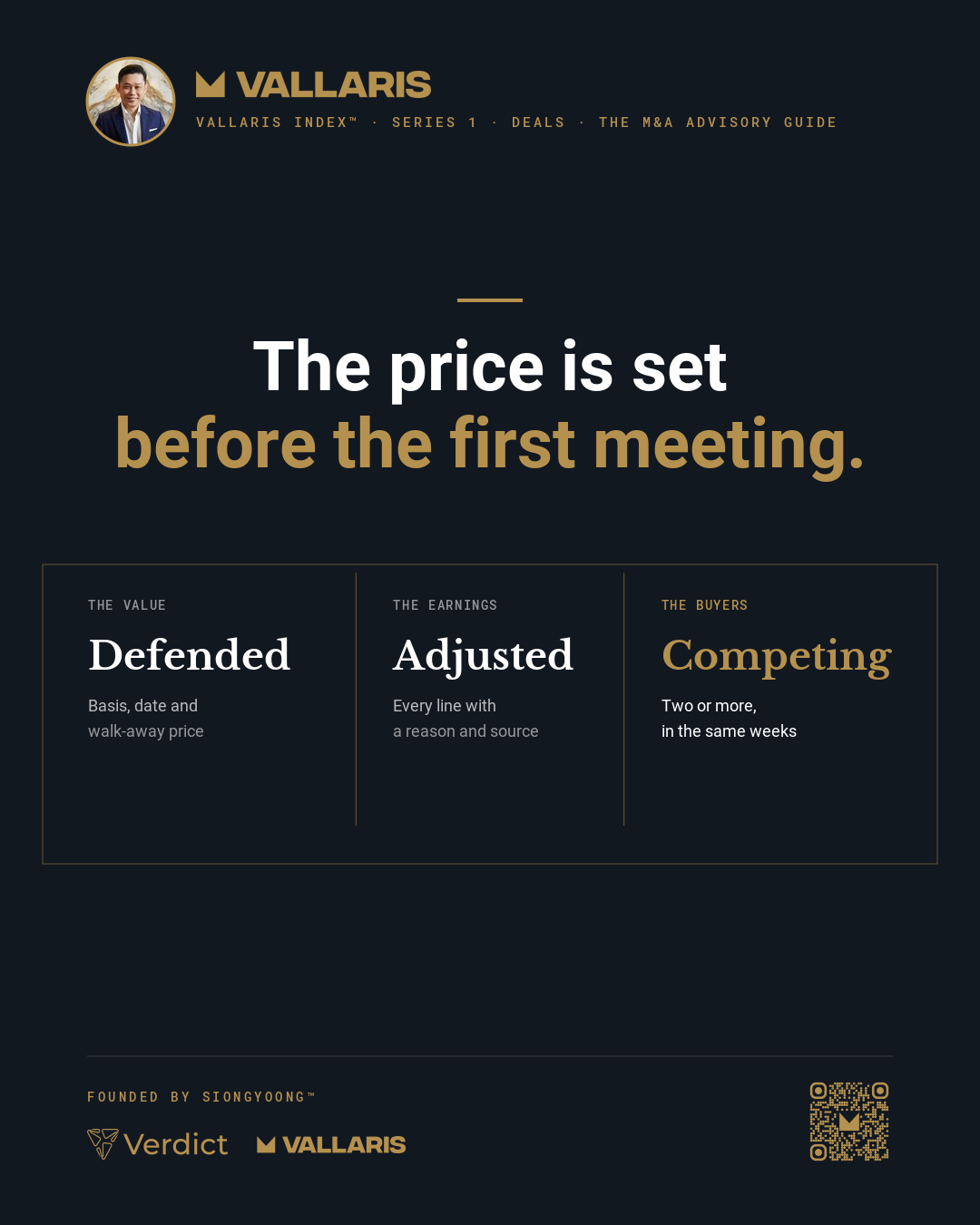
In short: In a sale, the buyer forms its view of your earnings before the first meeting, and every later offer is argued from that first number. So the price is set before the first meeting: by a defended value, adjusted earnings with a source for every line, the structure decided, and more than one buyer at the same time. The headline price then becomes cash at completion only after net debt, working capital and any earn-out.
You built the company over years. A buyer has called, or you have decided the time has come.
The first meeting feels like the start of the negotiation. It is closer to the end of it.
By the time you sit down, the buyer has read your accounts, formed a view of your earnings and decided how much of them it believes. Its first number comes from that view. Every later offer is argued from it.
So the work that moves the price happens before anyone meets. The price is set before the first meeting. Prepare the value, the numbers and the buyers first, and the negotiation starts from your number.
This guide shows how that is done in Singapore.
When the price is really set
Three things fix the range a deal lands in. All three are settled at your desk, weeks before the meeting.
- The earnings the buyer believes. A buyer pays for earnings it expects to continue. Earnings it can check go into the price. Earnings it cannot check are discounted, or left for later.
- The first defended number on the table. Whoever puts a number down first, with its reasoning, sets the anchor. Later offers are measured against it.
- The buyers at the table at the same time. One buyer negotiates against your patience. Two or more, in the same weeks, negotiate against each other.
A buyer that meets you before any of this is ready will form its view anyway. It will simply form it from what it has.
Five decisions to make before you meet a buyer
- What the company is worth, and to whom. A value on a stated basis, at a stated date, with the reasoning written down. Know your walk-away number before you hear an offer. A buyer that can make savings only it can make may pay more than one that cannot; that is its investment value, and it is worth knowing which buyers have it.
- Your adjusted earnings. Start from the audited accounts. Adjust, line by line, for what a new owner will not carry: your own pay above a market salary, one-off costs, rent paid to a related party above the market rate. Give every adjustment a reason and a source.
- What is for sale. The shares of the company, or its business and assets. The choice changes the tax, the stamp duty, which contracts move with the business, and what the buyer takes on.
- What you want after completion. A full exit, an earn-out, or staying on for a period. Buyers price each one differently, so decide before they ask.
- Who should be in the room. A long list of buyers, a short list you approve, and the names you want kept out. Approach is made through your adviser, with a two-page anonymous teaser first and a non-disclosure agreement before anything that names the company.
One rule holds the five together: one set of facts. Revenue, earnings, customers, headcount and deal terms sit on one fact sheet, each with its date and source, and every document quotes it. I have seen investor documents for one company, sent in the same months, give two different figures for trailing revenue, each drafted from a different source at a different time. A buyer who finds two numbers will ask which one to believe.
A worked example
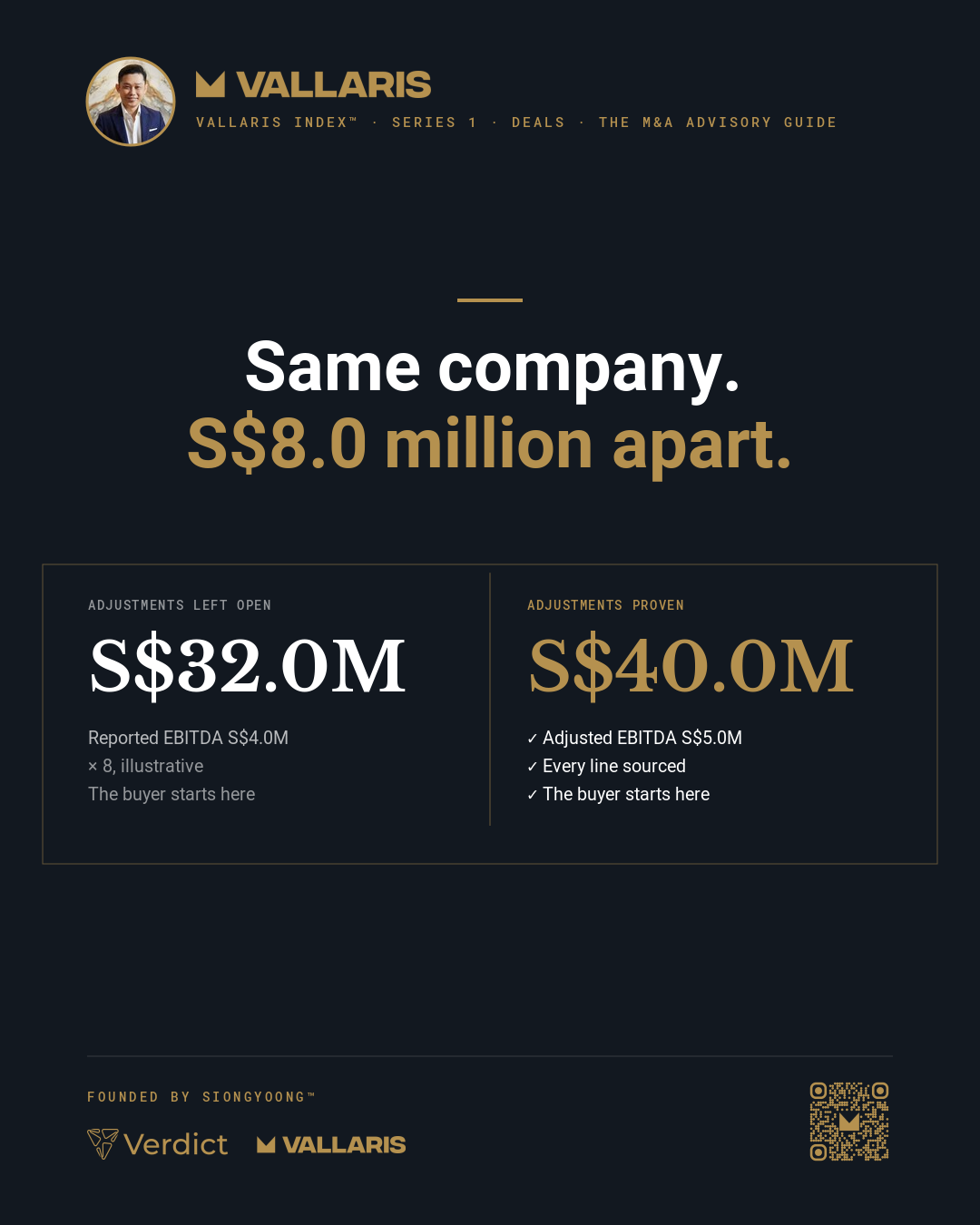
Illustrative figures, for the arithmetic only. The multiple is chosen to show the arithmetic, not as a market rate.
A Singapore distributor reports EBITDA (earnings before interest, tax, depreciation and amortisation) of S$4.0 million. Two items in that year will not continue under a new owner:
- the founder’s pay, S$0.6 million above a market salary for the role;
- a one-off legal cost of S$0.4 million.
Adjusted EBITDA is S$5.0 million. Assume the buyer pays 8 times the EBITDA it believes.
- The adjustments are proven before the first meeting, each with a reason and a source. The buyer starts from S$5.0 million of EBITDA: S$40.0 million.
- The adjustments are left for the buyer to find. The buyer starts from the reported S$4.0 million: S$32.0 million. Any adjustment it accepts later is argued up from there, one at a time.
Same company. S$8.0 million apart.
The business is identical in both cases. What changed is what was ready on the day the buyer formed its view.
From the headline price to the cheque
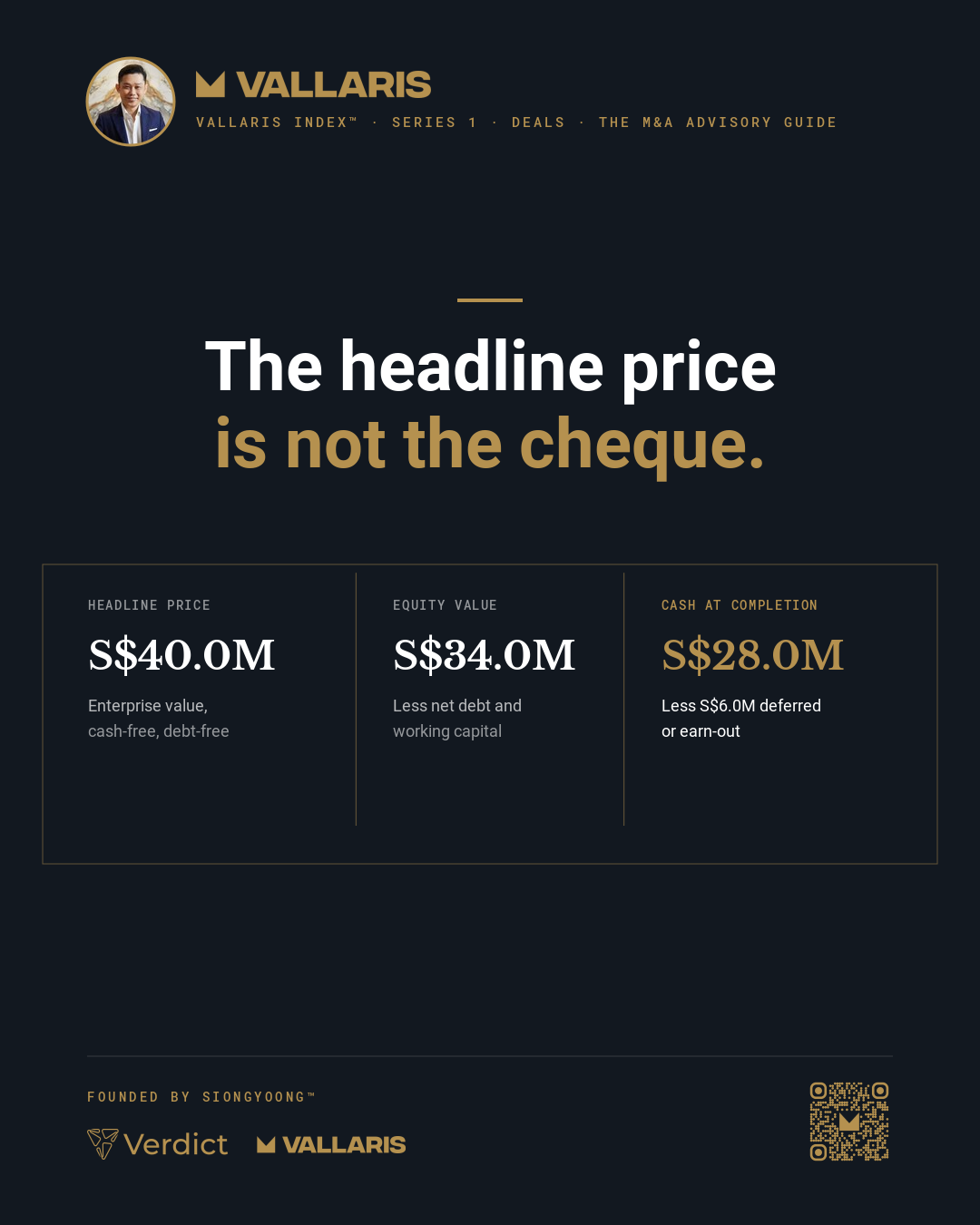
The price in an announcement is rarely the money you receive at completion. Most private deals are priced cash-free and debt-free, with a normal level of working capital, and then adjusted.
Continuing the example, at a price of S$40.0 million for 100% of the company:
- Enterprise value: S$40.0 million.
- Less net debt at completion: S$5.0 million. Borrowings and leases, plus debt-like items such as unpaid tax and shareholder loans, less cash.
- Less the working capital adjustment: S$1.0 million, because working capital on the day sits that far below the agreed normal level, the peg.
- Equity value for 100%: S$34.0 million.
- Paid later: S$2.0 million deferred for 12 months, and an earn-out of up to S$4.0 million over two years, paid only if its targets are met.
- Cash at completion: S$28.0 million, before tax and deal costs.
The headline price is not the cheque. Three negotiated lines decide the gap: what counts as debt, where the peg is set, and how the earn-out is measured. Each is cheaper to settle in your favour before the offers arrive than after.
Two ways to fix the final number:
- Completion accounts. The price is adjusted after completion for the actual net debt and working capital on the day. The buyer pays for exactly what it receives.
- A locked box. The price is fixed on an earlier balance sheet date, and you promise that no value leaves the company between that date and completion. You know your number when you sign.
Choose before the offers come in, so every buyer prices the same thing.
If an earn-out is part of the price, agree in writing: the measure and how it is calculated, who runs the business while it runs, what the buyer may not do that would reduce it, how disagreements are settled, and the amount expected as well as the maximum.
What the buyer checks first
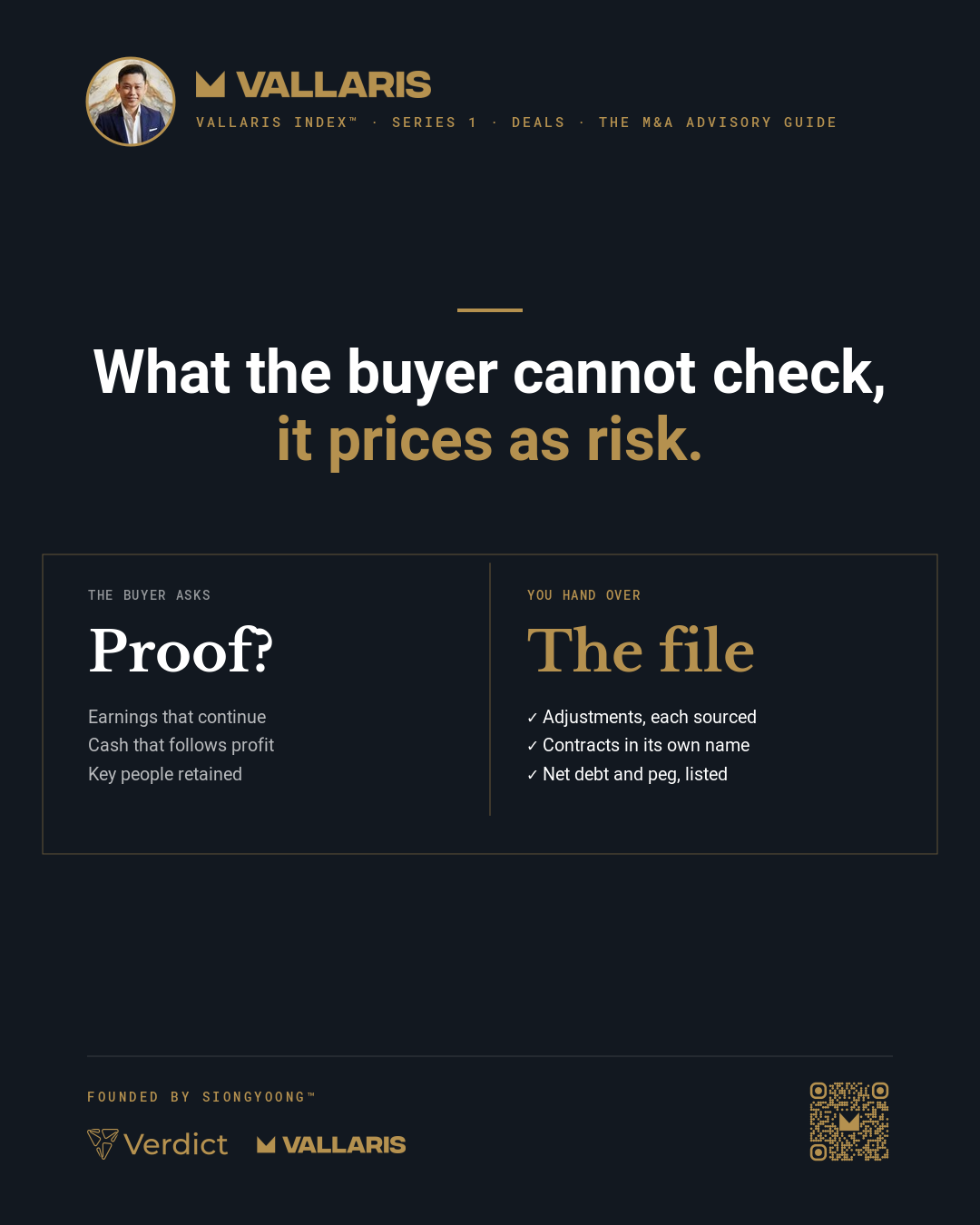
What the buyer cannot check, it prices as risk. When I prepare a company for sale, these are the first places a buyer’s diligence team looks. Check yours before they do.
- Adjusted earnings tie to the audited accounts. Every adjustment has a reason and a document. Adjustments that are large against reported earnings get the closest reading.
- Cash follows profit. Operating cash flow that keeps pace with EBITDA year after year. Where cash runs behind, the buyer will ask why.
- Customers. How much of revenue sits with the largest customers, on what contract terms, and whether those contracts continue after a change of control.
- The business runs without you. Key people with retention terms, and decisions that do not all wait for the founder.
- Net debt and working capital. The debt-like items listed in advance, and a peg drawn from a normal year’s average.
- What you sell is yours to sell. Contracts, licences and intellectual property held in the company’s name.
- Spending keeps the assets working. Capital spending in line with depreciation, so the buyer is not paying for a catch-up.
Each answer you prepare is one the buyer does not have to price. Each one left open tends to reappear in the sale agreement as a price reduction, a warranty, an indemnity or money held back.
How a sale runs, and how long it takes
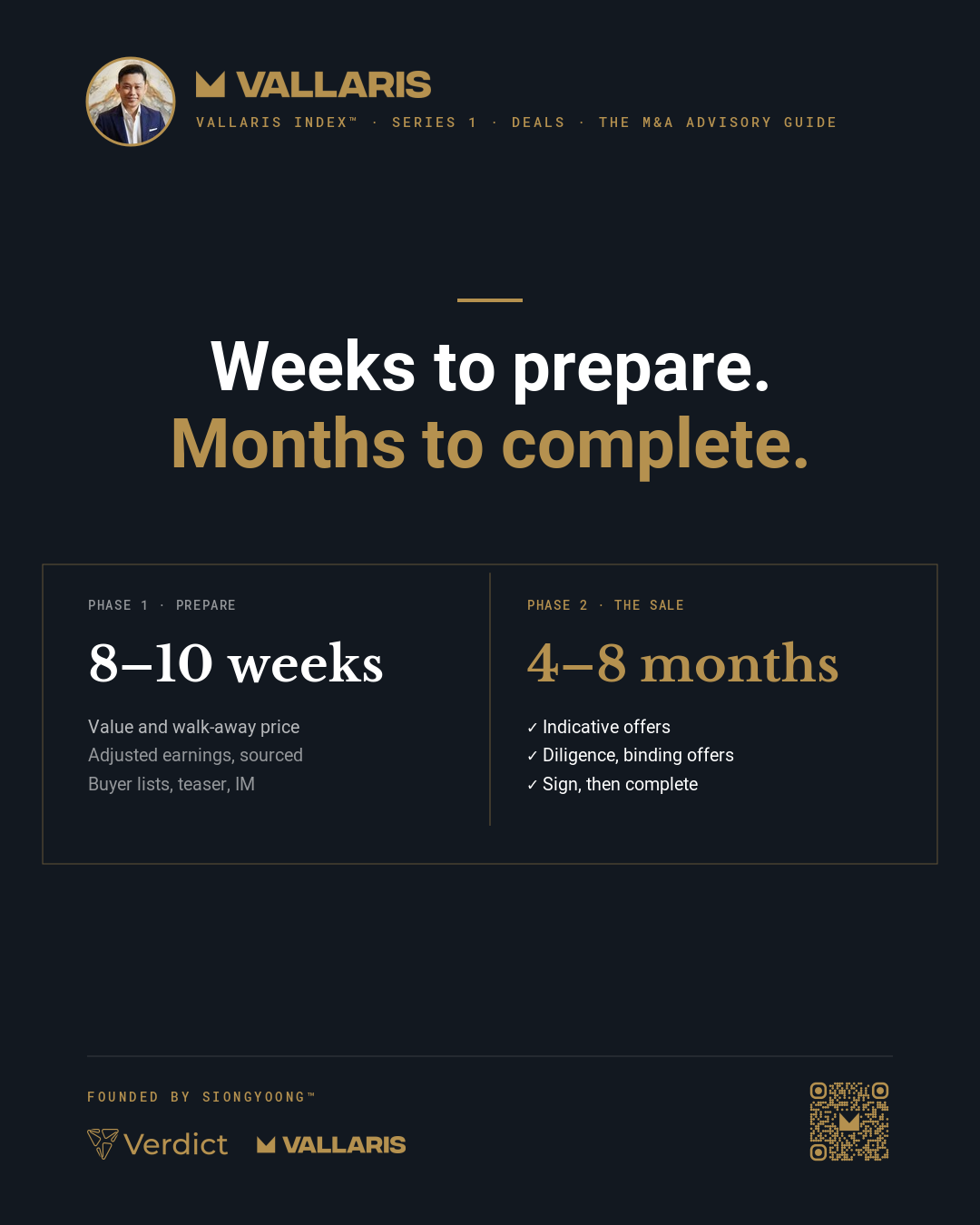
A sale runs in two phases.
Phase 1, preparation. The valuation and the walk-away price; adjusted earnings; vendor due diligence where it helps; the buyer lists; the teaser and the information memorandum; the non-disclosure agreement and the process letter that sets the rules and dates for offers.
Phase 2, the sale. Approach the buyers; receive indicative offers; choose a shortlist; management presentations; the data room; binding offers; the sale and purchase agreement; completion.
Keep the stages apart. An indicative offer is a starting point; the binding offer comes after diligence. Signing fixes the terms; completion moves the money.
In our practice, preparation takes eight to ten weeks. The sale, from first approach to completion, takes four to eight months, depending on how many buyers there are and which approvals the deal needs. Weeks to prepare. Months to complete. The weeks spent in the first phase are what keep the second phase moving.
How many buyers to approach is a choice. A wide process suits a business many buyers want, and gives the most competition. A targeted approach to a few chosen buyers keeps news of the sale contained. Decide it with your adviser before the first call.
Buying a company: the same rule, the other side
A buyer’s price is also set before the first meeting.
- Write your criteria and your walk-away price before you meet a seller.
- Pay for what the business earns on its own. Savings that only your group can make are your investment value. Pay them across to the seller and you have bought your own upside.
- Plan the diligence. Financial, tax, legal and commercial. Name who does each, and what each must answer before the binding offer.
- Arrange the financing before the binding offer, not after.
- Plan the accounts. After completion, SFRS(I) 3 Business Combinations (IFRS 3) requires you to allocate the price across everything you acquired, at fair value, within a measurement period of no more than one year. Our purchase price allocation guide shows how.
- Plan the integration before signing, with the people who will run it.
Where a board or an exchange needs an independent view of whether the price is fair to shareholders, a fairness opinion gives one.
Singapore rules that shape the deal
- Stamp duty on shares. Stamp duty on a transfer of shares is 0.2% of the purchase price or the value of the shares, whichever is higher. For a private company incorporated more than 18 months earlier, IRAS takes the value as the net asset value of the shares, from accounts dated within 24 months before the transfer, with any property at market value. On the S$34.0 million equity value in the example, if that is the higher figure, the duty is S$68,000.
- Selling through a holding company. Under section 13W of the Income Tax Act 1947, gains a company makes on selling ordinary or preference shares are exempt from tax, for disposals on or after 1 January 2026, where it has held at least 20% of the target’s ordinary shares (or, from 2026, shares worth at least 20% of its paid-up share capital) for a continuous 24 months before the sale. The section sets conditions and documents to file with the tax return, so confirm the position with your tax adviser before you choose the structure.
- Competition. Section 54 of the Competition Act 2004 prohibits mergers that substantially lessen competition in a market in Singapore. Telling the Competition and Consumer Commission of Singapore is voluntary. It says it is unlikely to intervene unless the merged business would hold at least 40% of a market, or between 20% and 40% where the three largest firms together would hold at least 70%.
- A buyer listed on SGX. Under Mainboard Rule 1014, if any of the relative figures in Rule 1006 exceeds 20%, the deal is a major transaction: subject to limited exceptions, it must be made conditional on approval by the buyer’s shareholders in general meeting, with a circular to them. Build that time into the timetable.
Each of these is a decision about structure, so it belongs in Phase 1, before the price is discussed.
Questions owners ask
What does an M&A adviser do?
An M&A adviser values the company, finds and approaches the buyers or targets, runs the process and the due diligence, and negotiates the price and terms through to completion. At VALLARIS™ the same adviser values the company and signs the valuation.
When should I start preparing to sell?
Before the first conversation with a buyer, and ideally before a buyer calls. Preparation takes about two months in our practice, and it is what sets the range the price will land in.
How long does an M&A deal take in Singapore?
In our practice, eight to ten weeks to prepare, then four to eight months from the first approach to completion. The time depends on how ready the company is, what due diligence finds, and whether financing, a competition review or a listed buyer’s shareholder vote is needed.
How will a buyer value my company?
Usually on the earnings it believes will continue, at a multiple it can defend to its own board, cross-checked against cash flow. The adjusted earnings you can prove before the first meeting are the base it works from.
Should I sell the shares or the business and assets?
It depends on the tax, the stamp duty, the contracts and licences that need to move, and what the buyer will accept. A share sale moves the whole company, contracts included. An asset sale lets the buyer choose what it takes. Decide with your tax adviser and lawyer before the teaser goes out.
Should I accept an earn-out?
An earn-out pays part of the price later, if agreed targets are met. It can bridge a gap between your price and the buyer’s. Agree the measure, who runs the business during it, what the buyer may not do that would reduce it, and the expected amount as well as the maximum.
How much does an M&A adviser cost?
The fee follows the size and shape of the deal. VALLARIS™ quotes the fee in writing after the first conversation, which has no fee.
Sources
- IRAS — Buying or acquiring shares (stamp duty). 0.2% of the purchase price or the value of the shares, whichever is higher; private company shares valued at net asset value.
- Singapore Statutes Online — Income Tax Act 1947, section 13W. Exemption of gains on disposal of ordinary or preference shares, for disposals on or after 1 January 2026 (s13W(1A), (1B)); conditions in s13W(2).
- Singapore Statutes Online — Competition Act 2004, section 54. Mergers that substantially lessen competition in a market in Singapore are prohibited.
- Competition and Consumer Commission of Singapore — Notify a merger: overview. Notification is voluntary; indicative thresholds of 40%, or 20% to 40% with a three-firm share of 70%.
- SGX RegCo — Mainboard Rules, Rule 1014 (major transactions). Relative figures over 20% under Rule 1006: conditional on shareholder approval, with a circular.
- Accounting Standards Committee — SFRS(I) 3 Business Combinations, 2026 volume. Measurement period of no more than one year from the acquisition date (para 45).
General information only, not legal, tax, accounting or valuation advice. Worked figures are illustrative. Confirm the structure with your lawyer and the tax position with your tax adviser.