

In short: Portfolio company valuation sets the fair value of a fund’s unlisted holdings at each reporting date, under SFRS(I) 13 and the IPEV Valuation Guidelines. Every mark starts at the price you paid: the method is calibrated to the entry price or the last orderly round, rolled forward with the market and the company’s results, and split across share classes by their rights.
Every quarter, your fund reports a net asset value. Most of it may sit in companies that have no quoted price.
Your auditor will ask how each number was reached. Your LPs will compare it with the last round, and with the exit when it comes.
So a mark your LPs can rely on is not a guess that happens to look reasonable. It is a walk, step by step, from a price someone actually paid to the value today, with a reason at every step.
Every mark starts at the price you paid. This guide shows how the rest of the walk is done in Singapore.
When you need one
Five moments, in the order fund managers usually meet them:
- Every reporting date. Each time the fund reports net asset value to its investors, every investment needs a fair value conclusion. For most private funds that is quarterly or half-yearly, as the fund documents set out.
- The year-end audit. Your auditor will re-perform the significant marks, and will expect the IPEV Valuation Guidelines to have been followed.
- A new round, a down round, or no round for a long time. Each one changes how much weight the last price can carry.
- A complex capital structure. Preference shares, convertible notes, SAFEs and warrants mean the headline price is not the price of every class.
- Fundraising, a secondary sale or a continuation fund. New LPs and buyers will read your track record through your marks.
Write down the fund, its reporting dates and its accounting framework before anything else. One valuation date per fund, used everywhere.
What fair value means for a fund
Fair value is an exit price. It is what the fund would receive to sell its holding in an orderly transaction between market participants at the measurement date (SFRS(I) 13, paragraph 9).
Three ideas follow from that one line:
- Assume a sale today, whether or not a sale is planned or the company is ready for one.
- Value what the fund holds. The unit of account is the fund’s holding: its Series B shares, its notes, its warrants. Not the whole company.
- Use market participants’ assumptions, not the fund’s own plans for the company.
Cost is not a default. Under SFRS(I) 9, cost may stand in for fair value only in limited cases, and a significant change in the company’s performance against its budget, plans or milestones, or in its market, is a sign that cost no longer does. An unchanged mark is a conclusion that needs reasons.
Start at the price you paid
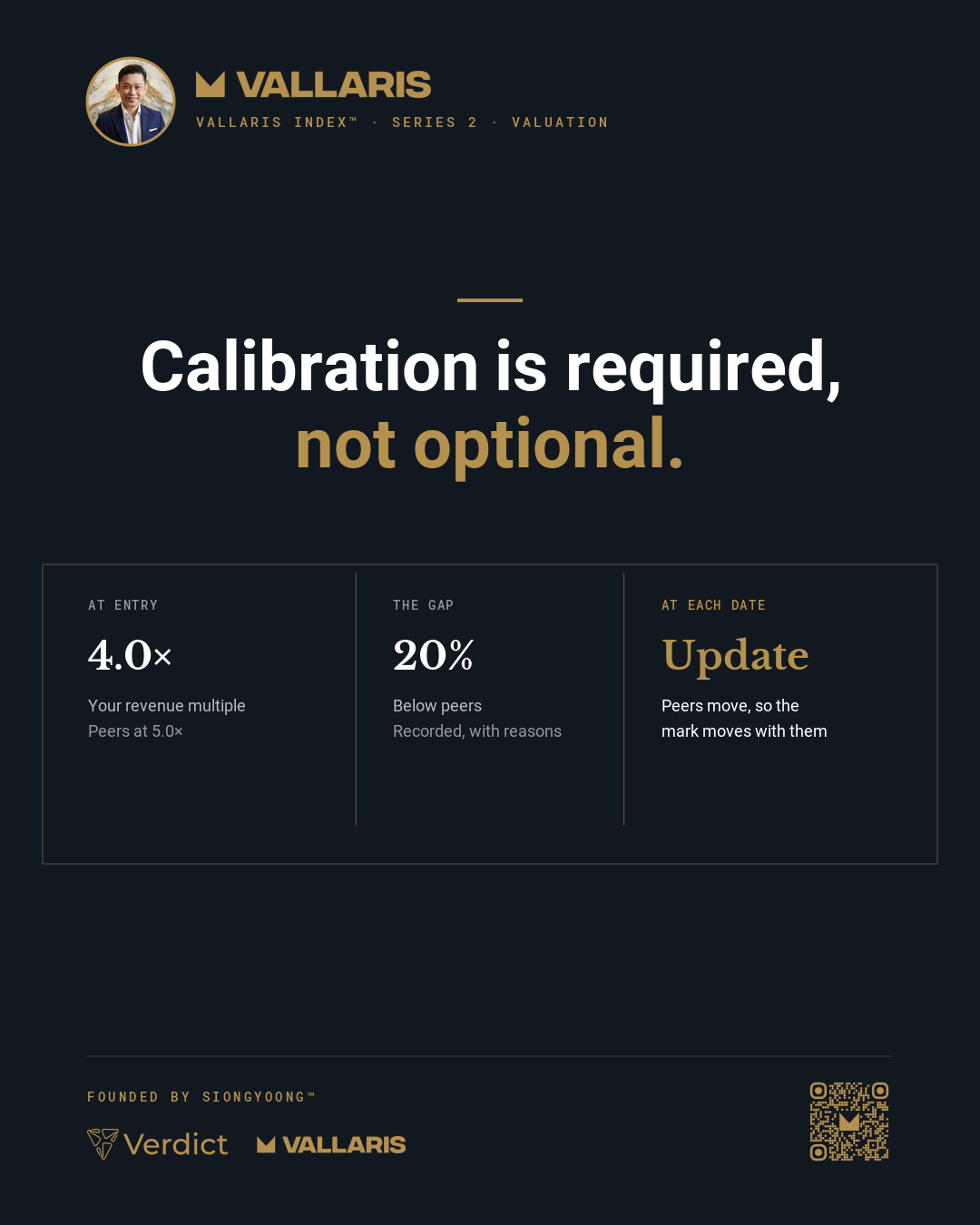
Calibration is required, not optional. It is the step that turns a model into a mark. Where the price you paid was fair value and your method uses inputs the market cannot see, SFRS(I) 13 says the method shall be calibrated to that price (paragraph 64).
On the day you invest, the price you paid is your best evidence of fair value. So you set up the method you will use later, a revenue multiple for example, and tune it until it returns that price on that day.
The tuning tells you something. If your company was bought at 4.0 times revenue while listed peers traded at 5.0 times, the 20% gap is information: the stage, the scale, the risk that a buyer priced in. Record it.
At every later date, start from that calibrated position and update it:
- Move the inputs with the market. If peers re-rate, your mark moves with them.
- Judge the gap. Should it stay, narrow or widen? Write down why. Do not carry it forward by habit.
- Recalibrate to a later round, if an orderly one has happened since.
The price of a recent investment is not a valuation method on its own. It calibrates the methods that follow. Its weight falls as time passes, or when the round was an insider round, a strategic investment, a rescue, or carried new rights the old shares do not have.
Multiples, cash flows and net assets
The IPEV Guidelines list the methods. Use one or more at each date, and reconcile them into one value. Never average them.
Multiples. Apply a multiple of revenue or earnings, from comparable listed companies or deals, to your company’s matching figure, for the same period and on the same accounting basis. Revenue multiples suit companies that are not yet sustainably profitable. Keep the comparable set stable unless the market gives you a reason to change it.
Discounted cash flow. Use it where the forecast can be relied on. Calibrate the discount rate at entry: split the rate the price implied into its cost of capital and a company-specific premium, then update each part at every date. Put each risk in the forecast or in the rate, never in both.
Net assets. For holding companies, asset-heavy businesses and companies winding down.
Industry benchmarks, such as price per user, are a sanity check. They are rarely enough on their own.
Use the same method from one date to the next. Change it only when the new one measures fair value better, and record why. Your fund has to disclose the change.
From the company to your share

The method gives you the value of the company. Your fund holds one slice of it. The waterfall turns one into the other, in six steps set out by IPEV:
- Enterprise value of the company.
- Adjust for surplus assets, excess liabilities and contingencies.
- Deduct the instruments ranking ahead of yours, at the amount a buyer would deduct. Debt that must be repaid on a sale is usually deducted at its payoff amount, not its book value.
- Allow for dilution: in-the-money options and warrants, with their exercise cash added.
- Apportion what is left by ranking and rights.
- Apply your fund’s holding in each instrument.
The headline price is not every class’s price. Multiplying the latest round price by every share in issue gives a headline number. It does not value the ordinary shares, or an earlier series with fewer rights.
Where preferences matter, the split needs a method another valuer can replicate: scenarios, an option pricing model, or a mix of the two. The current value method fits only when an exit is close.
What the auditor and LPs check first
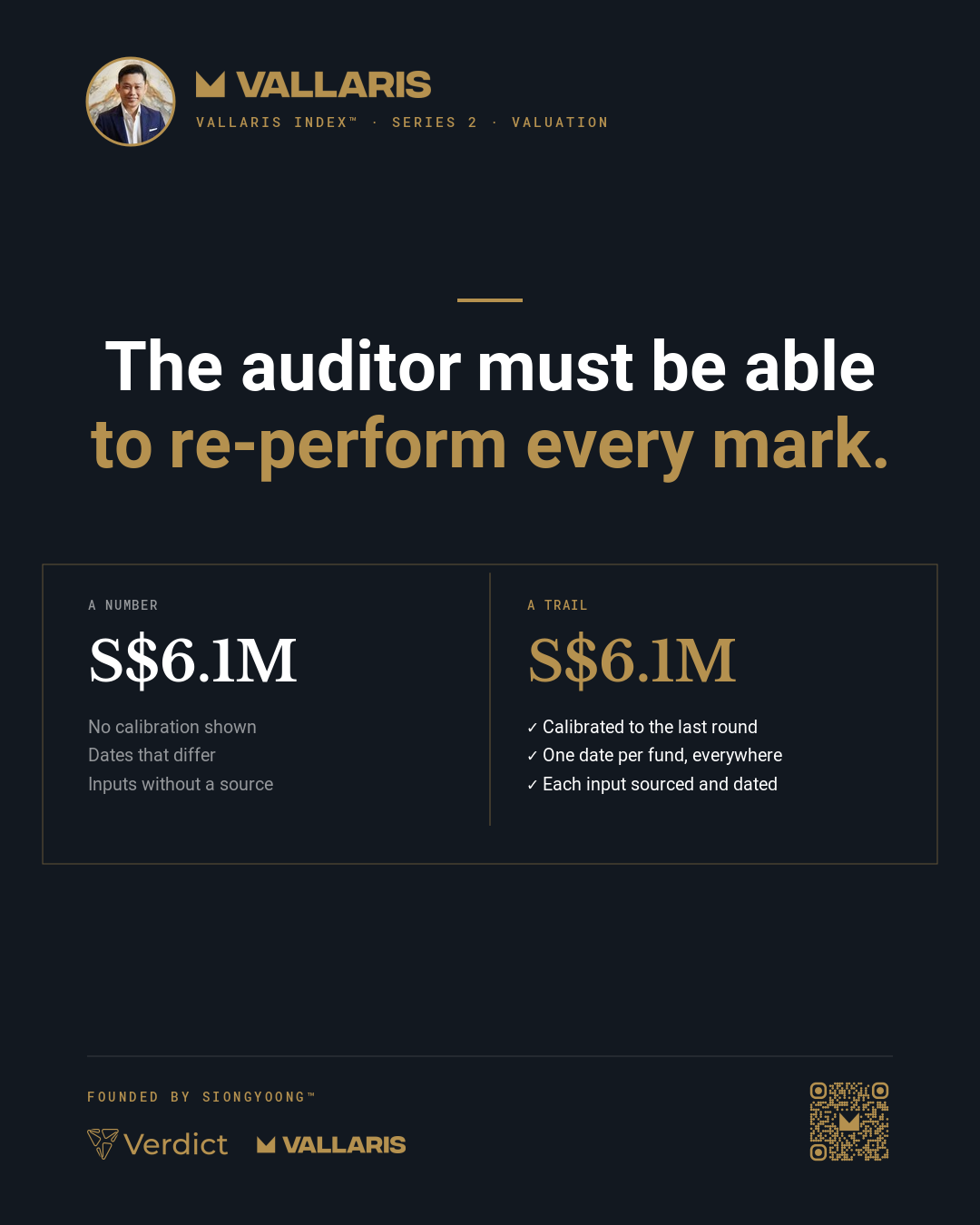
The auditor must be able to re-perform every mark from the report and the model. When I review a set of marks, these are the first places I look. Check yours before anyone else does.
- One date per fund, everywhere. The engagement letter, the report and the model carry the same valuation date for each fund.
- The calibration is shown. For every holding valued with unobservable inputs, the model returns the entry price or the last orderly round at its date.
- The cap table ties to the signed investment documents and the fund’s register, fully diluted.
- The allocation adds up to the equity value, and every senior class’s preference is honoured.
- Every input is sourced and dated: volatility, term, risk-free rate, peer multiples.
- The movement since last quarter is explained, investment by investment.
- The Level 3 table is there: the significant unobservable inputs, in numbers, and how sensitive the mark is to them. Your fund needs it for its own SFRS(I) 13 disclosures.
A worked example
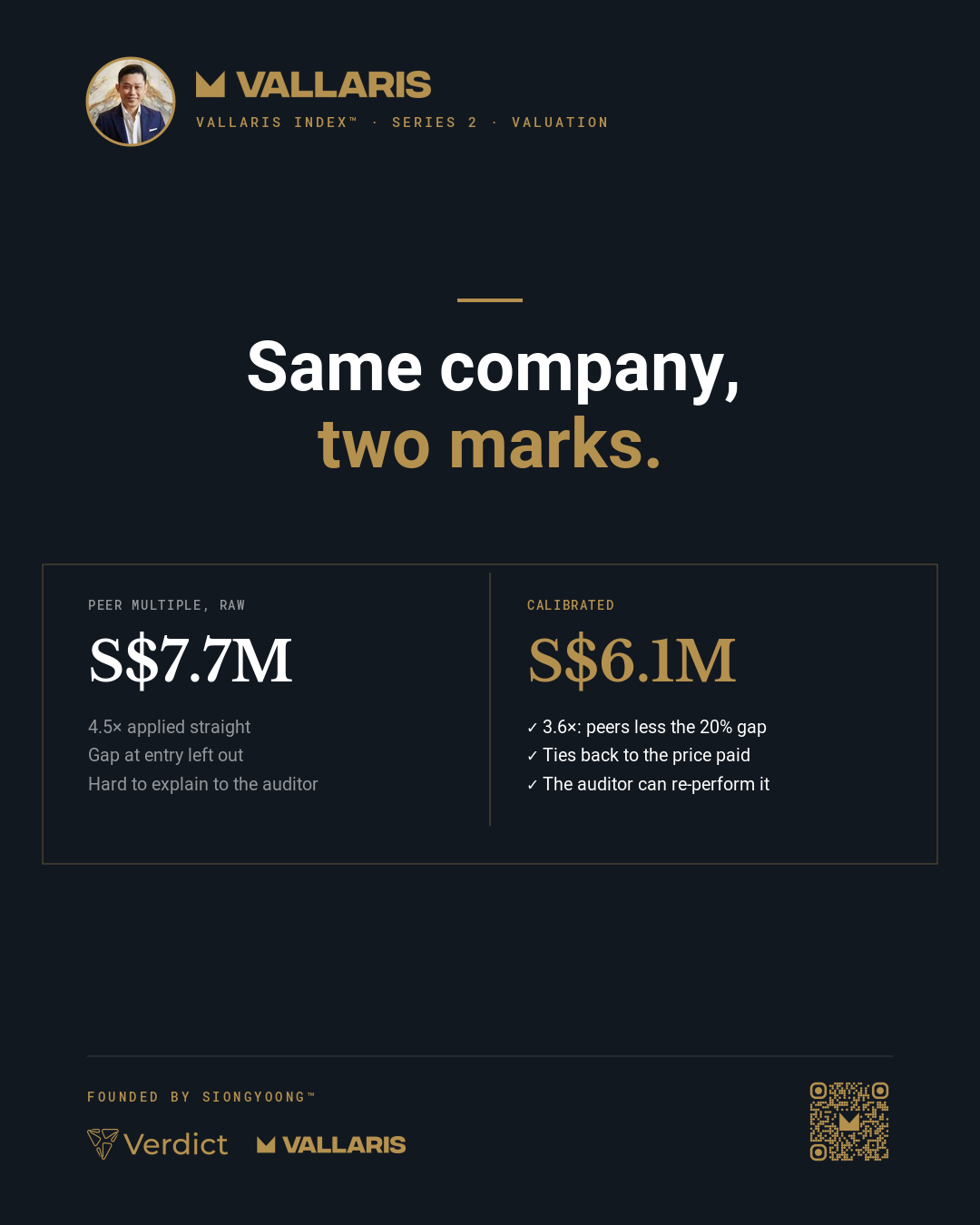
Illustrative figures, chosen to show the arithmetic only. They are not a market range for any sector.
At entry, 31 March 2025. Your fund pays S$5.0 million for Series B preference shares: 12.5% of the company, fully diluted. The company has S$10.0 million of revenue over the last twelve months, no debt and no surplus cash. The round implies an enterprise value of S$40.0 million, or 4.0 times revenue. Listed peers trade at 5.0 times. Calibrated gap: 20% below peers.
At the reporting date, 30 September 2026. Revenue has grown to S$14.0 million. Peers have moved to 4.5 times. Growth against peers has not changed, so the 20% gap stays: 3.6 times.
- Enterprise value: 3.6 × S$14.0 million = S$50.4 million.
- Less S$4.0 million of venture debt, repaid on a sale, plus S$2.4 million of surplus cash: equity value of S$48.8 million.
- For the arithmetic, every class would convert in a sale at this value, so the split is pro rata: 12.5% of S$48.8 million is S$6.1 million.
The mark moves from S$5.0 million to S$6.1 million, and every step ties back to the price you paid.
Now skip the calibration. Apply the peer multiple of 4.5 times straight to S$14.0 million, and the same bridge gives S$7.7 million. Same company, two marks. The difference of S$1.6 million is the 20% gap the buyer priced in at entry, and it is the first thing your auditor will ask about.
Near the preference stack, the split would not be pro rata, and an option pricing or scenario method can move the answer a long way. That is where most of the judgement in a venture portfolio sits.
What moves the mark
From both sides of the table, these move a mark most:
- Performance against plan. Revenue, cash burn and customer take-up, measured against what the round was priced on.
- The market. Peer multiples and discount rates, at the measurement date.
- A new round, and its terms. An orderly round with new outside investors carries the most weight. An insider round in proportion to existing holdings, a strategic investor or new preference rights each carry less.
- Cash runway and the next round. How long the cash lasts, and what the company will need to raise before an exit.
- Debt and preferences. Venture debt, payoff terms and liquidation preferences decide how much of the company value reaches your class.
- Currency. Holdings are translated at the bid spot rate at the measurement date.
- Sustainability effects that are known or knowable at the date, in the cash flows, the rate or the choice of peers.
What does not move it: a discount for marketability. The 2025 IPEV Guidelines say a discount for marketability, meaning the time it takes to complete a sale, is not appropriate. Differences in liquidity are already captured by calibrating to the price you paid. Transaction costs are not deducted either (SFRS(I) 13, paragraph 25).
The standards behind it
- IPEV Valuation Guidelines, December 2025 edition, published 11 December 2025 by the IPEV Board. In effect for quarterly reporting periods beginning on or after 1 April 2026, with early adoption encouraged. They replace the 2022 edition. Where IPEV and the law, regulation or accounting standard differ, the law, regulation or standard wins.
- SFRS(I) 13 Fair Value Measurement, Singapore’s version of IFRS 13, with SFRS(I) 9 for when cost may stand in for fair value, and SFRS(I) 10 for investment entities, which measure their subsidiaries at fair value instead of consolidating them. All three as applicable for annual periods beginning on 1 January 2026.
- International Valuation Standards, issued by the International Valuation Standards Council (IVSC), effective 31 January 2025.
- BU-004, the practice bulletin for Chartered Valuer and Appraiser holders on valuing pre-revenue and loss-making companies (13 May 2026), and PN-001, the practice note on minimum requirements for performing valuations and issuing business valuation reports. Both are published on ACRA’s business valuation resources page.
- The Monetary Authority of Singapore’s information paper, Valuation Practices for Fund Management Companies (published 29 May 2026). It says fund managers must ensure independent valuation of the assets they manage, either by a third party such as a fund administrator, or by an in-house valuation function kept separate from portfolio management. A manager that engages an external valuer should document why, assess the valuer’s independence, expertise and qualifications, and check from time to time that the arrangement works as intended.
- For a variable capital company (VCC), the Variable Capital Companies Act 2018 requires the VCC’s property to be measured on a fair value basis (section 19(1)(c)). Net asset value is total assets less total liabilities, determined under the Accounting Standards (section 2(1)).
Questions fund managers ask
What are the IPEV Valuation Guidelines?
The International Private Equity and Venture Capital Valuation Guidelines set out recommended practice for measuring the fair value of private capital investments, under IFRS 13 and SFRS(I) 13. The current edition is December 2025, in effect for quarterly periods beginning on or after 1 April 2026. Most auditors and LPs expect funds to follow them.
How often should portfolio companies be valued?
At every date the fund reports net asset value to its investors, commonly quarterly or half-yearly, as the fund documents set out. Not every holding needs a full valuation each time. An approach paper agreed with your auditor decides which holdings get a full valuation and which get a roll-forward, but every holding still gets a fair value conclusion.
How long does a valuation take?
About three weeks from receiving the information to the draft, then about a week to finalise.
Can we keep an investment at cost?
Only in limited cases, and only with reasons. SFRS(I) 9 lists the signs that cost no longer stands in for fair value, such as a significant change in performance against budget, plans or milestones, or in the market for the company’s shares or products. Calibration to the price you paid, rolled forward, is usually the better answer.
Is the last round price our fair value?
On the day of the round, often yes. Later, it is a starting point, not an answer. Its weight falls with time, with a change in the market, and when the round was an insider round, a rescue, or carried new rights. It also prices only the class that was bought.
Do we deduct a discount for lack of marketability?
No. The 2025 IPEV Guidelines say a discount for marketability is not appropriate, and SFRS(I) 13 does not permit a blockage discount for the size of a holding. The illiquidity of a private holding is already in the price you paid, and calibration carries it forward.
Do we need an independent valuer?
MAS expects fund managers to ensure independent valuation: by a third party, or by an in-house team kept separate from the people who manage the portfolio. A manager that engages an external valuer documents why, and checks the valuer’s independence, expertise and qualifications. Many fund managers use an independent valuer for the marks that matter most, or to review their own quarterly marks. A review is labelled a review, and gives no valuation opinion.
Sources
- IPEV Board — International Private Equity and Venture Capital Valuation Guidelines, December 2025. In effect for quarterly reporting periods beginning on or after 1 April 2026.
- ACRA Accounting Standards Committee — SFRS(I)s effective for annual reporting periods beginning on 1 January 2026. SFRS(I) 13, 9 and 10.
- Monetary Authority of Singapore — Valuation Practices for Fund Management Companies. Information paper, published 29 May 2026.
- Singapore Statutes Online — Variable Capital Companies Act 2018. Sections 2(1) and 19(1)(c).
- ACRA — Business valuation resources. BU-004 (13 May 2026) and PN-001.
General information only, not valuation, legal, accounting or tax advice. Worked figures are illustrative and are not a market range for any sector.