
In short: A purchase price allocation splits what you paid for a business across everything you acquired, at fair value on the acquisition date, under SFRS(I) 3. Customers, brands, order books and stock are valued one by one. Goodwill is what is left, so it is only as reliable as every number before it, and the auditor rebuilds it from your numbers.
You bought a company. The price is agreed, the money has moved, and the deal team has gone home.
Now the accounts have to say what you bought.
Your auditor will take the price apart, asset by asset: the customers, the brand, the order book, the stock, the earn-out. Whatever cannot be named and valued separately becomes goodwill.
So goodwill is never the starting point. It is what is left. Get every other number right first, with a source behind each one, and goodwill takes care of itself.
This guide shows how that is done in Singapore.
When you need one
SFRS(I) 3 Business Combinations requires an allocation whenever you gain control of a business. Four moments bring it to the CFO’s desk:
- You have completed an acquisition. The first year-end after completion needs the allocation in the consolidated accounts.
- You have bought more of a company you already part-owned. Crossing into control counts as an acquisition, and the stake you already held is remeasured at fair value.
- You are listed, or about to be. A circular, a prospectus or the annual report will carry the acquisition accounting.
- Your auditor has asked for it. Often at the planning meeting for the first audit after the deal.
Two dates matter. The acquisition date is the day you gained control, and every fair value is measured on that day. The measurement period runs for no more than one year from it. You may report provisional amounts at your first year-end and finalise them later, but only for facts that existed at the acquisition date.
One question comes before any number, and only management can answer it: did you buy a business, or a group of assets? The standard asks whether you acquired inputs and a substantive process. An optional concentration test settles many cases quickly. If substantially all the value sits in one asset, such as a building, it is an asset purchase, and no goodwill arises.
What a purchase price allocation is
A purchase price allocation, or PPA, splits what you paid across everything you acquired, at fair value on the acquisition date.
Four pieces of arithmetic sit underneath it:
- The consideration. Everything you gave: cash at completion, deferred payments, shares and any earn-out, each at fair value.
- The identifiable assets and liabilities. The target’s balance sheet, remeasured to fair value, plus the intangible assets that were never on it.
- Deferred tax. The tax effect of every step-up.
- Goodwill. The consideration, less the identifiable net assets.
Goodwill is never valued directly. It is the residual, so it is only as reliable as every number above it.
Fair value here is an exit price: what market participants would pay, not what you were willing to pay. Savings only your group can make belong in goodwill, not in the value of the assets.
What you bought that was never on the balance sheet
The target’s accounts show what it built and bought. They rarely show why you paid more than book value. The standard’s illustrative examples sort them into five groups. Work through all five, and write down why each one was or was not recognised:
- Marketing. Trade names, domain names, non-compete agreements.
- Customer. Customer contracts and relationships, order backlog, customer lists.
- Artistic. Content, images, music.
- Contract-based. Licences, franchises, supply or lease terms better than the market.
- Technology. Software, patented and unpatented technology, databases, trade secrets.
An intangible is recognised if it can be separated and sold, or arises from a contract or a legal right. Order backlog is recognised even where the orders can be cancelled. A customer relationship can exist without a current contract, where the target is in regular contact with the customer.
One asset is never recognised: the assembled workforce. Its value sits in goodwill.
Each asset gets the method that fits it:
- Excess earnings (the multi-period excess earnings method) for the asset that drives a revenue stream, usually customer relationships. The cash flow is charged a return for every other asset that helps earn it.
- Relief from royalty for trade names and technology: the royalty you would pay to license the asset if you did not own it.
- With and without for non-compete agreements: the profit the agreement protects.
- Cost only where no other approach works, such as software built for internal use.
How it is done, step by step
- Read the sale and purchase agreement. Every part of the consideration, the percentage acquired, the completion date and any payments to sellers who stay on. A payment the seller loses on leaving is pay for future service, not consideration. Deal costs are expensed.
- Fix the opening balance sheet at the acquisition date.
- Value the consideration. An earn-out goes in at fair value, weighted for the chance of each payout and discounted, never at its maximum.
- Identify the intangibles, working through all five groups.
- Value each asset at a discount rate that fits its risk. Backlog is usually less risky than customer relationships, and intangibles are usually riskier than tangible assets.
- Step up the tangible assets. Inventory at its selling price, less the costs to complete and sell it and a profit for that effort. Property and equipment at fair value.
- Record deferred tax on the step-ups.
- Calculate goodwill, then reconcile three rates: the deal’s internal rate of return (IRR), the weighted average cost of capital (WACC) and the weighted average return on assets (WARA). Goodwill should carry the highest implied rate.
- Write the report the auditor will read, with every source shown.
A worked example
Illustrative figures, for the arithmetic only. A Singapore group buys 100% of a distributor.
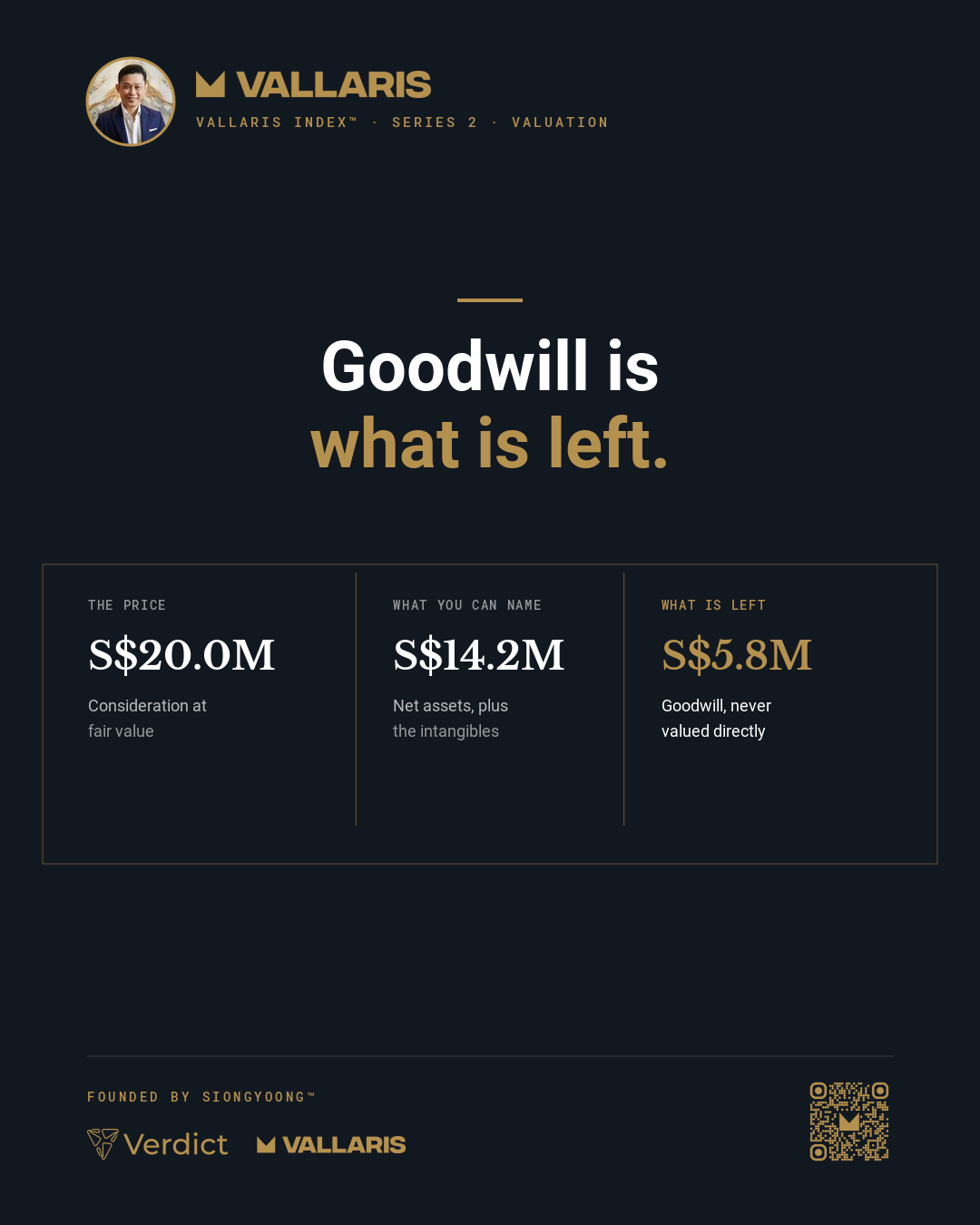
- Consideration. S$17.0 million cash at completion, plus an earn-out of up to S$4.0 million over two years. Weighted for the chance of each payout and discounted, the earn-out’s fair value is S$3.0 million. Total consideration: S$20.0 million.
- Book net assets at the acquisition date: S$8.0 million.
- Step-ups. Customer relationships S$5.0 million. Trade name S$1.5 million. Order backlog S$0.5 million. Inventory S$0.5 million above book. Total: S$7.5 million.
- Deferred tax at Singapore’s 17% corporate rate on S$7.5 million: S$1.3 million, rounded.
- Identifiable net assets: S$8.0 million plus S$7.5 million, less S$1.3 million: S$14.2 million.
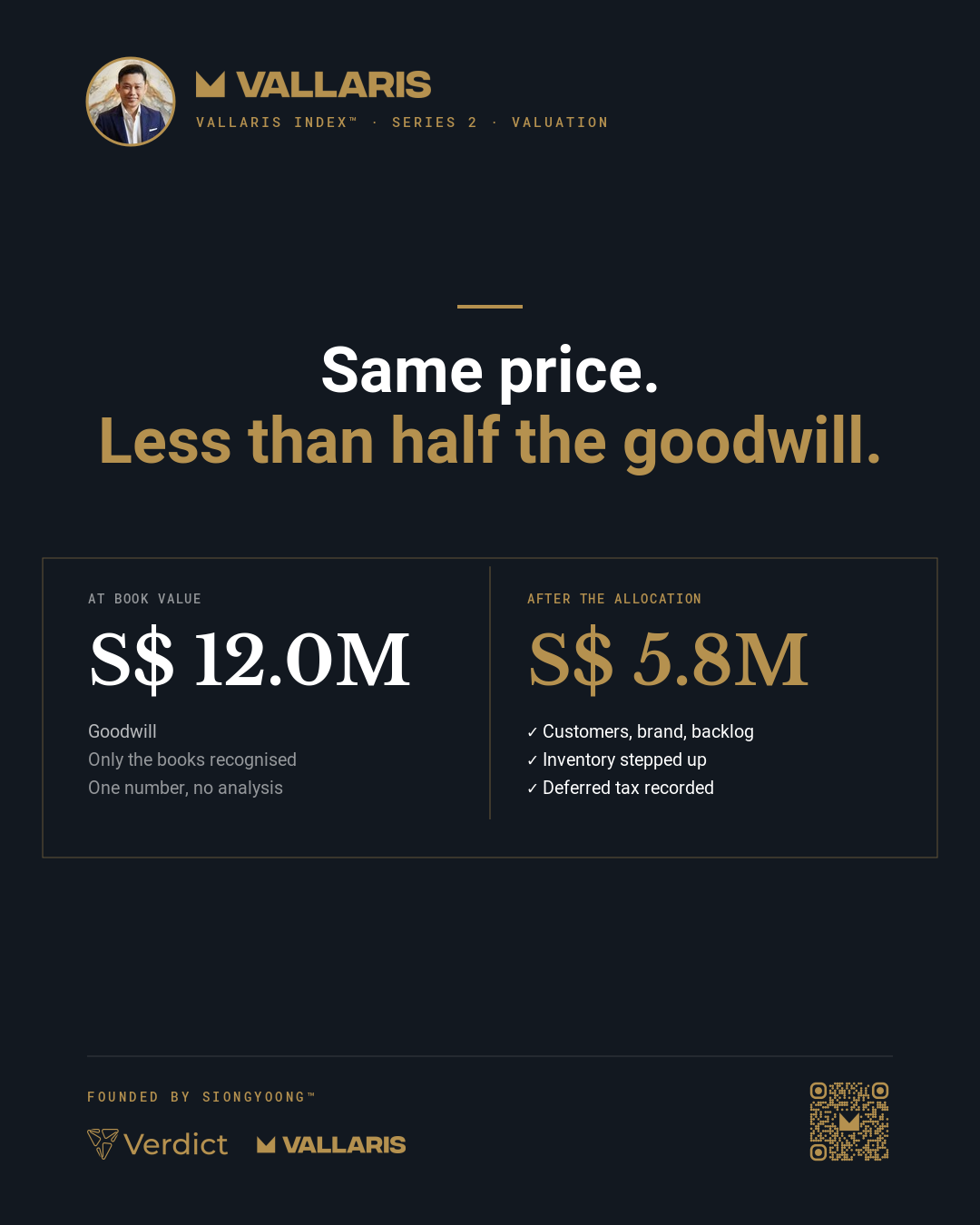
- Goodwill: S$20.0 million less S$14.2 million: S$5.8 million.
Take the books as they stood and goodwill would be S$12.0 million. Same price. Less than half the goodwill.
The split reaches your profit. Customer relationships, backlog and, usually, the trade name have finite lives, so they are amortised year by year. Goodwill is not amortised; it is tested for impairment every year. The allocation shapes your reported earnings for years after the deal.
Had the earn-out gone in at its S$4.0 million maximum, goodwill would rise by S$1.0 million, and the auditor would ask why.
What the auditor checks first
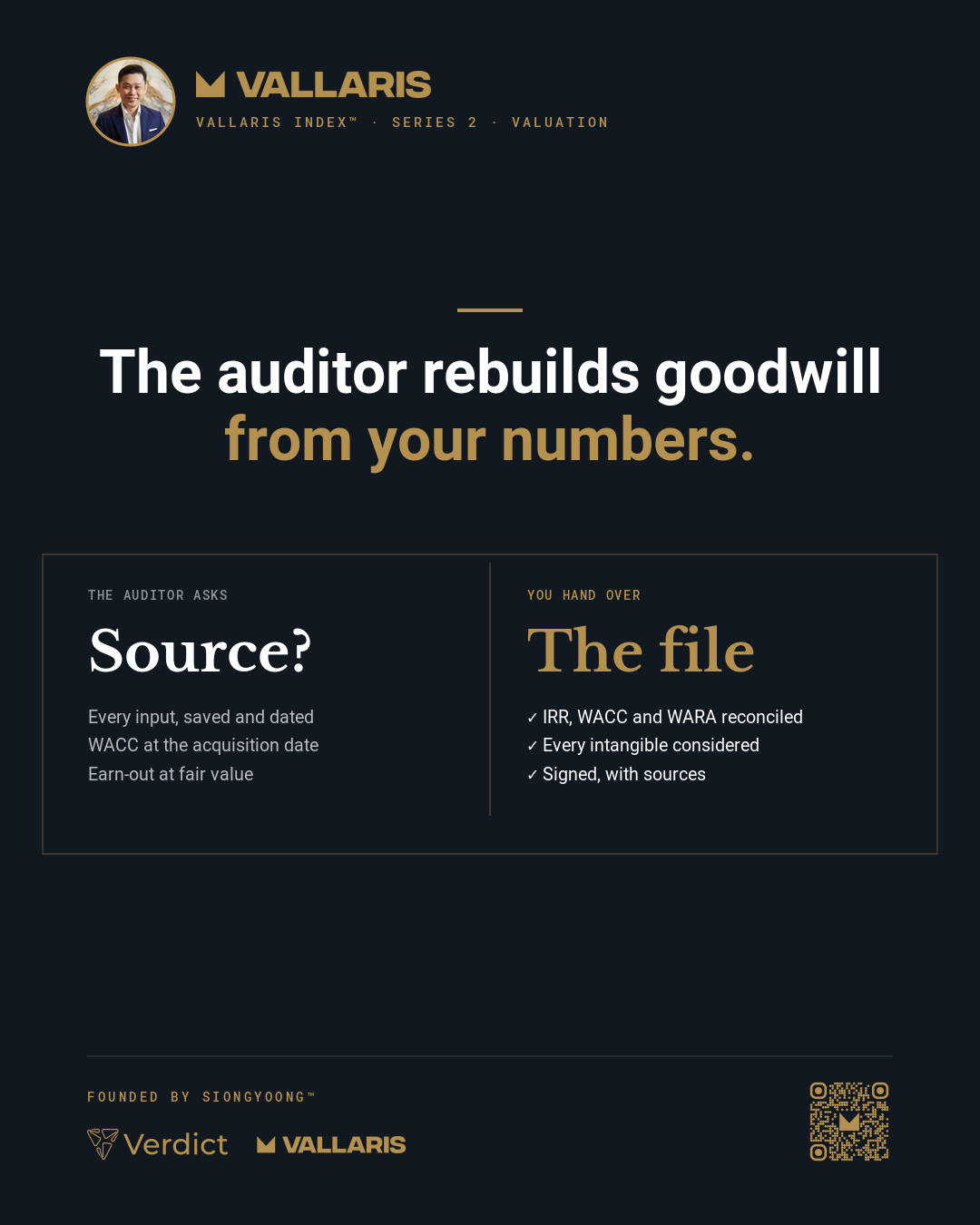
The auditor rebuilds goodwill from your numbers. When I answer an auditor’s queries on a PPA, these are the first places they look. Check yours before they do.
ACRA’s own reviews point to the same places. Its Financial Reporting Surveillance Report 2024 (March 2025) lists three common findings in acquisition accounting from a decade of reviews: measuring assets and liabilities at fair value on the acquisition date, measuring the consideration, and recognising intangibles separately from goodwill.
- Every part of the consideration is in, at fair value. Deferred and contingent payments discounted, consideration shares included, the percentage acquired applied once.
- The discount rate is dated at the acquisition date, with current market data and a size premium sourced for this company.
- Every intangible was considered, with a written reason for each one recognised or not. A services company that recognises no customer relationships needs to say why.
- The three rates reconcile. IRR, WACC and WARA agree within a set tolerance, and goodwill carries the highest implied rate.
- A gain is reviewed before it is booked. If goodwill comes out negative, a bargain purchase, the standard requires every asset, liability and part of the consideration to be reassessed first, and the review written down.
- Every figure has a saved source. An auditor may ask for the source of a financing rate long after the work is done. Save it on the day.
What moves the result
- The earn-out. Fair value, not the cap. Later changes in the value of an earn-out paid in cash go to profit or loss, not to goodwill, so the estimate at the acquisition date matters.
- Customer attrition. How quickly customers leave sets the life, and most of the value, of customer relationships. It should come from the target’s own customer data.
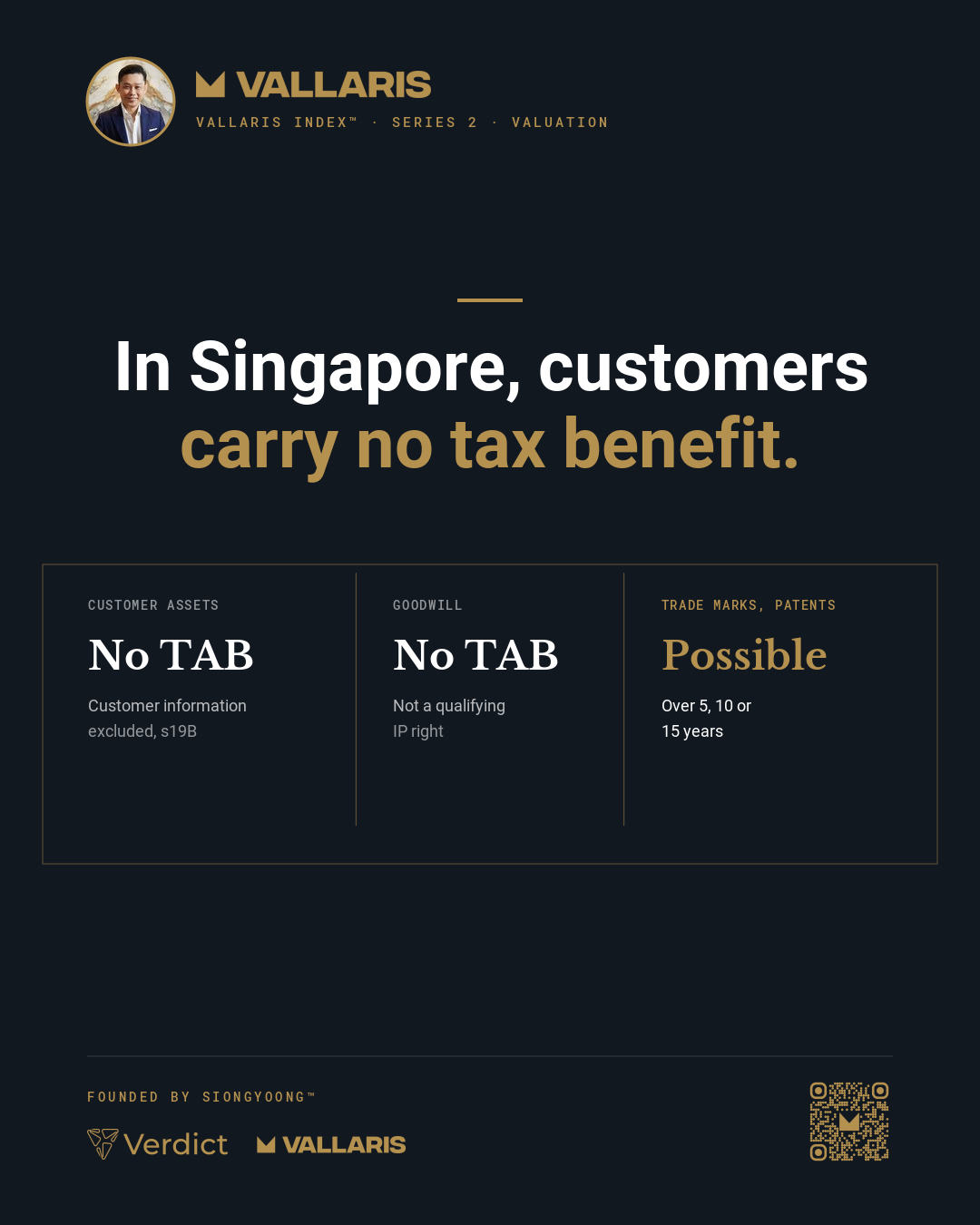
- Tax amortisation benefit. Under IVS 210, an income-approach value for financial reporting generally includes the tax saving a buyer of that asset would get from amortising it. In Singapore, writing-down allowances under section 19B of the Income Tax Act 1947 cover only qualifying intellectual property rights, and the Act excludes customer information. In Singapore, customers carry no tax benefit. A qualifying trade mark or patent may, over a writing-down period of 5, 10 or 15 years, for rights acquired by the end of the basis period for Year of Assessment 2028. Apply the tax law of the country where the asset is taxed.
- Non-controlling interest. Buy less than 100% and management chooses, deal by deal, to measure the rest at fair value or at its share of net assets. The choice changes goodwill.
- A stake you already held. In a step acquisition it is remeasured at fair value at the acquisition date, any gain or loss goes to profit or loss (or to other comprehensive income, where that is how the stake was held), and the remeasured stake enters the goodwill calculation.
- Leases. Where the target rents its premises, the lease liability is measured as if the lease were new at the acquisition date.
The standards behind a Singapore PPA
- SFRS(I) 3 Business Combinations, in the Accounting Standards Committee’s 2026 volume, with SFRS(I) 13 Fair Value Measurement for the meaning of fair value and SFRS(I) 1-38 Intangible Assets for useful lives. Paragraph numbers match IFRS 3, IFRS 13 and IAS 38. Companies reporting under FRS use FRS 103 and FRS 113 instead.
- SFRS(I) 1-36 Impairment of Assets, for the yearly goodwill test that follows.
- International Valuation Standards, issued by the International Valuation Standards Council (IVSC), effective 31 January 2025, including IVS 210 Intangible Assets, with its section 110 on tax amortisation benefit. The basis of value is Fair Value as IFRS 13 defines it.
- IVAS GN-003, Valuation of Intangible Assets: Key Focus Areas and Guidance, from the Institute of Valuers and Appraisers, Singapore (announced 26 August 2026), and IVAS PN-001, Minimum Requirements for Performing Valuations and Issuing Business Valuation Reports (1 December 2021). A CVA is expected to follow a Practice Note, and to follow a Guidance Note or explain any departure.
- Section 19B of the Income Tax Act 1947, with the IRAS e-Tax Guide on valuation reports for IPRs under section 19B (second edition, 30 January 2026) and IVAS GN-002, Valuation of Intellectual Property Rights for Section 19B of the Singapore Income Tax Act 1947 (7 August 2026), wherever a writing-down allowance is in play.
- What is changing. In March 2024 the International Accounting Standards Board proposed new disclosures on how acquisitions perform after the deal, and changes to the goodwill impairment test (Business Combinations—Disclosures, Goodwill and Impairment). At its 23 September 2026 meeting it was still redeliberating; its next step is to decide the project’s direction. The IVSC has also consulted on a new edition of the IVS, proposed to take effect on 31 January 2028.
Questions owners ask
What is a purchase price allocation?
The split of the price you paid for a business across the assets and liabilities you acquired, each at fair value on the acquisition date. Whatever is left is goodwill. SFRS(I) 3 requires it whenever you gain control of a business.
When does the PPA need to be finished?
Ideally before the first year-end audit after completion. If it is not complete by then, you may report provisional amounts and finalise them within one year of the acquisition date, adjusting only for facts that existed on that date.
Why not put the whole difference into goodwill?
The standard requires every identifiable intangible to be recognised separately. An auditor will ask for the analysis behind a single goodwill number, and the split changes your profit for years, because most intangibles are amortised and goodwill is not.
Who should prepare a purchase price allocation?
Management is responsible for the accounts. Most acquirers engage an independent valuer for the fair values, because the auditor will test them, often with its own valuation specialists. The valuer should follow the IVS and sign the report.
How long does a PPA take?
About three weeks from receiving the information to the draft report, then about a week to finalise it. Start as soon as the deal completes, and agree the timetable with your auditor so the report is signed before audit fieldwork begins.
Can I claim tax deductions on the intangibles?
In Singapore, writing-down allowances under section 19B apply to spending on acquiring qualifying intellectual property rights, such as patents, trade marks and copyright, not to customer information or goodwill. The company must hold the rights as assignee, so buying the shares of the company that owns them is not, on its own, spending on the rights. From Year of Assessment 2026, IRAS requires a valuation by an appropriate valuer where the spending on the rights is S$40 million or more from an unrelated party, or S$10 million or more from a related party. Confirm the position with your tax adviser.
How much does a PPA cost?
The fee follows the number of assets to value, the structure of the consideration and the auditor’s review. VALLARIS™ quotes a fixed fee in writing after the first conversation, which has no fee.
Sources
- Accounting Standards Committee — SFRS(I) 2026 volume: SFRS(I) 3, 13, 1-36 and 1-38. Measurement period of up to one year (SFRS(I) 3 para 45); concentration test (B7A–B7B); five groups of intangibles (IE16–IE44); paragraph numbers match IFRS.
- ACRA — Financial Reporting Surveillance Report 2024. Fifth report, March 2025: common findings in acquisition accounting, p. 7.
- IFRS Foundation — Business Combinations—Disclosures, Goodwill and Impairment. Exposure Draft March 2024; redeliberating at the 23 September 2026 meeting; next step: decide the project direction.
- IVSC — International Valuation Standards. Effective 31 January 2025; IVS 210 section 110 on tax amortisation benefit. Next edition proposed effective 31 January 2028.
- ACRA (IVAS practice guides) — Business valuation resources: PN-001, GN-002 and GN-003. PN-001 dated 1 December 2021; GN-002 dated 7 August 2026; GN-003 announced 26 August 2026.
- Singapore Statutes Online — Income Tax Act 1947, section 19B. Writing-down period of 5, 10 or 15 years (s19B(1AA)); customer information excluded (s19B(11A)); rights acquired up to the basis period for YA 2028 (s19B(10)(aa)).
- IRAS — e-Tax Guide: IPRs Valuation Report for Purposes of Section 19B (second edition). Published 30 January 2026; valuation required at S$10M or more (related party) or S$40M or more (unrelated party), para 5.1.2, from YA 2026.
- IRAS — Corporate income tax rates. 17% flat rate, used in the worked example.
General information only, not valuation, accounting, legal or tax advice. Worked figures are illustrative. Confirm the accounting with your auditor and the tax position with your tax adviser.