
In short: A share-based payment valuation sets the fair value of each option or share award on the day it is granted. In Singapore it follows SFRS(I) 2 or FRS 102, and the International Valuation Standards. That one number becomes the expense in your accounts for years, so the inputs behind it, from expected life to volatility, are what your auditor tests first.
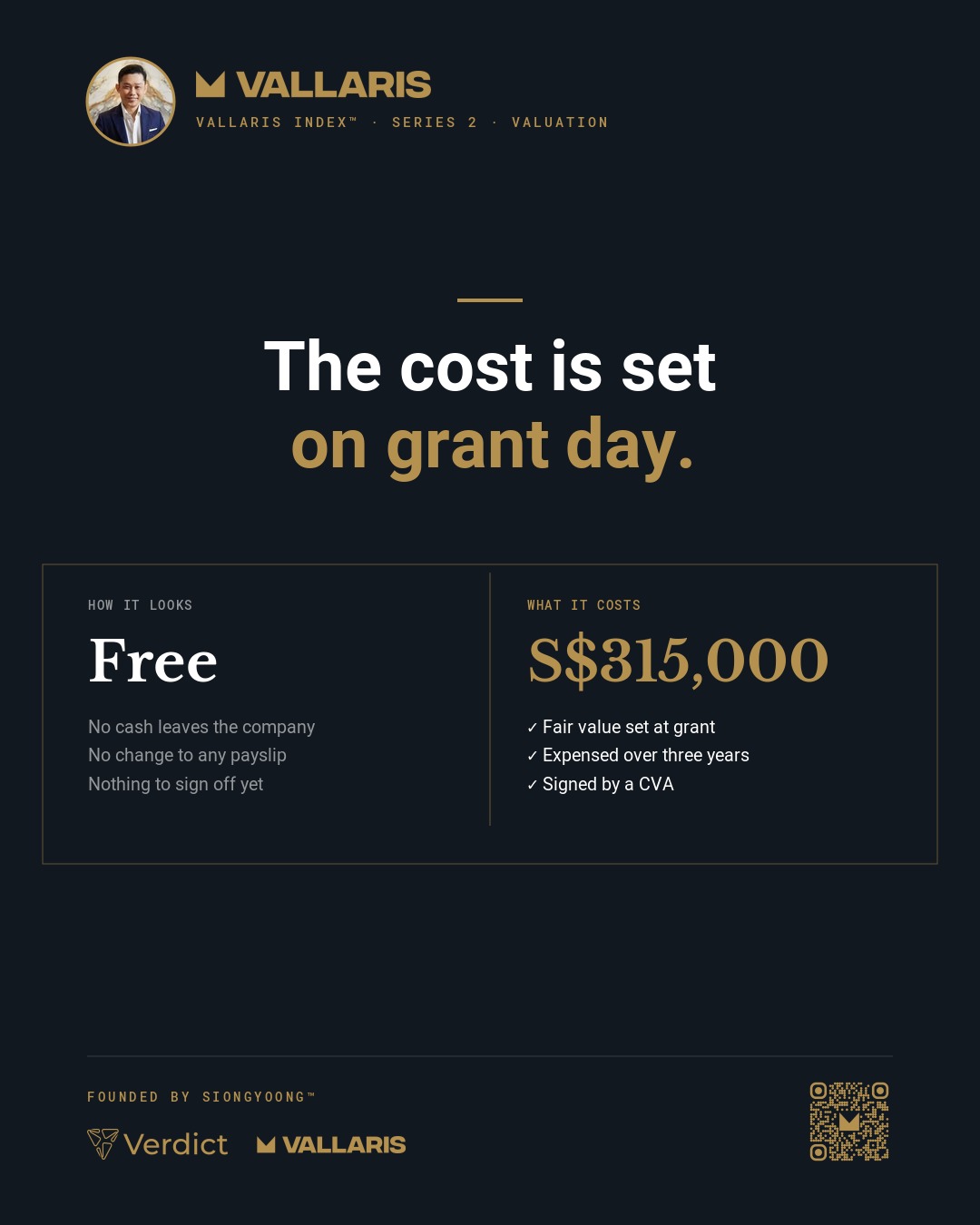
An option feels free when you grant it. No cash leaves the company. Nobody’s payslip changes.
Your accounts see it differently. Under SFRS(I) 2, every option, restricted share and performance share is a cost. It is measured at fair value on the day you grant it, and spread over the years your people earn it.
So the cost is set on grant day. The auditor’s questions, next year’s expense and the notes to your accounts all run back to that one number, and to the reasoning behind it.
This guide shows how that number is built in Singapore.
When you need one
Five moments, in the order companies usually meet them:
- You grant options or shares to your team. Any ESOP, RSU or performance share plan in audited accounts needs a fair value per award at each grant date.
- Your auditor asks. Usually at the first year end after a grant, often in the weeks before signing.
- You raise a round. A new preference share price changes what your ordinary shares are worth, and so what the next grant costs.
- You change the plan. Repricing, extending, accelerating on a sale or replacing awards is a modification. The extra value is a cost too.
- You prepare to list. The accounts in the prospectus carry every grant from earlier years, and the reporting accountant reads each one.
Gather every grant date, the plan rules and each award letter before anything else. The terms decide the model, and the model decides the answer.
What it is: the price of a promise
A share-based payment valuation puts a fair value on each award at its measurement date. For employees, that is the grant date: the day you and the employee share an understanding of all the terms, after any approval the plan needs. An offer is not yet a grant.
Three points shape everything else.
- Fair value has its own definition here. SFRS(I) 2 sets it out in Appendix A: the amount for which the award could be exchanged between knowledgeable, willing parties in an arm’s length transaction. The standard says this differs in some respects from the general fair value standard, SFRS(I) 13, so SFRS(I) 2’s meaning is the one that counts.
- Awards settled in shares are valued once. An option settled in shares is valued at the grant date and not revalued, whatever the share price does next.
- Awards settled in cash are valued again and again. A phantom share, or a cash bonus tied to the share price, is a liability. It is valued at grant, at every reporting date and at settlement.
The valuer measures fair value. The company does the accounting: the vesting period, how many awards it expects to vest, and the expense each year. A good report keeps that line clear, and says where it relies on a company judgement.
How it is done, step by step
- Read the terms. Plan rules, board minutes and every award letter. One line per grant date and per vesting instalment, because each instalment has its own expected life, and an option’s value does not rise in a straight line with time.
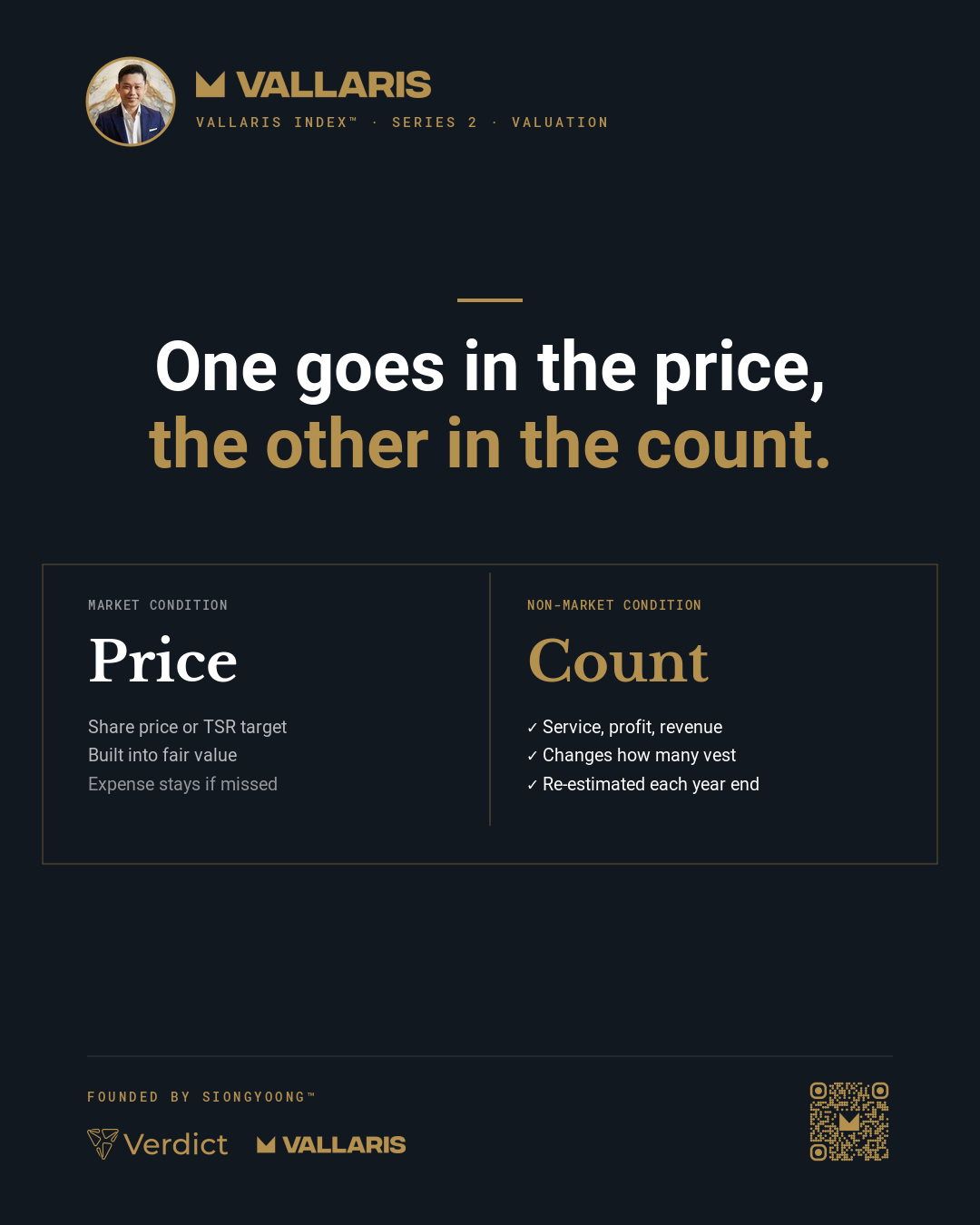
- Sort the conditions. A target tied to your share price, such as total shareholder return, is a market condition. Service, and profit or revenue targets met while the holder is still employed, are non-market conditions. One goes in the price, the other in the count. Market conditions are built into fair value, so if the target is missed but the service is given, the expense stays. Non-market conditions change how many awards the company expects to vest, which it re-estimates at every year end.
- Set the share price at the grant date. For a listed company, the market price. For an unlisted company, a valuation of the equity, allocated across the share classes so ordinary shares never carry the preference share price.
- Choose the model. Black-Scholes suits a plain option, with an expected life input. Where early exercise or a share price target matters, a binomial lattice or a Monte Carlo simulation does the work.
- Source every input at the grant date. Exercise price, expected life, volatility, dividends and the risk-free rate, each with its source and its date.
- Test the model, then report. Check the model against a known case. Report the value per award, per grant date and per tranche, with sensitivities.
The rule behind every step: your auditor should be able to rebuild each award’s value from the report alone.
A worked example, for the arithmetic only
Illustrative figures throughout, chosen to show the steps. They are not a benchmark for any company.
An unlisted Singapore company grants 1,000,000 options to 20 employees.
- Share price at grant: S$1.00, from a valuation of the ordinary shares.
- Exercise price: S$1.00.
- Vesting: all at once, after three years of service.
- Contractual life: ten years. Expected life: four years, from how holders like these exercise.
- Volatility: 40%, from comparable listed companies. Risk-free rate: 2.5%. Dividends: none expected.
Black-Scholes gives a fair value of about S$0.35 per option.
The company expects 10% of the options to lapse as people leave before vesting, so 900,000 are expected to vest. The expense is 900,000 × S$0.35 = S$315,000, spread over three years: S$105,000 a year. If more people stay, the count rises and the expense is trued up. The S$0.35 stays where it is.
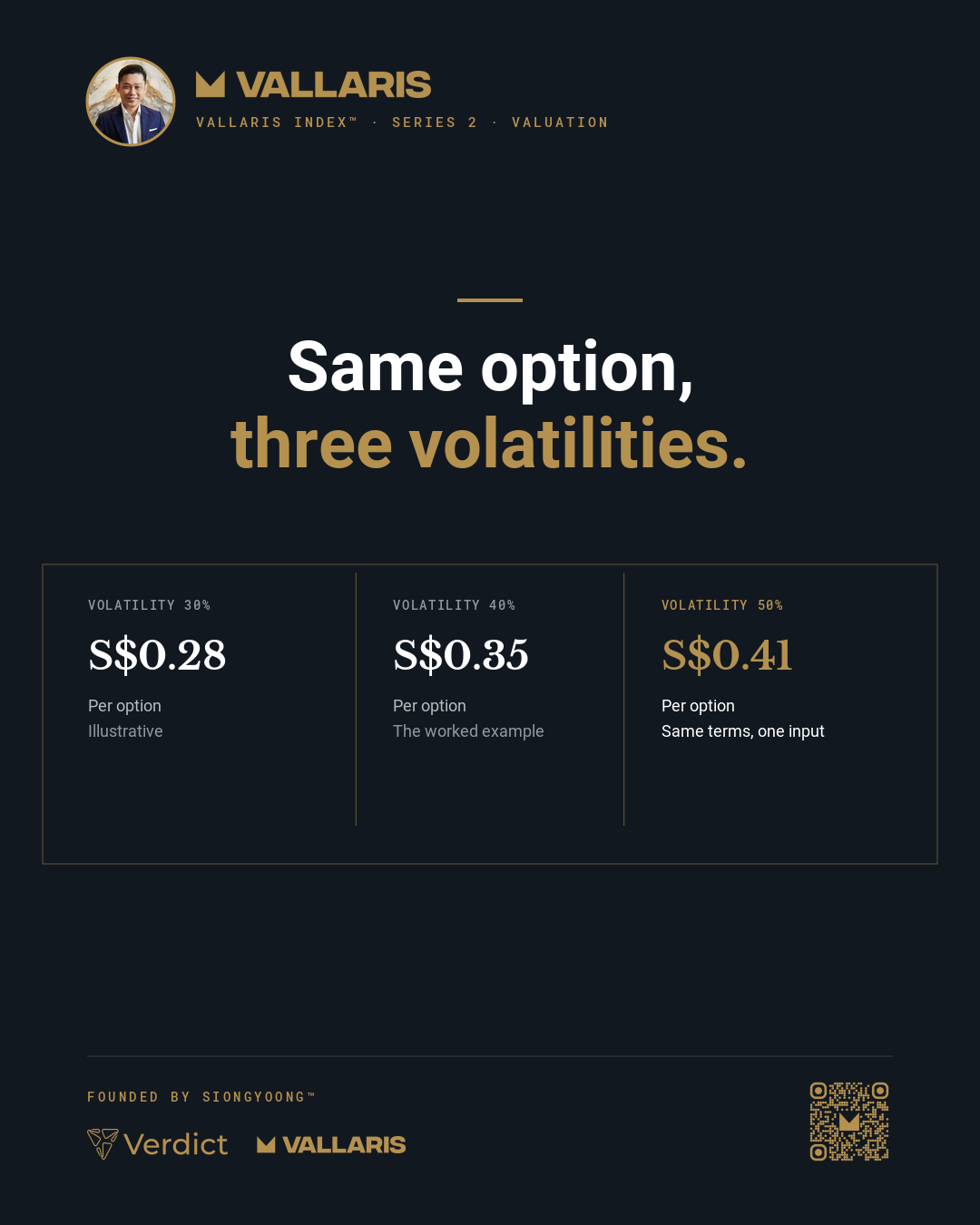
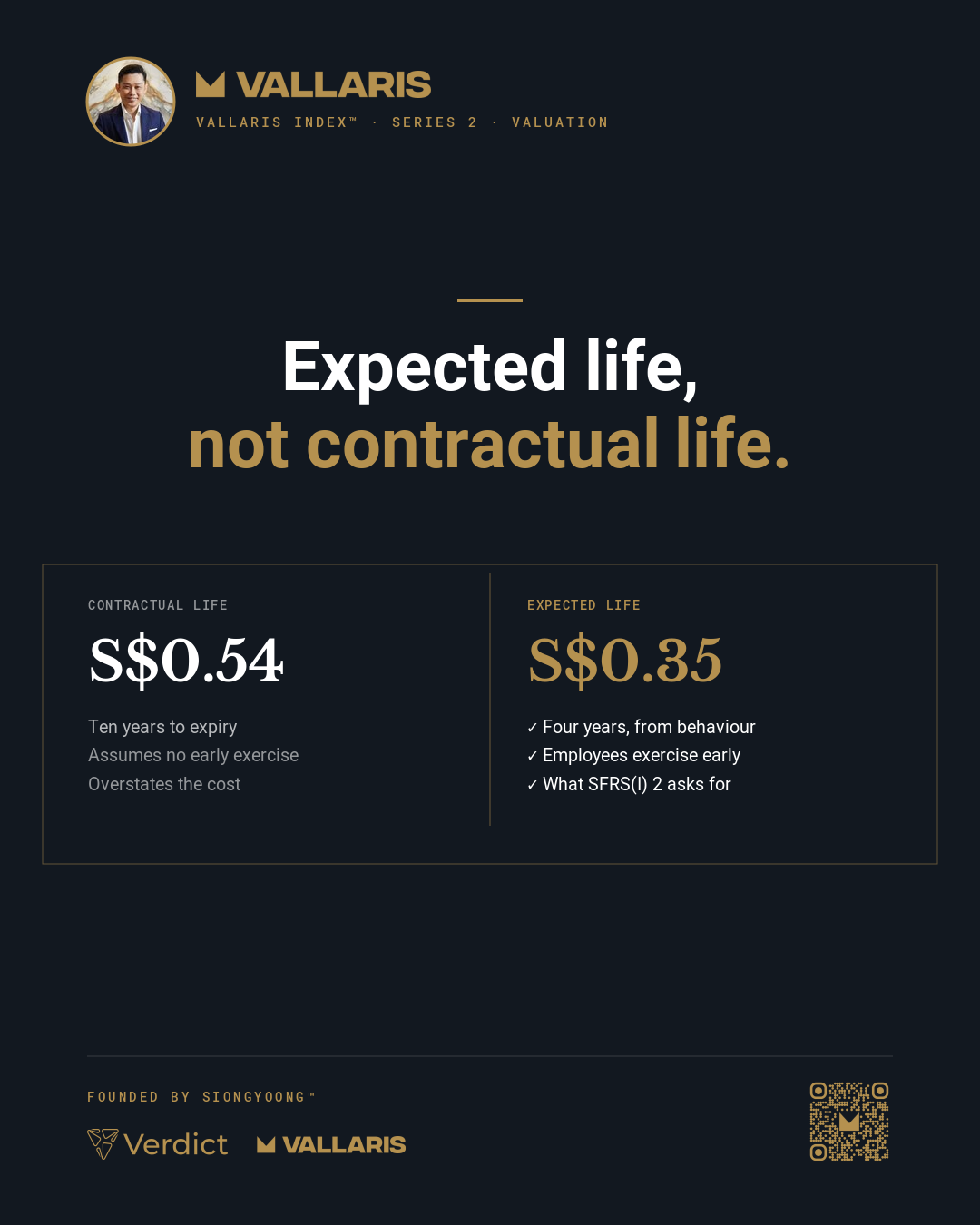
Now change one input at a time. Same option, three volatilities: at 30% the value is about S$0.28; at 40%, S$0.35; at 50%, about S$0.41. Use the ten-year contractual life in place of the four-year expected life and it rises to about S$0.54. Expect a 3% dividend yield and it falls to about S$0.27.
What moves the result
Four inputs carry most of the value. The standard says how each one is set.
- Expected life, not contractual life. Employees exercise early: options cannot be sold, people move on, and holders want to spread their wealth. SFRS(I) 2 asks for the expected life, estimated from the vesting period, past exercise behaviour, the share price, seniority and volatility, for groups of holders who behave alike. One blended life for everyone overstates the total. Where there is no exercise history, some valuers use the mid-point of vesting and expiry. That is the US SEC staff’s “simplified method”, not a rule in SFRS(I) 2, so the report should say so. Where options can only be exercised on a sale or a listing, the expected life reflects when that sale or listing is expected.
- Volatility. The annualised standard deviation of continuously compounded returns, over a period that matches the expected life and ends on the grant date. An unlisted company usually takes it from comparable listed companies, adjusted for stage and borrowing.
- Dividends. Expected dividends lower an option’s value, because the holder does not receive them before exercise. A company that pays none and plans none uses zero. If holders do receive dividends before vesting, there is no deduction.
- The risk-free rate. The yield on zero-coupon government bonds in the exercise price’s currency, for the expected life. For Singapore dollar options, Singapore Government Securities.
Two things the value leaves out. People leaving before vesting belongs in the company’s count, not in the price. And the fact that an employee cannot sell the option is reflected through early exercise, not through a separate discount.
What the auditor checks first
When an auditor reviews an award valuation, these are the first places they look. Check yours before they do.
- The share price fits the class. Ordinary shares priced at the latest preference share price overstate every option.
- The volatility window ends on the grant date. A series that runs past it uses information nobody had that day.
- Every instalment is valued. Awards that vest in stages have more than one expected life, so more than one value.
- Conditions are classified as the standard defines them. A share price target is a market condition; a service or profit target is not.
- Grants are kept apart, and exercise prices are not averaged, unless there is support the auditor will accept.
- Award counts tie between the plan register, the report and the accounts.
- Each instrument is measured at each date. On one engagement, the auditor’s first question was why a preference instrument carried the same price at two valuation dates a year apart. The answer was to measure it again at the second date, and write the reasoning down.
The tax number is a different number
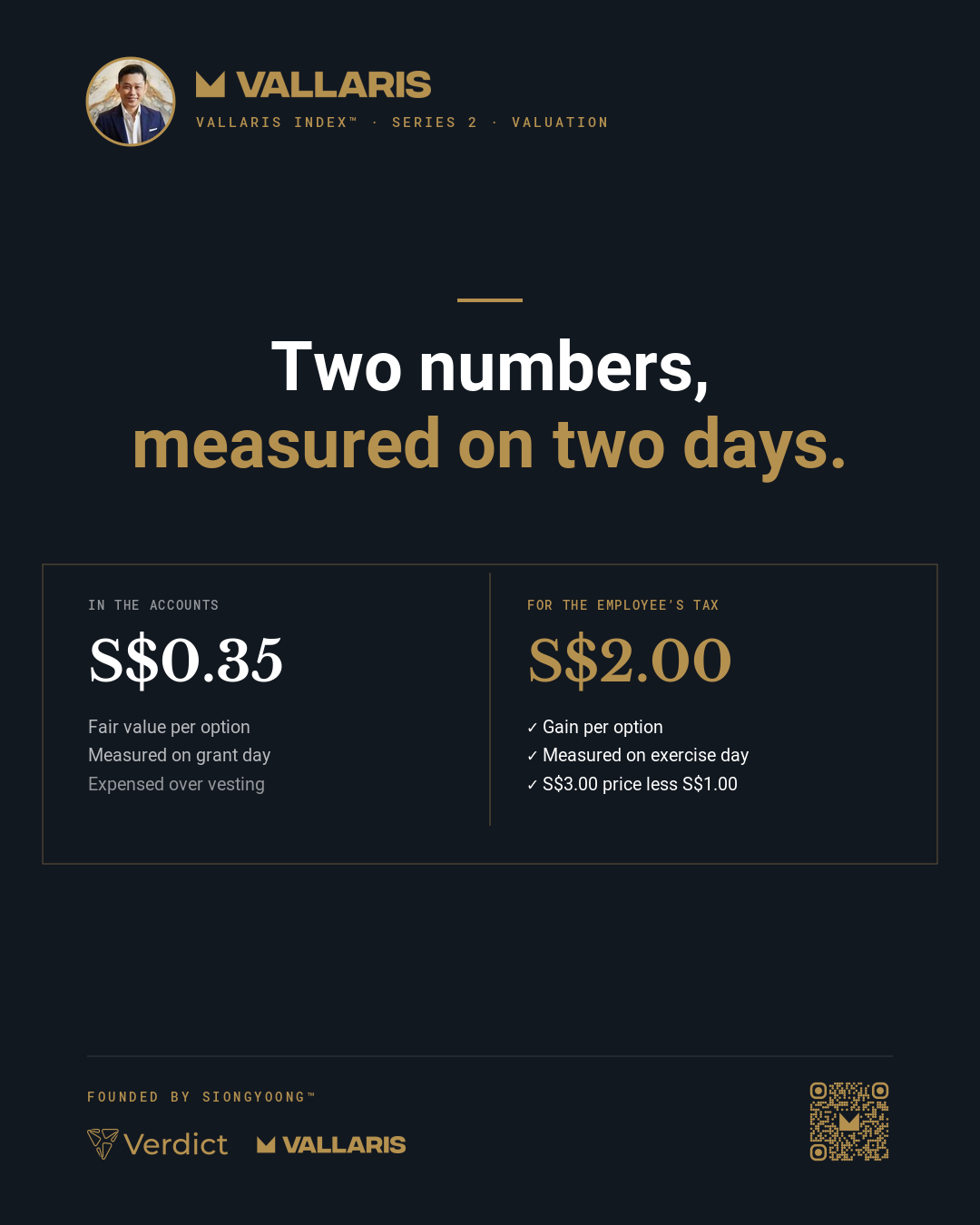
The cost in your accounts and the gain your employee is taxed on are not the same figure. Two numbers, measured on two days.
- In the accounts: the grant-date fair value, S$0.35 in the example, expensed over the vesting period.
- For the employee: IRAS taxes the gain as employment income, generally in the year an option is exercised or a share vests, or in the year a selling restriction lifts. The gain is the open market price on that date less what the employee paid. If the share is worth S$3.00 when an option is exercised at S$1.00, the taxable gain is S$2.00 per option.
Three more IRAS points matter for a growing team. Where an open market price is not readily available, IRAS may use the net asset value of the shares. When a foreign employee, or a permanent resident leaving Singapore permanently or posted overseas, stops working in Singapore holding unexercised options or unvested shares, the gain is generally deemed to arise one month before the employment ends, or at grant if later. And under the QEEBR scheme, an eligible employee can defer the tax for up to five years, with an interest charge.
These points come from the IRAS e-Tax Guide on employee share plans (sixth edition, 30 January 2026). Confirm your own plan with your tax adviser; this is not tax advice.
The standards behind it
- SFRS(I) 2 Share-based Payment, with its Implementation Guidance, required for Singapore-incorporated companies that are listed, or listing, in Singapore. It is the Singapore version of IFRS 2, which the International Accounting Standards Board issued in February 2004. The current volume applies to annual periods beginning on 1 January 2026.
- FRS 102 Share-based Payment, for other Singapore companies that report under FRS. Small companies that use the SFRS for Small Entities follow that standard instead.
- International Valuation Standards, issued by the International Valuation Standards Council (IVSC), effective 31 January 2025, including IVS 104 on data and inputs and IVS 105 on valuation models.
- IVAS PN-001, Minimum Requirements for Performing Valuations and Issuing Business Valuation Reports, a practice note that Chartered Valuers and Appraisers are expected to comply with, published on ACRA’s business valuation resources page.
- The IRAS e-Tax Guide Tax Treatment of Employee Stock Options and Other Forms of Employee Share Ownership Plans (sixth edition, 30 January 2026), for the employee’s tax.
Questions owners ask
What is my ESOP really costing the company?
In the accounts, the grant-date fair value of every award expected to vest, spread over the vesting period. In the worked example above, 1,000,000 options cost S$315,000 over three years. No cash leaves the company for an award settled in new shares; the cost shows up in profit, and the dilution shows up on the cap table.
We are a private company. Do we still need a valuation?
If your accounts are audited and you have granted options or shares to staff, yes. Most unlisted companies report under FRS 102 or SFRS(I) 2, and both require a fair value at each grant date. With no market price, the ordinary share price is valued first.
Our options only pay out on an exit. Why is there an expense?
Fair value is not what the option would pay if exercised today. It is what a knowledgeable buyer would pay for the right to buy later at a set price. That right has value even when the share price equals the exercise price. Where exercise can only happen on an exit, the expected life reflects when that exit is expected.
Do we revalue every year?
Not for awards settled in shares: each is valued once, at its grant date, and each new grant needs its own value. Awards settled in cash are revalued at every reporting date until they are paid.
What if we reprice or extend the options?
That is a modification. The award is valued immediately before and after the change, at the modification date. Any increase is an extra cost, spread over the remaining vesting period. A decrease is ignored.
When is the employee taxed?
Generally when the option is exercised or the share vests, or when a selling restriction lifts, on the gain at that date. It is a different number from the accounting cost, measured on a different day.
How long does it take?
About three weeks from receiving the information to the draft, then about a week to finalise. The information means the plan rules, the award letters, the cap table and the share price inputs.
Sources
- IFRS Foundation — IFRS 2 Share-based Payment. Issued by the IASB in February 2004.
- IFRS Foundation — IFRS 2 Share-based Payment, issued text. Grant-date fair value; market and non-market conditions; cash-settled awards.
- ACRA — Singapore Financial Reporting Standards (International). SFRS(I) 2 Share-based Payment. 2026 volumes published 13 January 2026.
- US SEC — SEC staff issues year-end help for expensing employee stock options. The simplified method for expected term (SAB 107 and SAB 110).
- IRAS — Tax Treatment of Employee Stock Options and Other Forms of Employee Share Ownership Plans. e-Tax Guide, sixth edition, 30 January 2026.
- IVSC — International Valuation Standards. Effective 31 January 2025; IVS 104 Data and Inputs; IVS 105 Valuation Models.
- ACRA — Business valuation resources. IVAS PN-001.
- ACRA — Institute of Valuers and Appraisers, Singapore (IVAS). Established under the umbrella of ACRA.
General information only, not valuation, accounting, legal or tax advice. Worked figures are illustrative. Confirm the accounting with your auditor and the tax with your tax adviser.