

In short: Singapore government tenders are evaluated on published criteria that generally include both quality and price, and value for money does not mean the lowest quote always wins. So the price that wins is the one the evaluator believes: derived from the project cash flows, with its headroom shown, every input owned and sourced, and every clarification answered from the model the agency holds.
The tender documents have arrived. The deadline is fixed, the team is stretched, and the board wants a price.
It is natural to assume the lowest price wins. In Singapore government procurement, it often does not.
The Ministry of Finance says so in five words: “We look beyond the lowest price.” Quality, reliability, risk, timeliness and long-term costs count too. An evaluator reads your price, then asks whether you can deliver it for the whole contract. On a project-finance bid, the lenders ask the same question of the same model.
So the price that wins is the one they believe. A price earns that belief when every number behind it has an owner, a source and a reason, and when every answer in clarifications matches the model the evaluator holds.
This guide shows how that is done in Singapore.
When you need bid advice
Four moments bring a tender to the CEO’s desk:
- A tender invitation has arrived for a contract or concession worth US$10 million or more, with a fixed deadline and published evaluation criteria.
- It is your first project-finance bid. The awarding body and the lenders will both read the financial model, line by line.
- The tender asks for a commercial proposal. A business model, a tender price or rent, and projected financials, on top of the technical offer.
- You are shortlisted, and the questions have started. Each answer has to agree with the numbers already submitted.
In each case the decision in front of the board is the same: whether to bid, at what price, and on what proof.
What the evaluator is scoring
Singapore’s public buyers publish the rules before the bidding starts. The Ministry of Finance (MOF) says agencies publish “all requirements, procedures, and evaluation criteria on GeBIZ”, the Government’s procurement portal, and that bids are evaluated against those published criteria, which “will generally include both quality and price”.
Three points follow for the bidder.
- The criteria are the brief. MOF’s guide for suppliers says evaluations are “based strictly on the criteria indicated in the Tender document”, and that agencies do not change criteria or waive essential requirements during evaluation. Build the bid in the order the criteria are scored, so the evaluator finds every answer where they expect it.
- The weighting varies. Each tender sets its own balance of price and quality. In a reply in Parliament on 11 July 2016, the Minister for Finance said “there is no ideal price-quality weightage that is suitable for all situations”. Read the weights in your tender before you set the price.
- Quality includes belief. Value for money, in MOF’s words, “does not mean that contracts will always be awarded to the lowest quote”. Relative risk and reliability are weighed too. A price the evaluator cannot follow is scored as a risk, whatever its size.
A worked example: the lowest price came second
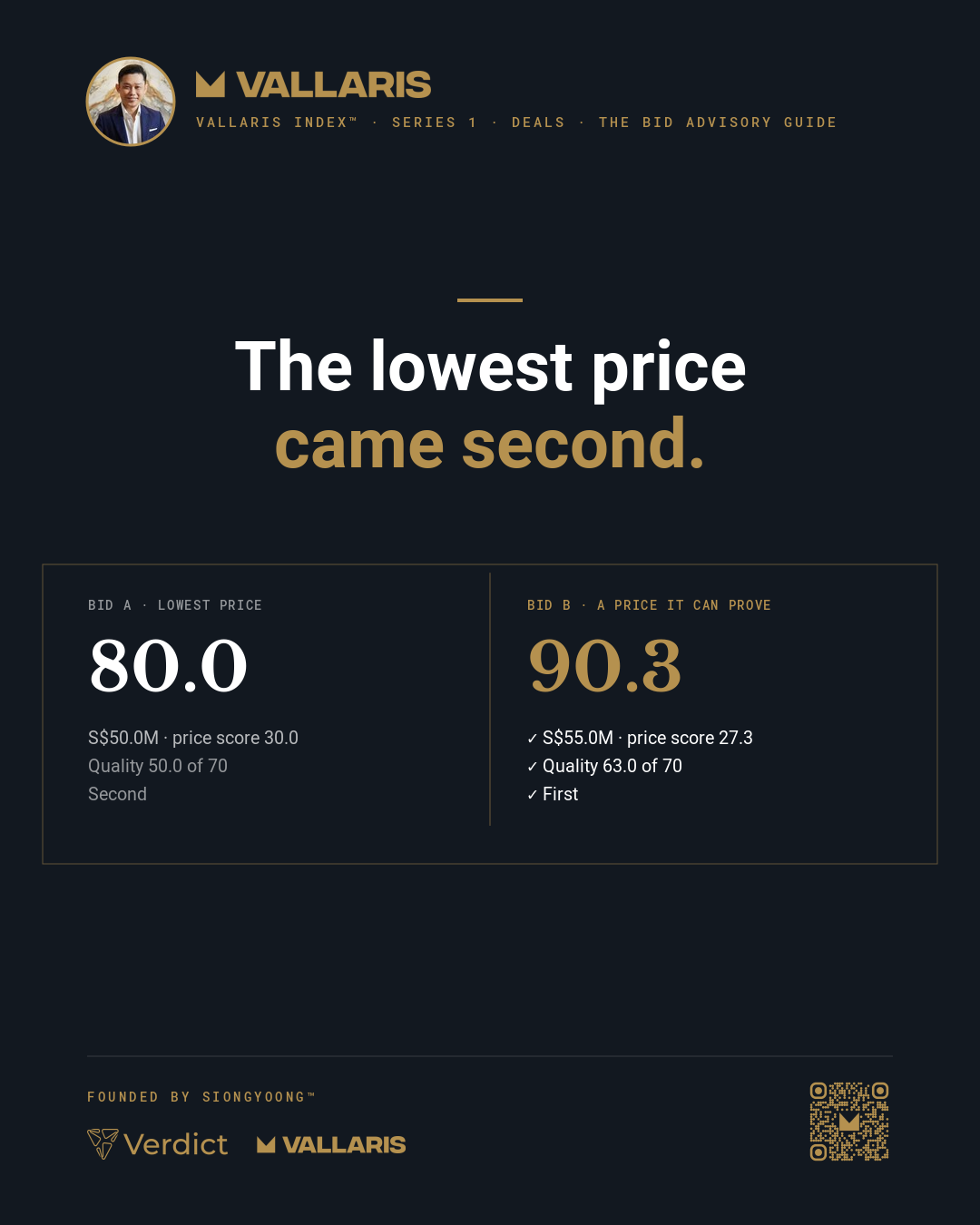
Illustrative figures, for the arithmetic only. The weights and the price formula are chosen to show the arithmetic; each tender sets its own.
A contract is scored out of 100: 30 points for price and 70 for quality. The lowest price takes the full 30 points. Every other bid scores 30 × (lowest price ÷ its price).
- Bid A offers S$50.0 million, the lowest price. Its plan leaves the evaluators unsure how the staffing and the cost of materials were reached, and it scores 50.0 of 70 on quality. Total: 30.0 + 50.0 = 80.0.
- Bid B offers S$55.0 million, 10% more. Its model shows where each cost comes from, its staffing plan matches its cost lines, and its key risks are priced, with sensitivities the evaluator can see. It scores 63.0 of 70 on quality. Price score: 30 × (50.0 ÷ 55.0) = 27.3. Total: 27.3 + 63.0 = 90.3.
The lowest price came second. Bid B gave up 2.7 points on price and gained 13.0 on quality.
Those quality points were not won with adjectives. They were won with numbers the evaluator could follow from the price back to their source. The price that wins is the one they believe.
Bid or no-bid: seven questions
Before any model is built, answer seven questions in writing. Half a page is enough.
- How many working days are left? Below about ten, narrow the scope to what can be done well.
- How will the bid be scored? The criteria, their weights, and which part of the bid each one lands in.
- Are you eligible? Track record, financial capacity and licences, as the tender defines them.
- What must the commercial proposal contain? The business models allowed, the tender price or rent, the projected financials and the required forms.
- Who else will bid? And whether any adviser you appoint acts for one of them.
- Can the board decide its price and business model in time? The model cannot be finished before those decisions are made.
- Does the prize justify the cost of bidding? Include the management time.
A clear no on eligibility, conflicts or timing is a reason to stop, or to bid for less.
The model behind the price
A tender model has two readers. You use it to decide the bid: which business model, what price, how much capital. The evaluator uses it to test whether the bid can be believed: will the customers come, can the operator pay the rent for the whole term, is the project funded? On a project-finance bid the lenders add a third question: will the cash pay the debt, with room to spare?
Build the model so that every one of those questions has an answer inside it.
- An evaluation criteria tab. The tender’s criteria and weights, and where the model answers each one.
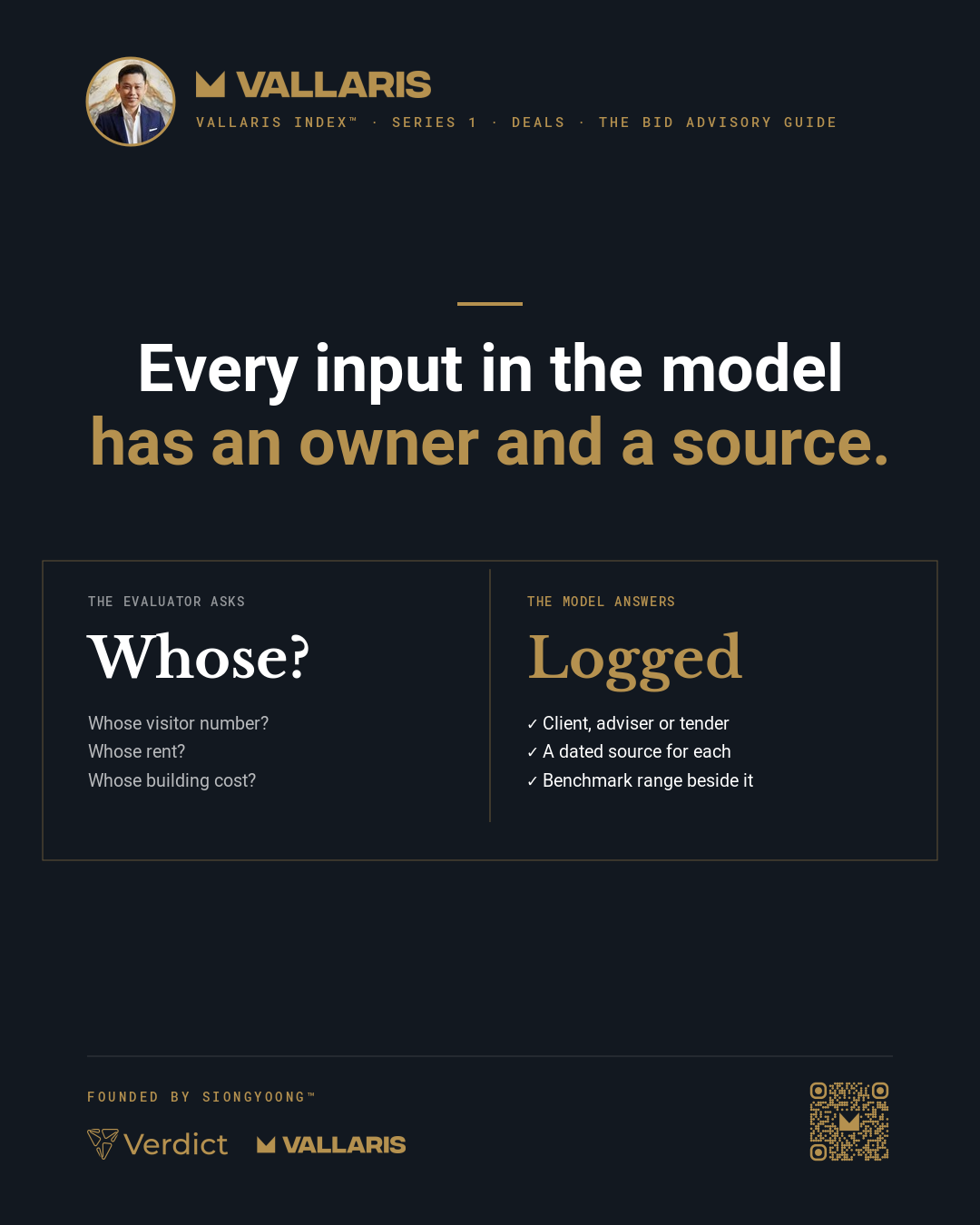
- An assumption log. One row for every input that moves the price or the return. For each: the value used, who owns it, its dated source, the benchmark range, and what it was changed from.
- Three kinds of owner. The client (your commercial decision), the adviser (a benchmark we chose) or the tender (fixed by the documents). Late changes are normal in a bid. The log shows who decided each one, and when.
- Demand built two ways. Bottom-up from capacity, utilisation and operating days; top-down from the catchment and a capture rate. The two are reconciled, and the difference explained.
- One operating model behind every option. Where you offer more than one structure, such as a fixed rent and a revenue share, or joint ventures with different splits, each option draws on the same operating model, and every capital split is derived from one total.
Every input in the model has an owner and a source.
One rule matters more than the rest: a target is never presented as a benchmark. If the board wants to plan on one million paying visitors, enter one million as the board’s own input, and show the share of visitors it implies beside the market benchmark. I have reviewed a tender model in which a percentage, carried to many decimal places and described as an average, existed only to turn a total into a round million. An evaluator who finds one number like that will question every other.
What you show the authority is your decision, and leaving a metric out is acceptable. What is shown should be complete in itself, and give a fair picture of what the authority would receive.
How the price is set, and the headroom
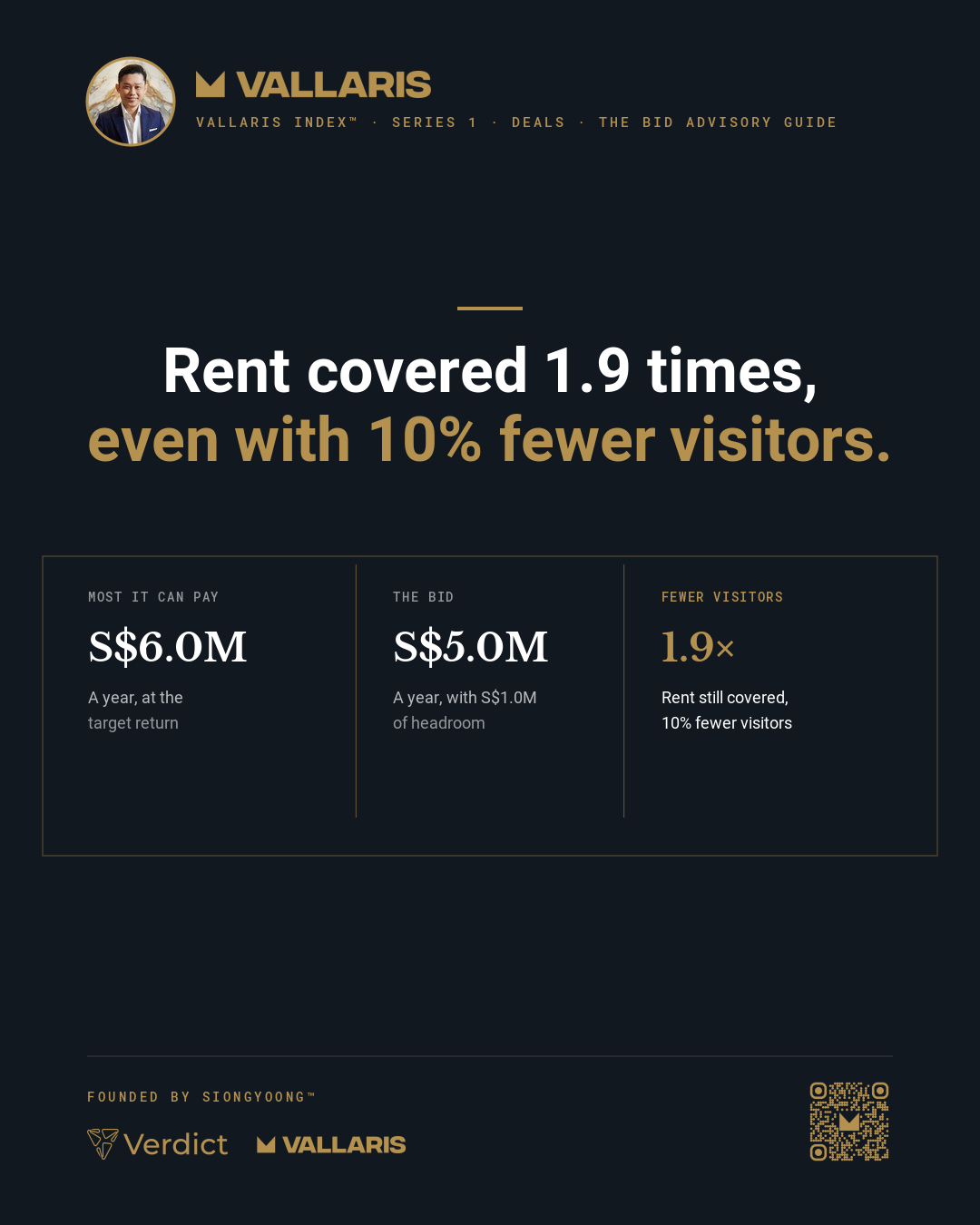
Illustrative figures, for the arithmetic only. A Singapore operator bids an annual rent for a 20-year concession to run a visitor attraction.
The model works from the operator’s side first:
- Operating cash flow before rent, in the stabilised year: revenue of S$30.0 million, less operating costs of S$18.0 million: S$12.0 million.
- What the investors need to keep: S$6.0 million a year, to meet the board’s target return on the capital it puts in.
- The most the operator can pay: S$12.0 million less S$6.0 million: S$6.0 million a year.
- The bid: S$5.0 million a year, leaving S$1.0 million of headroom. In the base case, the rent is covered 2.4 times (S$12.0 million ÷ S$5.0 million).
Now the question every evaluator asks: what if fewer visitors come? With 10% fewer visitors, revenue falls by S$3.0 million and costs by S$0.5 million, because most costs are fixed. Operating cash flow before rent becomes S$9.5 million. The investors earn less than their target that year, but the rent is still covered 1.9 times (S$9.5 million ÷ S$5.0 million).
Rent covered 1.9 times, even with 10% fewer visitors. That line, with its arithmetic, answers the evaluator’s question before it is asked.
The tender price is never typed into the model. It is derived from the project cash flows and the board’s target return, with the headroom and the sensitivities on the same page: visitors, prices, capital cost and rent, each moved by 10% and 20%, and the volume needed to break even in the first year.
What the evaluator checks first
An evaluator scores against the criteria, then looks for the number that will not hold. When I review a bid model, these are the first places I look, because they are the first places an evaluator looks. Check yours before they do.
- Demand against the market. Customer or visitor numbers against comparable operations and the catchment. A total larger than the population it draws on, plus visitors from abroad, cannot be right.
- Prices and margins against comparables. Prices, rents and operating margins benchmarked, with the source of each kept on file.
- Costs that match the plan. Staff costs that match the staffing chart; utilities from tariff data; capital cost against a construction cost handbook.
- The rent or fee, year by year. Covered by operating cash flow in every operating year, with the margin shown.
- Totals that add up on the page. Equity plus debt equals the total capital cost in the text as well as in the model, and the total is stated once.
- A currency on every amount. S$5.0 million, never $5.0 million.
- Claims about your track record. Each with its source on the page, and worded to say exactly what it compares. “A net profit margin three times the average of two listed peers in FY2025” can be checked. “Profits three times higher” invites a question.
Each answer prepared in advance is one the evaluator does not have to score as a risk.
Clarifications: answers that hold
After submission, the agency may write with questions. MOF’s guide for suppliers asks bidders to “respond to agencies’ clarifications on your submitted proposals, if required”. For a large bid, this is often where a shortlisted bid is decided.
- Answer in a table: the question word for word, the answer, and the model reference (tab and cell) behind it.
- Quote only numbers in the model the agency holds. If a number has to change, submit a revised model and say so in the answer.
- Keep one voice. The answers are yours, sent by you, in your company’s words, and consistent with the proposal.
An answer that agrees with the model adds to the evaluator’s belief. An answer that differs from it leaves the evaluator holding two numbers, and asking which one to believe.
In one government tender, VALLARIS™ designed the bid layout, built the financial model behind it and coached the team on clarifications, and the bid qualified for discussions.
How long it takes
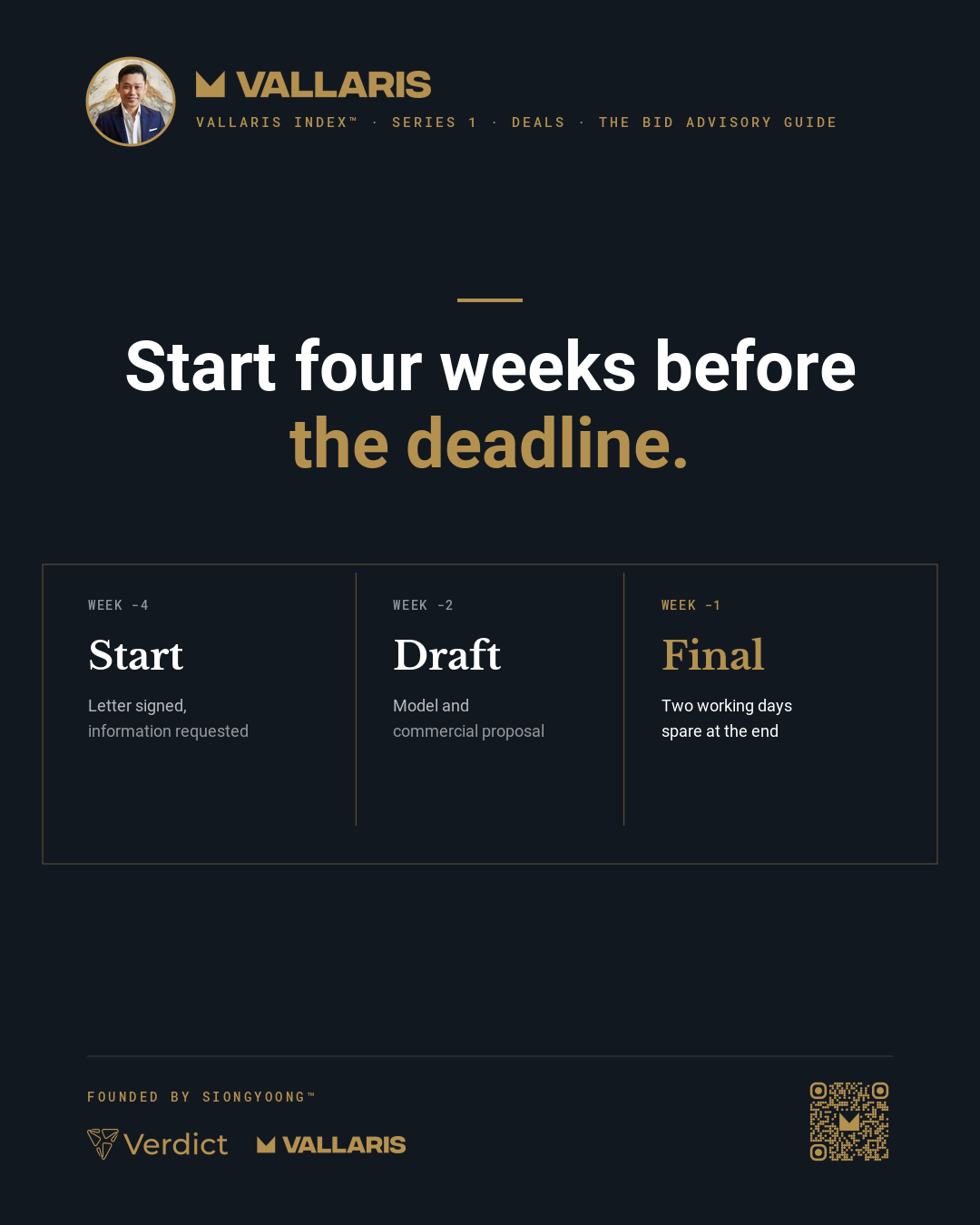
A bid is planned backwards from the submission deadline. In our practice:
- Four weeks before: the engagement letter is signed and the information request goes out.
- Three weeks before: the board decides the business model options and the key inputs.
- Two weeks before: the draft model and the draft commercial proposal.
- One week before: your review, a signed representation letter on the information you provided, and the final.
- At least two working days before: the final is in your hands, for printing, forms and submission.
Start four weeks before the deadline. MOF’s guide is clear that bids submitted after the closing date and time “will not be accepted”, so the two spare working days are there for the forms, the signatures and the upload.
Singapore rules that shape the bid
- Published criteria, applied as written. Requirements, procedures and evaluation criteria are published on GeBIZ, and agencies do not change criteria or waive essential requirements during evaluation.
- A base offer first. MOF’s guide for suppliers advises submitting the base offer in line with the tender’s terms and conditions, and setting out any proposed changes to those terms as an alternative offer.
- Award notices are public. When a contract is awarded, an award notice with the supplier’s name and the contract sum is published on GeBIZ. Past awards for similar contracts are a public reference point for your price.
- Feedback is available. MOF’s guide says the agency is obliged to explain why a bid was not successful, upon writing in. Ask after every result: it sharpens the next bid.
- International rules. Singapore is a party to the World Trade Organization’s Agreement on Government Procurement, and the Government Procurement Act 1997 gives effect to it and to Singapore’s other international procurement obligations.
- Your adviser’s position. Before accepting the tender documents, an adviser should confirm that it does not act for another bidder in the same tender, and check the tender’s rules on disclosing advisers.
Questions bidders ask
What is bid advisory?
Support for a company competing for a contract or concession through a formal tender: whether to bid, how to price it, the financial model that proves the price can be delivered and funded, and how the bid is presented and defended in clarifications.
Does the lowest price win a Singapore government tender?
Not always. The Ministry of Finance says value for money “does not mean that contracts will always be awarded to the lowest quote”, and evaluation criteria generally include both quality and price. Each tender publishes its own criteria and weights.
How are government tenders evaluated in Singapore?
Against the criteria published in the tender documents on GeBIZ, which generally cover quality and price. Agencies do not change the criteria or waive essential requirements during evaluation, so the bid should answer each criterion in the order it is scored.
When should we start preparing a bid?
At least four weeks before the submission deadline, in our practice, with the final ready two working days early. With fewer than about ten working days left, narrow the scope to what can be done well.
Should we submit the financial model with the bid?
Follow the tender. Where it is your choice, build the model as if the evaluator will open it: formulas visible, external links removed, and every key input logged with its owner and source. The commercial proposal and the model should show the same numbers.
What happens in tender clarifications?
The agency may ask questions about your submitted proposal. Answer each one in writing, from the model version the agency holds, with the tab and cell behind every number. If a number must change, submit a revised model and say so.
Will VALLARIS™ be named in our bid?
Not unless the tender requires advisers to be disclosed. The commercial proposal is your document, on your letterhead and in your voice, and you approve every word and number before it is submitted.
How much does bid advisory cost?
The fee follows the size of the tender, the number of business models to price and the time left to the deadline. VALLARIS™ quotes a fixed fee in writing after the first conversation, which has no fee.
Sources
- Ministry of Finance — What is government procurement?. Principles: transparency, open and fair competition, value for money (“We look beyond the lowest price”); Singapore is a party to the WTO GPA.
- Ministry of Finance — Procurement processes. Bids evaluated on published criteria, generally including both quality and price; award notices with supplier and contract sum published on GeBIZ.
- Ministry of Finance — A Guide for Suppliers Participating in Singapore Government Procurement Opportunities. Dated 27 October 2020: evaluation strictly on the tender criteria; clarifications; late bids not accepted; alternative offers; feedback on request.
- Ministry of Finance — Price-Quality Methods for Tender Evaluations (parliamentary reply). 11 July 2016: no ideal price-quality weightage suits all situations.
- Singapore Statutes Online — Government Procurement Act 1997. Gives effect to the WTO Agreement on Government Procurement and Singapore’s other international procurement obligations (2020 Revised Edition).
General information only, not legal, tax, accounting or procurement advice. Worked figures are illustrative. Each tender’s own documents govern; confirm its requirements with the procuring agency and your lawyer.