
In short: A business valuation sets what your company is worth on a stated basis, at a stated date. In Singapore it follows the International Valuation Standards and uses three approaches: income, market and cost. The number matters less than the reasoning, because the reasoning is what survives the other side’s questions.
Every valuation gets tested. By a buyer's adviser. By an auditor. By the other side's expert, under oath.
So the number is never the point. The reasoning is. A valuation that holds is one where every input has a source, every method has a reason, and every judgement has been written down before anyone asks.
This guide shows how that is done in Singapore.
When you need one
Five moments, in the order owners usually meet them:
- You are selling, buying or raising. You want a number to anchor the negotiation, and reasoning that holds when the other side pushes.
- A shareholder is leaving. A buyout, a shareholders' agreement or a succession needs a value both sides can accept.
- Your auditor needs a fair value. A purchase price allocation after a deal, an impairment test of goodwill, or share options under SFRS(I) 2.
- Tax or a restructuring. Shares moving between group companies or family members need a value IRAS can follow.
- A dispute. Oppression claims, divorce and damages claims turn on a value that will be cross-examined.
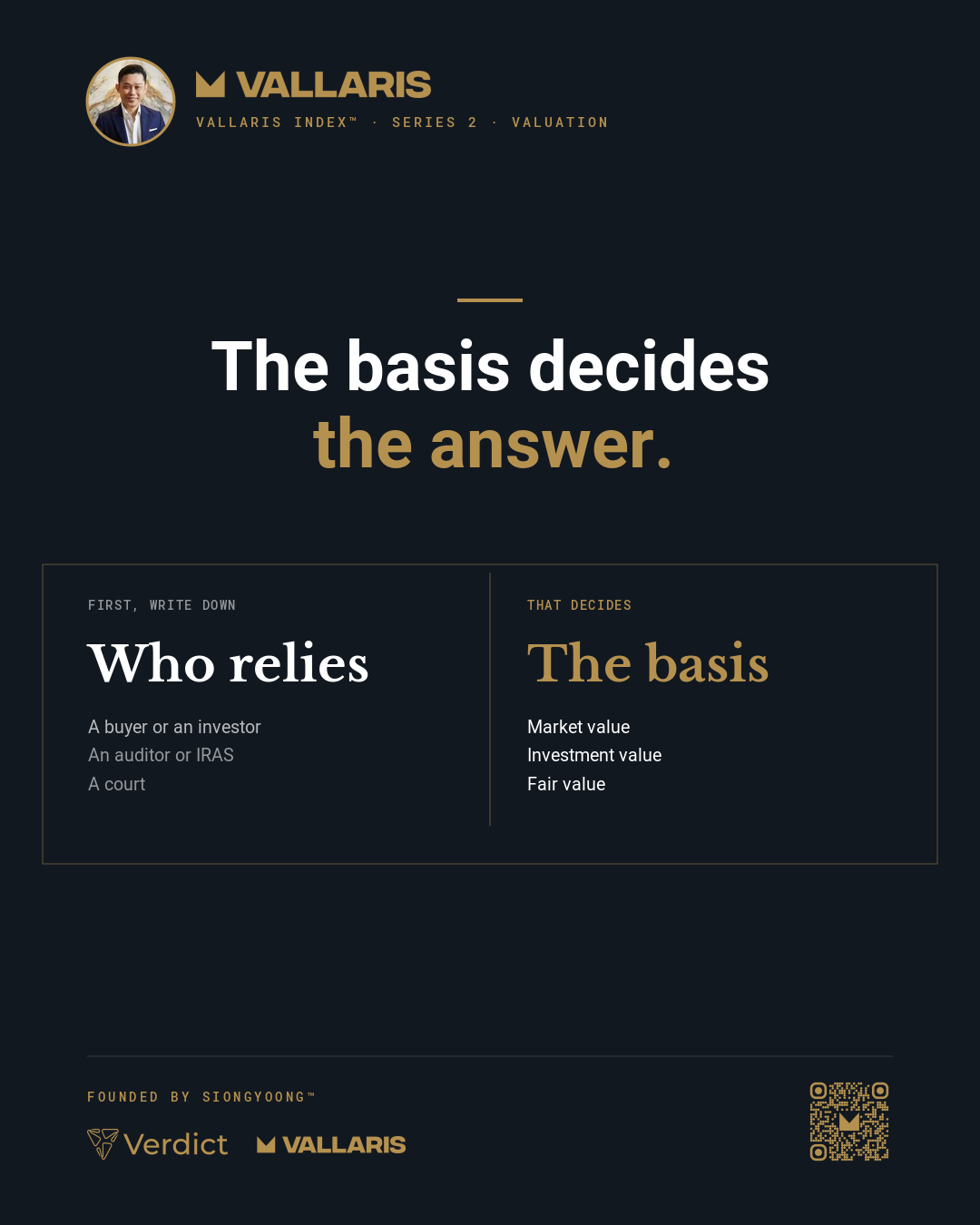
Write down who will rely on the number, and why, before anything else. That one line decides the basis of value, and the basis decides the answer.
Same company, three answers
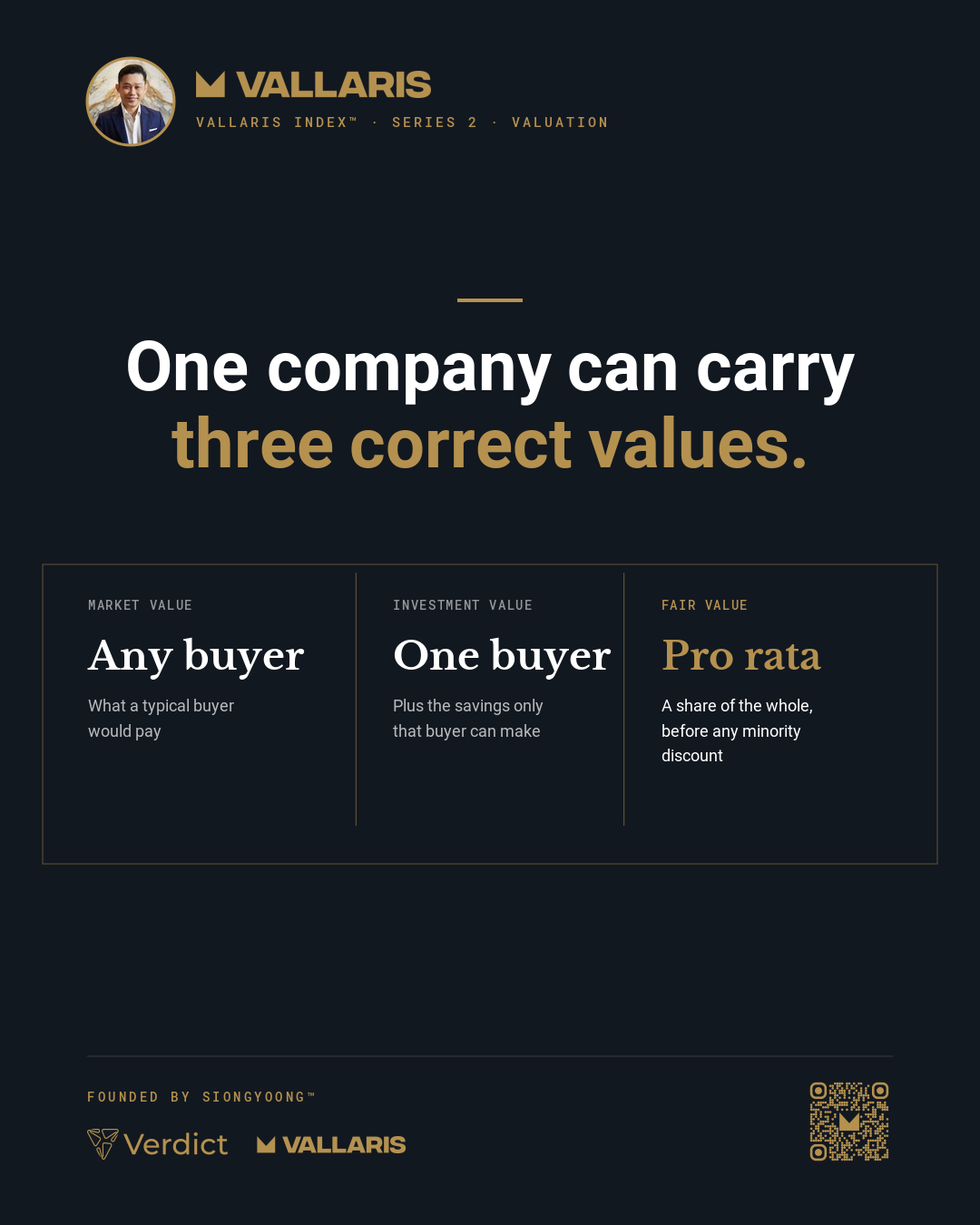
One company can carry three correct values on the same day.
- Market value is what a typical buyer would pay.
- Investment value is what one particular buyer would pay, including the savings only that buyer can make.
- Fair value under a shareholders' agreement, or in a court-ordered buyout, can mean a pro rata share of the whole company, before any discount for a minority stake.
The International Valuation Standards (IVS, effective 31 January 2025) require the valuer to state the basis. If a report does not say which one it uses, it has not answered the question.
Sometimes the court writes the basis for you. In one High Court shareholder suit I valued, the consent judgment fixed the terms before any number was run: a going concern, no minority discount, and one independent valuer both sides agreed on. Read the order first. It is the brief.
What it costs
The fee follows three things.
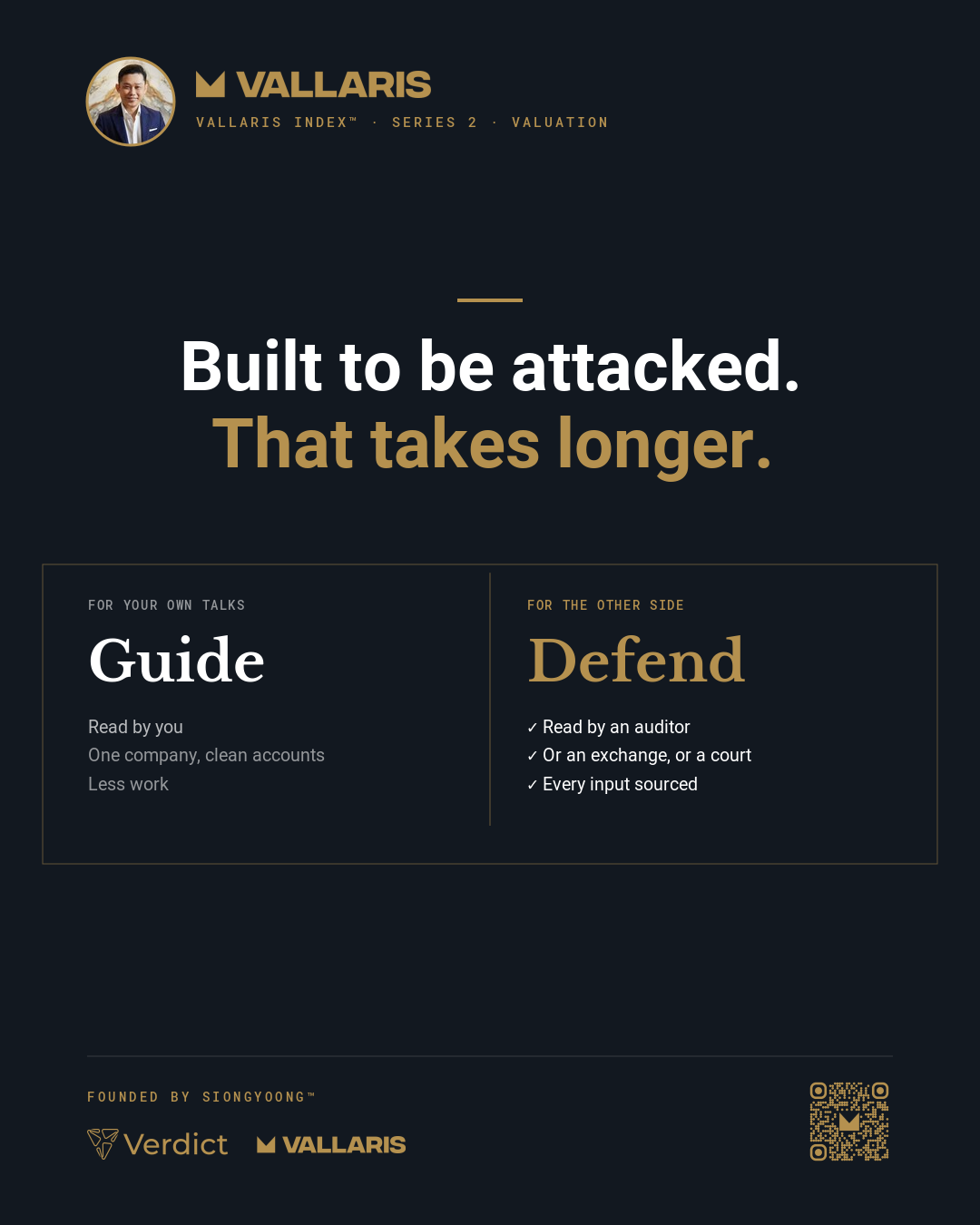
- Purpose. A report to guide your own negotiation needs less than one an auditor, an exchange or a court will read.
- Complexity. One company with clean accounts is less work than a group with foreign subsidiaries or intangible assets to value separately.
- Reliance. A report the other side's expert will attack is built to be attacked. That takes longer.
VALLARIS™ quotes a fixed fee in writing after the first conversation, which has no fee.
The three approaches
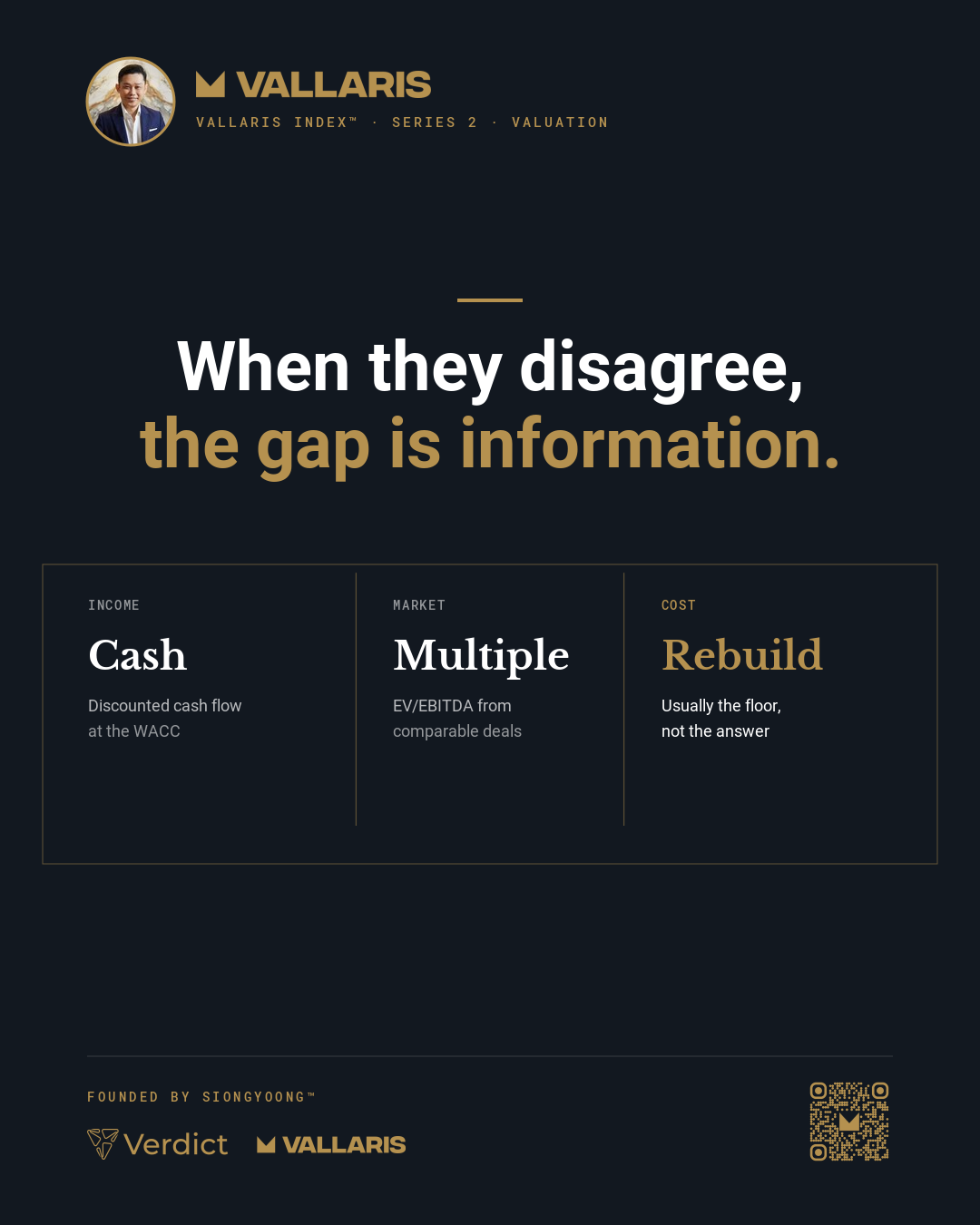
The IVS require the valuer to consider all three and explain the ones relied on.
Income. Value the cash the business will produce. Usually a discounted cash flow: forecast free cash flow for about five years, add a terminal value for the years after, and discount both at the weighted average cost of capital. For a private Singapore company the rate normally carries premiums for size and for risks specific to the company, each one sourced to a study that measures it.
Market. Value the business against what similar companies are worth. Take a multiple, such as enterprise value to EBITDA, from comparable listed companies or completed deals, and apply it to your own figure. The skill is in the comparables, and in adjusting them to your company's size and control position.
Cost. Value what it would cost to rebuild the assets. It suits holding companies and asset-heavy businesses. For a profitable trading company it is usually the floor, not the answer.
Use at least two. When they disagree, the gap is information. It usually means the forecast is more hopeful than the market, or the comparables are not comparable.
Public multiples do not travel
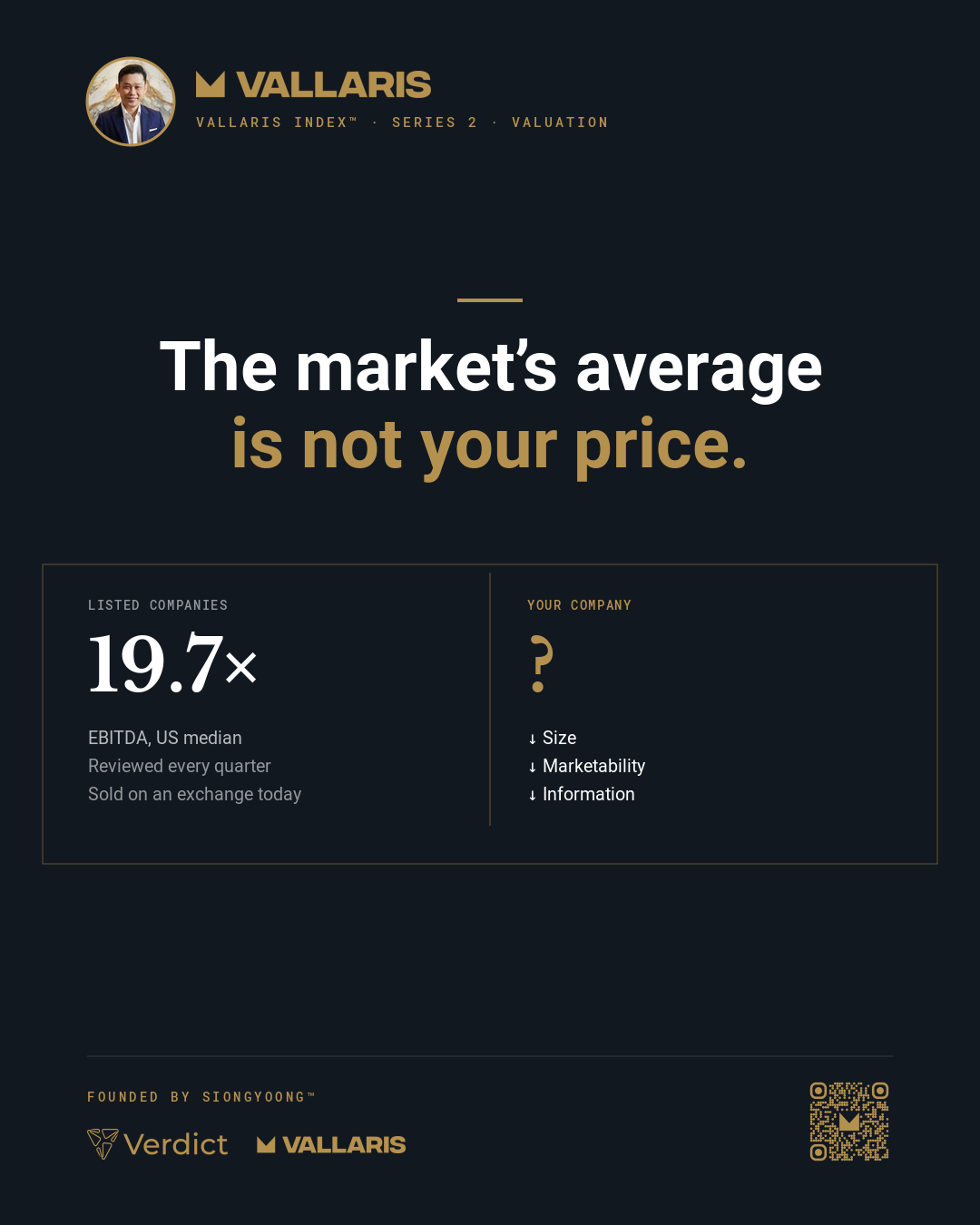
In January 2026, listed US companies traded at a median of 19.7 times EBITDA (Aswath Damodaran, NYU Stern, January 2026 data). Your company will not be priced like that, and the reasons are specific:
- Size. Fewer customers, fewer people, often one owner. Buyers price the concentration.
- Marketability. Private shares cannot be sold on an exchange tomorrow. Buyers pay for that wait.
- Information. A listed company publishes reviewed numbers every quarter. Yours may publish once a year.
There is no standard multiple for a Singapore owner-managed company. The range moves with the sector, the market, the buyer and the terms of the deal. A signed valuation works from the transactions closest to your company at the valuation date, not from a published average.
A rough value in four steps
A starting point for a conversation, not a valuation.
- Normalise EBITDA. Take last year's earnings before interest, tax, depreciation and amortisation. Strip out what will not recur: a one-off legal bill, an owner's salary above or below market, rent paid to the owner at a non-market rate.
- Choose a multiple range from completed deals in your industry and size band, not listed-company averages.
- Multiply. Normalised EBITDA times the low and high multiple gives enterprise value: the business before debt and cash.
- Bridge to equity. Subtract borrowings and debt-like items (unpaid tax, deferred consideration, shareholder loans). Add surplus cash. That is roughly what the shares are worth.
Worked example, for the arithmetic only. A distributor has S$1,000,000 of revenue and a 15% EBITDA margin: S$150,000. Add back S$30,000 of the owner's personal costs run through the company: normalised EBITDA of S$180,000. At 3 to 5 times, enterprise value is S$540,000 to S$900,000. Less S$100,000 of bank debt, plus S$60,000 of surplus cash: equity value of S$500,000 to S$860,000. The multiples are chosen to show the steps, not as a market range for any sector.
What the other side's expert checks first
When I review a valuation for the other side, these are the first places I look. Check yours before anyone else does.
- The discount rate in the DCF equals the one in the WACC workings. A typed rate that drifted from its own calculation is the fastest way to lose a room.
- The terminal year is consistent. Growth forever needs reinvestment forever. If capital spending only equals depreciation, the forecast cannot also grow.
- Every premium and discount cites a study that measures it. A marketability discount supported by control-premium data does not survive questioning.
- The data is the latest before the valuation date. Equity risk premium, size premium, risk-free rate: edition and date shown.
- The forecast is management's, with every adjustment the valuer made listed separately.
What Singapore courts have said about value
Disputes decide value by rules most owners never see until they are in one. Three that come up often (confirm each with your lawyer; this is not legal advice):
- Agreeing to a buyout is not the same as proving oppression. Where shareholders consented to a buyout without a finding of oppression, the Court of Appeal held that a discount for lack of control applies, and left any marketability discount to the valuer (Liew Kit Fah v Koh Keng Chew [2019] SGCA 78).
- Some goodwill belongs to the person, not the company. Where earnings depend on one person's own skill, the valuation separates personal goodwill from enterprise goodwill, and asks whether it can be sold (BJZ v BKA [2013] SGHC 149).
- In a divorce, the date moves. A business in the matrimonial pool is generally valued as at, or close to, the ancillary matters hearing, unless the court or both parties agree otherwise (BPC v BPB [2019] SGCA 3).
What moves the value
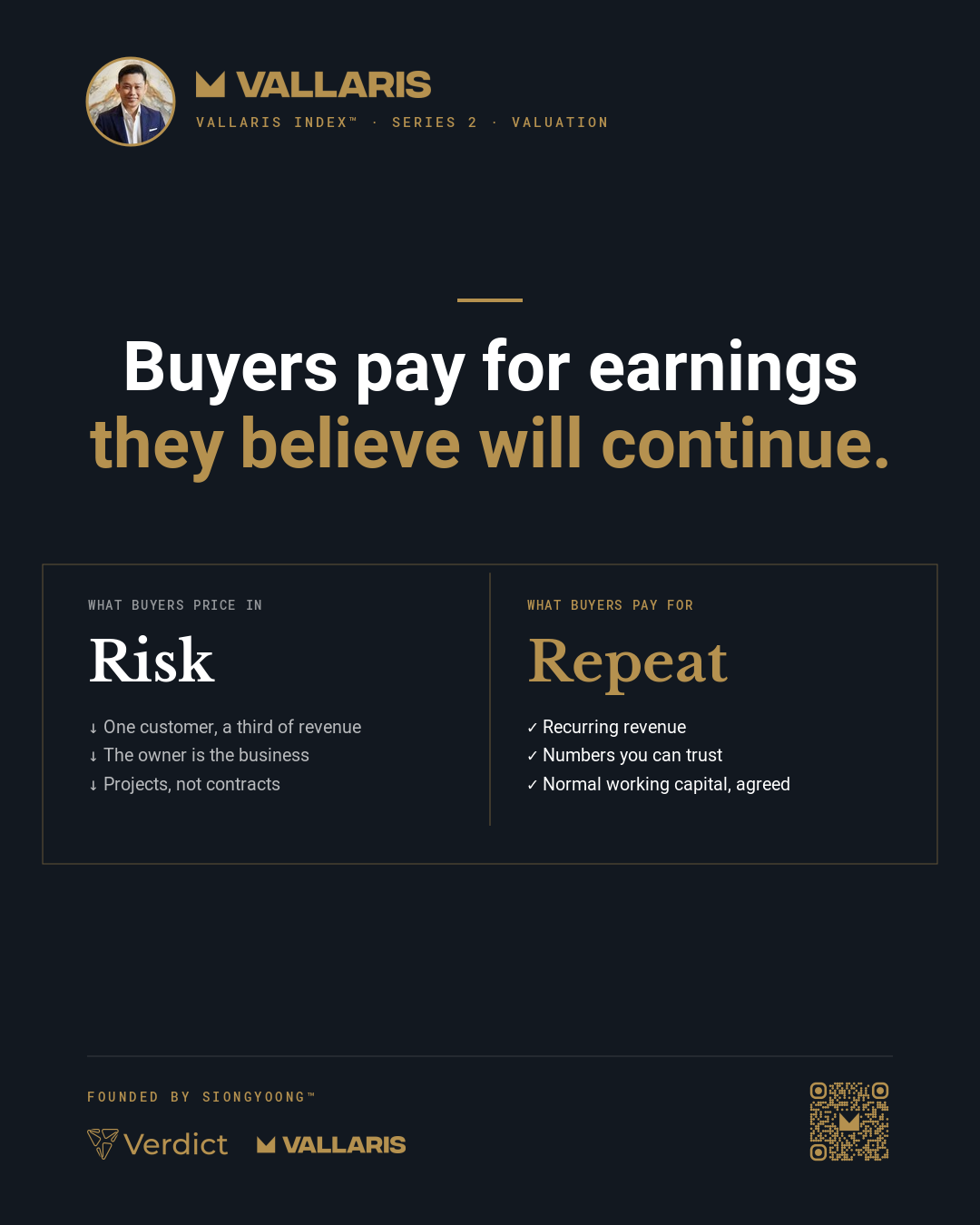
Buyers pay for earnings they believe will continue. From both sides of the table, these move the multiple most:
- One customer, a third of revenue. The buyer prices the day it leaves.
- The owner is the business. If the relationships live with you, the buyer needs you to stay, and pays part of the price later, on an earn-out.
- Recurring revenue. Contracts and repeat orders are worth more than projects.
- Numbers you can trust. Audited accounts, monthly management accounts and a forecast that reconciles to both shorten due diligence and protect the price.
- Working capital. The buyer expects a normal level left in the business. Agree what normal means early, or it becomes a price cut at completion.
The standards behind a Singapore valuation
- International Valuation Standards, issued by the International Valuation Standards Council (IVSC), effective 31 January 2025.
- IVAS PN-001, the Institute of Valuers and Appraisers, Singapore's minimum requirements for performing valuations and issuing business valuation reports (1 December 2021).
- The Chartered Valuer and Appraiser (CVA) programme, launched by IVAS in 2016 and described by IVAS as Asia's first professional business valuation certification. IVAS was set up by the Singapore Accountancy Commission in 2013 and is a member of the IVSC.
- SFRS(I) 13 Fair Value Measurement for values in financial statements, with SFRS(I) 3, SFRS(I) 1-36 and SFRS(I) 2.
Questions owners ask
How much should I pay for a business valuation?
It depends on the purpose, the complexity of the company and who will rely on the report. A report built for an auditor, exchange or court costs more than one to guide your own negotiation, because it is built to be tested. VALLARIS™ quotes a fixed fee in writing after the first conversation.
How much is a business worth with S$1,000,000 in sales?
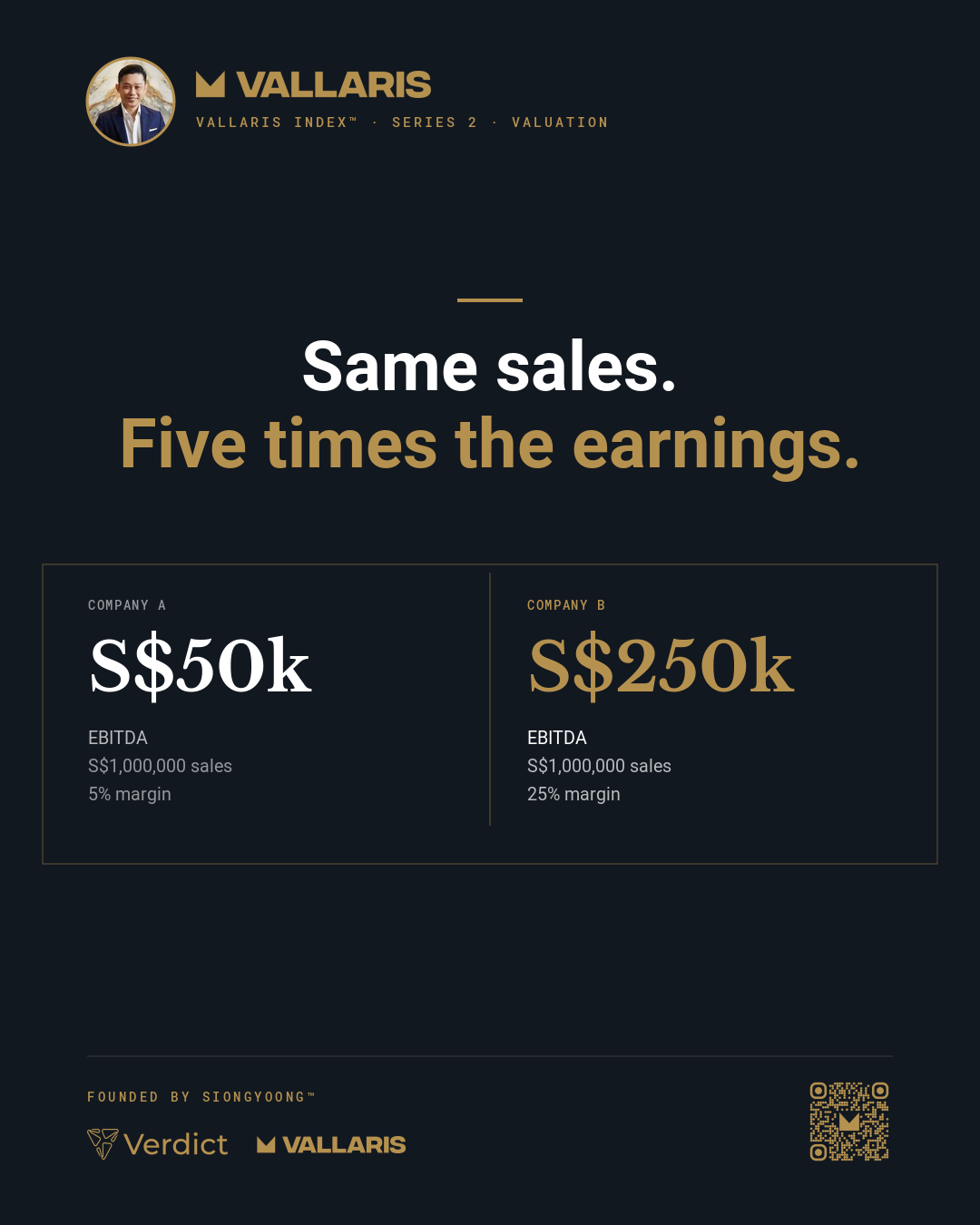
Sales alone do not set value; profit and risk do. Two companies with S$1,000,000 of sales can be worth very different amounts if one keeps 5% and the other 25%. Start from normalised EBITDA, apply a multiple from comparable deals, then adjust for debt and cash, as in the worked example above.
Is a business worth three times profit?
Three times profit means the buyer earns the price back in about three years: roughly 33% a year before growth. That can be fair where the risk is high, such as one large customer or heavy dependence on the owner. A company with recurring revenue, growth and a team that runs without the founder usually sells for more. The multiple is a price for risk and growth, so there is no single right number.
How can I calculate my business valuation?
Normalise EBITDA, apply a range of multiples from comparable deals, then bridge from enterprise value to equity value. Cross-check with a discounted cash flow if you have a forecast. For a number someone else will rely on, have it prepared and signed by a qualified valuer.
How long does a business valuation take?
About three weeks from receiving the accounts and forecasts to the draft report, then about a week to finalise. Longer for groups, and for disputes.
Who should sign a business valuation in Singapore?
For a report a regulator, auditor or court will read: an independent valuer with a recognised valuation qualification, who follows the IVS and signs it.
Sources
- Aswath Damodaran, NYU Stern — Enterprise value multiples by sector (US). January 2026 data.
- ACRA — Institute of Valuers and Appraisers, Singapore. IVAS set up by the Singapore Accountancy Commission in 2013; CVA programme launched 2016.
- Singapore Court of Appeal — Liew Kit Fah v Koh Keng Chew [2019] SGCA 78. Judgment.
- Allen & Gledhill — Court of Appeal considers whether discount applicable where parties consent to buyout order. Case note.
General information only, not valuation, legal or tax advice. Worked figures are illustrative. Case summaries are rules of practice; confirm each with your lawyer.