
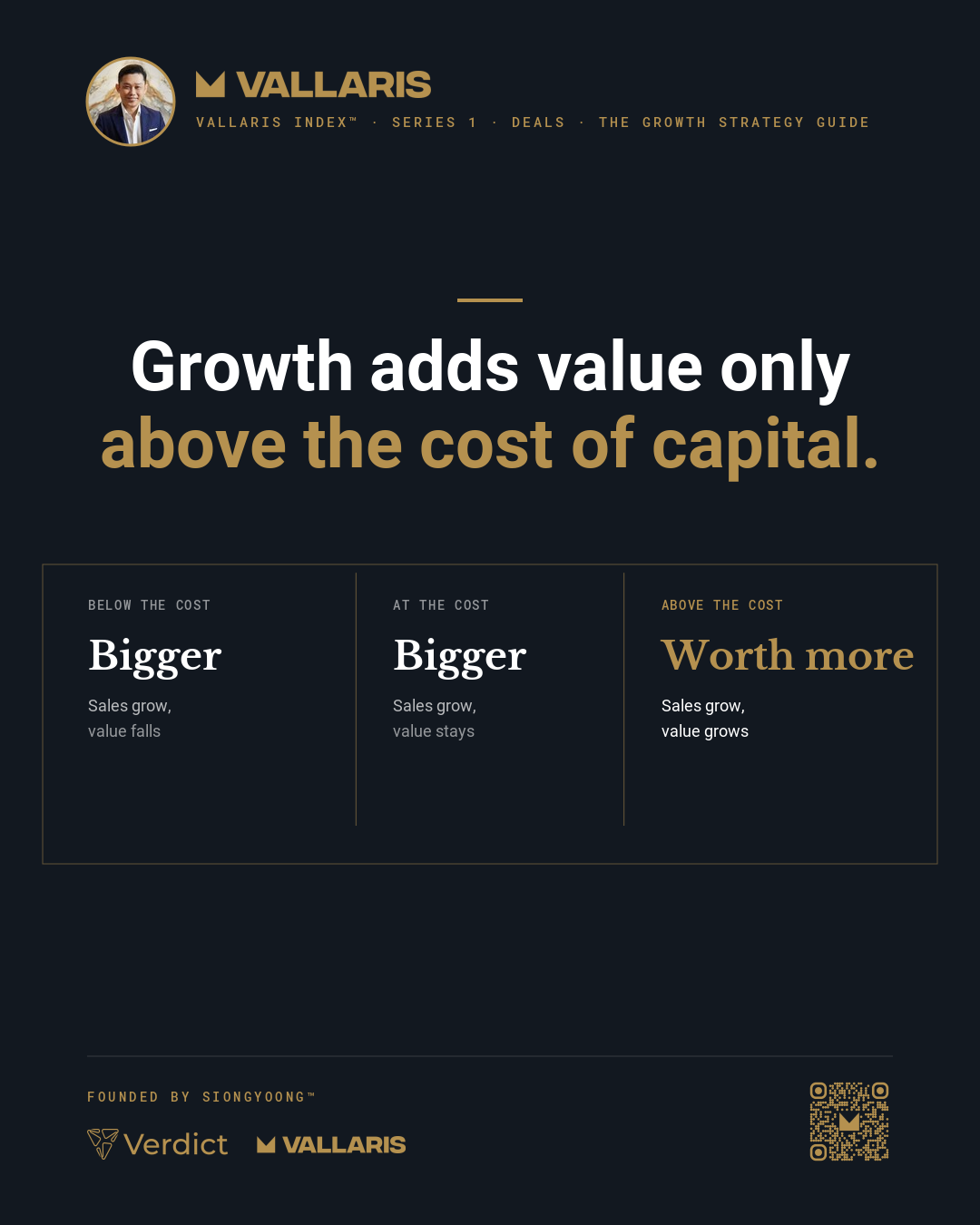
In short: Every growth move makes a company bigger, but only some make it worth more. The difference is what the new money earns: above the cost of capital, growth adds value; at it, the company is bigger and worth the same. So a growth strategy starts with return on capital against the cost of capital, measures every option against the base case, and treats an acquisition premium as a promise the buyer must keep.
You built a company that works. The core business is strong, the team is in place, and the next stage needs a bigger move: a new market, a new product, or an acquisition.
Every one of those moves will make the company bigger. Not every one will make it worth more.
The difference is what the new money earns. Each growth move needs capital: cash to hire, to build, to buy. If that capital earns more than it costs, the company is worth more. If it earns exactly what it costs, the company is bigger and worth the same. Below that, every extra dollar of sales lowers the value.
Growth adds value only above the cost of capital. So the strategy starts with one number, what the company earns on the money already in it, and judges every move by what the next dollar will earn.
Worth more, not just bigger. This guide shows how that is done in Singapore, for owners and boards weighing a move of US$10 million or more.
Start with where you stand
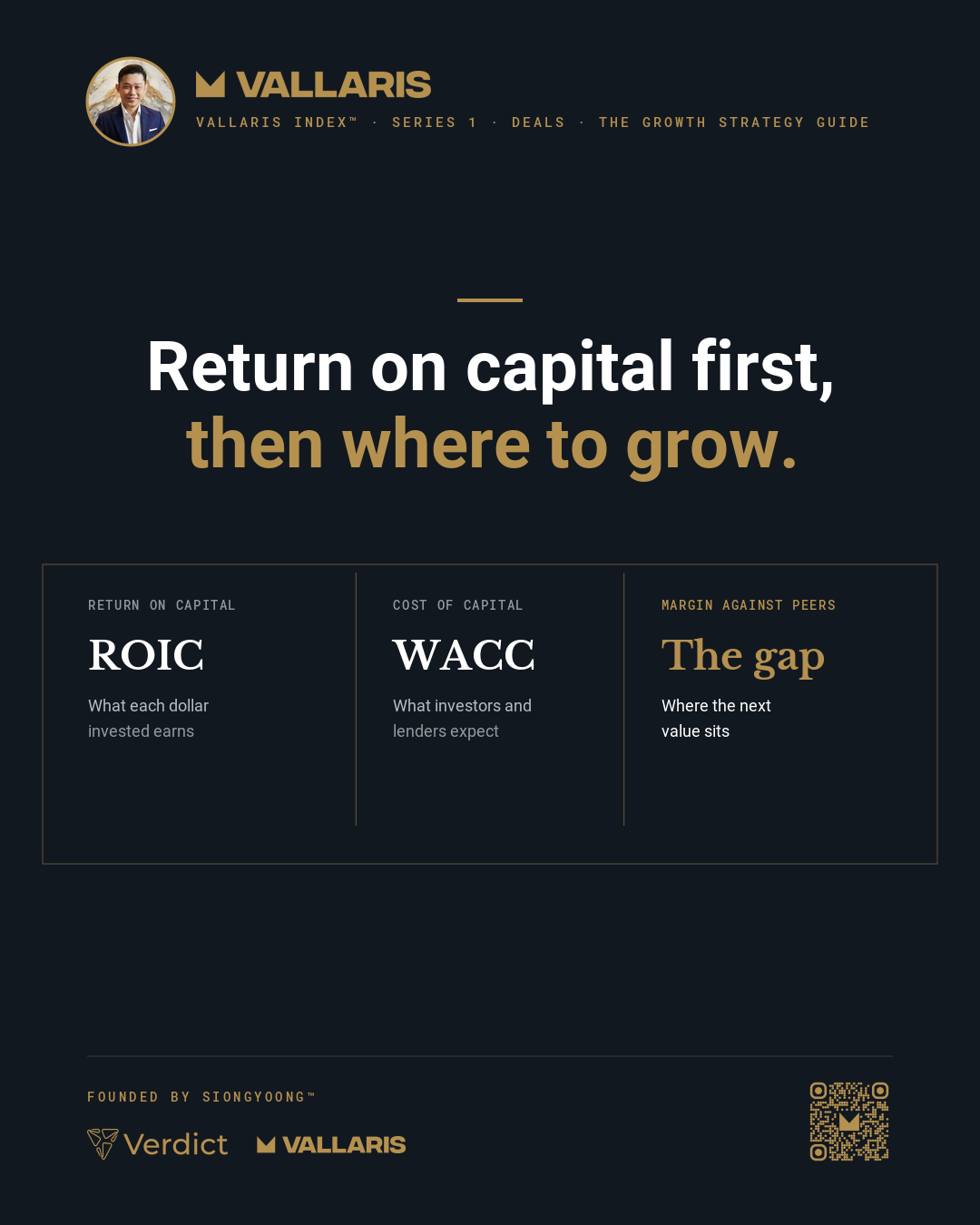
A growth strategy answers one question for the board: where should the company put its next dollar? Before that answer, three numbers set the position.
- Return on invested capital. What the business earns, after tax, on the money tied up in it: equipment, stock, receivables, less what suppliers fund. It is the best single measure of how well the company turns capital into profit.
- Cost of capital. The return that shareholders and lenders expect for the risk they carry, weighted by how the company is funded. It is the weighted average cost of capital (WACC), and it is built from market data for companies like yours, at a stated date.
- Margin against peers. Your earnings before interest, tax, depreciation and amortisation (EBITDA), as a share of sales, set against listed companies in the same business. Put every company on the same accounting basis before you compare, leases included.
Return on capital first, then where to grow. The spread between the first two numbers says whether growth is adding value today. The gap to peers says where the next gain is most likely to sit: in price, in cost, or in how much capital each dollar of sales needs.
On one recent review, a services group earned a return on capital more than twice its cost of capital, yet its EBITDA margin was less than half the median of its listed peers. The board had asked where to expand. The more valuable answer came first: what the peers did differently on margin, and how much of that gap the group could close before it expanded at all.
One ratio is not a business model. A low return on assets may mean the company owns its fleet while its peers lease theirs, so read each ratio against what the company owns.
Growth adds value only above the cost of capital
Illustrative figures, for the arithmetic only. A Singapore company earns S$5.0 million a year after tax. Its cost of capital is 10%. With no growth and no reinvestment, all S$5.0 million can go to the owners, and the business is worth about S$50.0 million (S$5.0 million divided by 10%).
The board wants to grow 3% a year. To do that, the company must put part of its profit back in, every year. How much depends on what the new money earns.
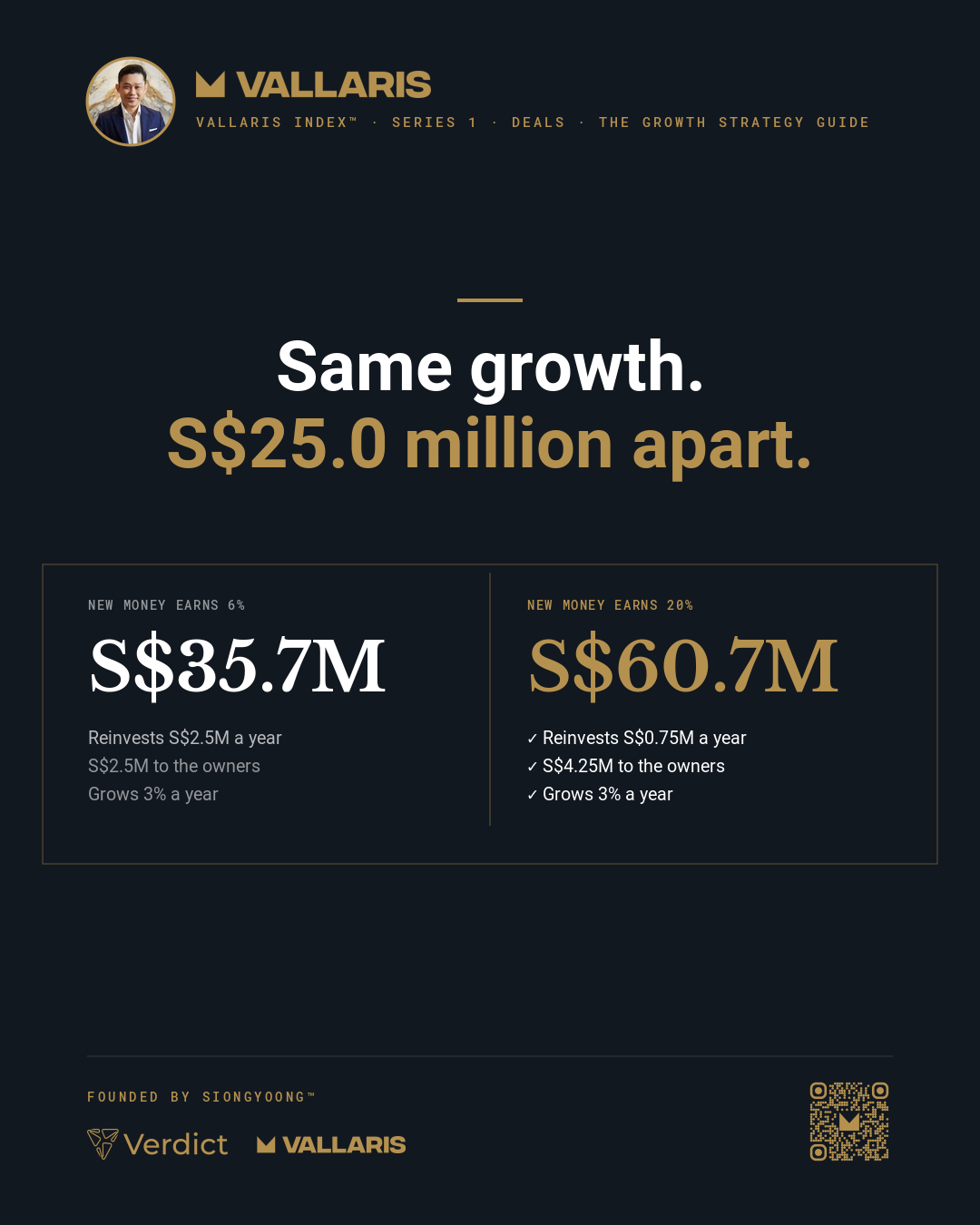
- New money earns 20%. To grow 3% a year, the company reinvests 15% of its profit: S$0.75 million. S$4.25 million goes to the owners, growing 3% a year. Value: about S$60.7 million.
- New money earns 10%, the same as the cost of capital. The company reinvests 30%: S$1.5 million. S$3.5 million goes to the owners. Value: about S$50.0 million, the same as not growing at all.
- New money earns 6%. The company reinvests 50%: S$2.5 million. S$2.5 million goes to the owners. Value: about S$35.7 million.
Same growth. S$25.0 million apart.
In all three cases sales and profit grow at the same pace. Only the value differs, because of what each new dollar earns. So the strategy measures every move by its return on the new capital, not by the sales it adds.
Two moves follow for most companies. First, raise the return on the capital already in the business, through price, cost or less capital per dollar of sales, because that lifts value without any new money. Second, grow only where the new money will earn more than the cost of capital, and grow fastest where the spread is widest.
Where to grow
Growth comes from four places. Each is tested on the same three questions: what it will earn on the money it needs, how large it can become, and how long it will take.
- More from the customers you have. Price, share of each customer’s spend, and retention. Usually the highest return, because the customers, the sales team and the systems are already paid for.
- New products or services for those customers. Higher return where the product fits what you already do well; lower where it needs new skills.
- New markets for what you already sell. A new country or segment. The return depends on how much of the home business travels: brand, contracts, people and licences.
- New capabilities. A technology, a channel or a skill the company does not have yet. Often the reason to buy rather than build.
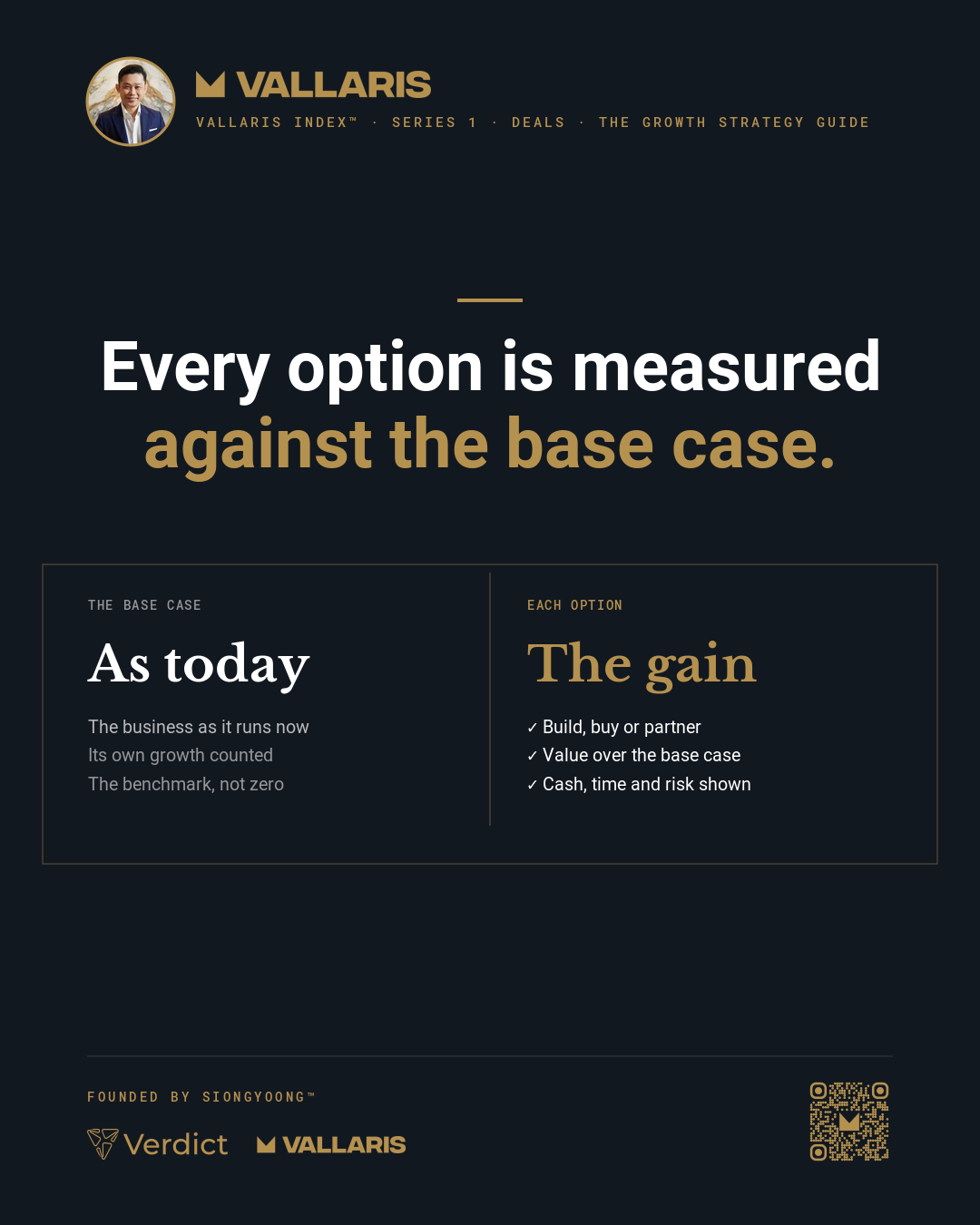
Write the options down side by side, and include the base case: the business carried on as it runs today. Every option is measured against the base case. A move that adds S$3.0 million of profit, where the base case would have added S$2.0 million anyway, is worth S$1.0 million of profit, not S$3.0 million. Say why each rejected option was rejected, so the board can see what was considered.
Build, buy or partner
Once the board has chosen where to grow, the next decision is how.
- Build. Grow with your own people and capital. You keep control and pay no premium to a seller. It is usually slower, and the return depends on your team doing something new.
- Buy. Acquire a company that already has the customers, products or capabilities. It is faster, and it comes with a price agreed with a seller, usually above what the business is worth on its own. The return depends on the savings and new sales you capture after completion.
- Partner. A joint venture, a licence or a distribution agreement. Less capital and less control. The return is shared, and so is the say on what happens next.
Compare the three on the same four lines: value added over the base case, cash needed, time to the first result, and what has to go right. Many companies use more than one: build in the core, buy a capability, partner in a market they are testing.
When the answer is to buy
An acquisition is a growth move with a price attached, so it carries two tests rather than one.
Strategic due diligence asks two questions, separately (Booz & Company, Strategic Due Diligence: A Foundation for M&A Success, 2006). Is the deal commercially attractive, judged from the outside: the market, the target’s position, and how customers and competitors will react? And can you capture the value, judged from the inside: your capabilities, your management time, and whether the time frame is realistic? A rationale that answers only the first is not finished.
The same paper sorts deals by two things: the size of the target against yours, and how closely the two will be combined. That gives four kinds of deal, and each one tells you what to test first.
- In-market consolidation (a large target, closely combined): customer reaction, the savings, and which processes to keep.
- In-market absorption (a small target, closely combined): the operating savings, how quickly they arrive, and how competitors respond.
- Out-of-market transformation (a large target, run separately): the new market, the people and capabilities to keep, and how the two will be governed.
- Out-of-market bolt-on (a small target, run separately): the new market, and what your company adds as a parent to help it grow.
Where combining the two businesses carries more risk, the price you are prepared to pay should be lower, and you should be ready to walk away if it is not met.
A worked example
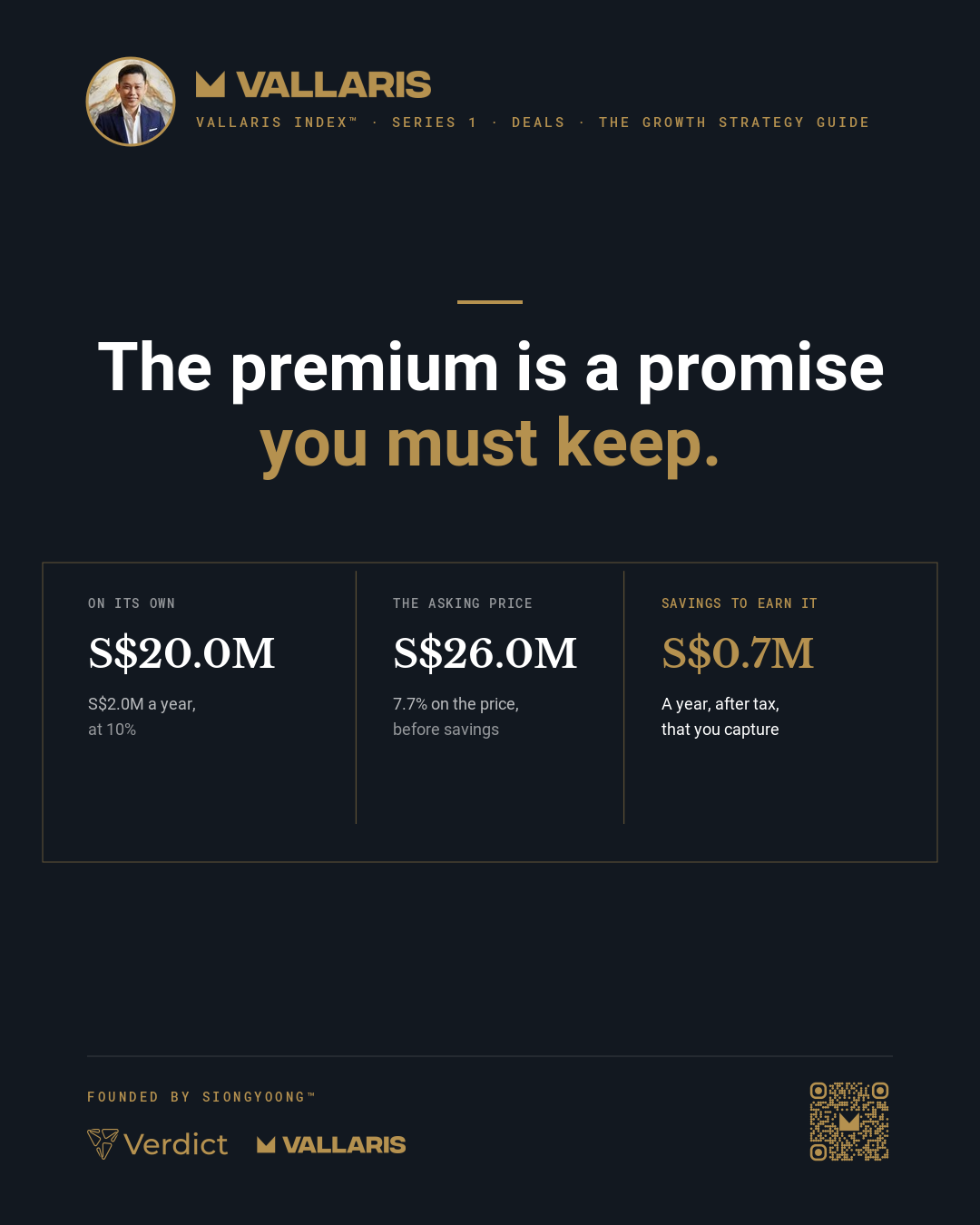
Illustrative figures, for the arithmetic only. Your company, with a 10% cost of capital, is looking at a distributor in a neighbouring market.
- On its own, the distributor earns S$2.0 million a year after tax. At 10%, with no growth, it is worth about S$20.0 million to any buyer.
- The seller asks S$26.0 million. On that price, the distributor’s own earnings return 7.7%, below your 10% cost of capital.
- Integration will cost about S$1.0 million: systems, people and the time of your own managers.
- To earn your cost of capital on S$27.0 million in total, the combined business needs S$2.7 million a year after tax. So the deal needs S$0.7 million a year of savings or extra profit, after tax, that only the combination creates: about S$0.84 million before tax at Singapore’s 17% corporate rate.
The S$6.0 million above the distributor’s own value is paid on the day you sign. The savings arrive over years, and only if your team delivers them. The premium is a promise you must keep.
So the strategy writes down, before any offer, which savings you can capture, who will deliver each one, and by when. That list, and not the seller’s asking price, sets the most you should pay. A growth strategy does not set the price itself; that is a separate valuation, done on its own terms. What the strategy gives the board is the reason for the deal and the savings it rests on.
What a deal does to your accounts
Value and reported profit can move in different directions after an acquisition.
Under SFRS(I) 3 Business Combinations, equivalent to IFRS 3, the price you pay is split across the assets you acquire at fair value, including customer relationships, brands and technology that were never on the seller’s balance sheet. Whatever is left is goodwill. Intangible assets with a finite life are amortised, year by year, through your profit. Goodwill is not amortised; under SFRS(I) 1-36 Impairment of Assets, equivalent to IAS 36, it is tested for impairment every year.
So a deal that adds value can still lower reported earnings for years, through amortisation, and the yearly goodwill test will show whether the savings arrived. Plan for both in the board paper.
Singapore rules that shape a growth move
- The M&A allowance. A Singapore company that buys ordinary shares in another company, and meets the conditions, may claim an allowance of 25% of the purchase price, written down over five years. The purchase price counted is capped at S$40 million a year, so the allowance is capped at S$10 million. It applies to acquisitions made up to 31 December 2030. The conditions include a buyer incorporated and tax resident in Singapore, with at least three local employees for the 12 months before the deal. Count the saving only once your tax adviser confirms it applies.
- Competition. Telling the Competition and Consumer Commission of Singapore about a merger is voluntary. The Commission says it is unlikely to step in unless the combined business would hold 40% of a market, or between 20% and 40% where the three largest firms together would hold 70% or more. If your deal comes near those shares, decide on notification with your lawyer before you sign.
- Listed buyers. On the SGX Mainboard, an acquisition where any relative figure under Rule 1006 exceeds 20% is a major transaction under Rule 1014. It must be announced and made conditional on shareholders’ approval, with a circular. Build the time for that into the plan.
- Tax. Singapore’s corporate income tax rate is 17%. Measure every option on profit after tax.
How the work runs
A VALLARIS™ growth strategy runs in phases, and each phase ends in one named deliverable.
- Strategic review. The company’s financial performance over recent years, its cost of capital, and a benchmark against listed peers. It ends in a report that leads with the position: return on capital against cost of capital, and the margin gap to peers, on the first page.
- Strategy. The market opportunity, the company’s competitive position, and the options compared against the base case, ending in recommendations, each tied to a number in the review.
- The move. Where the strategy points to a deal, the deal rationale is written as the argument you will make to the other side. When a client weighing a share swap with a larger group asked how its analysis could persuade the other side to agree, the review became the case it took into the room.
Questions owners ask
What is a growth strategy?
A plan that sets where a company will grow and how: by building, by buying, by partnering, or by preparing for a sale. For an established company, it decides which moves to pursue, which to decline, and how each one will change what the company is worth.
What is the difference between organic and inorganic growth?
Organic growth comes from the existing business: more customers, new products, new markets. Inorganic growth comes from acquisitions, mergers or partnerships. Most established companies use both, and the strategy sets the balance.
How do I know if growth is adding value?
Compare what the company earns on the capital invested in it with its cost of capital. If the return is higher, growth adds value. If it is the same, growth makes the company bigger without making it worth more. Measure each new move on the return its own capital will earn.
Should we build or buy?
Build when you have the capabilities and time is on your side. Buy when the capability, the customers or the speed are worth a premium, and you can name the savings or new sales that will repay it. Compare both against the base case, on value added, cash needed, time and what has to go right.
How much should we pay for an acquisition?
No more than the target is worth on its own, plus the value of the savings and new sales you can capture, less the cost of capturing them. A growth strategy sets out the reason for the deal and those savings. The price itself comes from a separate valuation.
How long does a growth strategy take?
The strategic review that starts it takes weeks, not months: in our practice, about three weeks from receiving complete information to the draft, then about a week to finalise. The strategy and any deal work that follow are timed once the review shows which moves are worth pursuing.
How much does a growth strategy cost?
The fee follows the phases and the questions the board needs answered. VALLARIS™ quotes a fixed fee in writing, by milestone, after the first conversation, which has no fee.
Sources
- Booz & Company (strategy+business) — Strategic Due Diligence: A Foundation for M&A Success. 28 September 2006: the two questions (pp. 1–2) and four deal types (Exhibit 2).
- IRAS — e-Tax Guide: Mergers and Acquisitions Scheme. Eighth edition, 30 January 2026: 25% allowance over five years; S$40M purchase price and S$10M allowance caps; acquisitions to 31 December 2030 (paras 4.1–4.3, 6.1).
- IRAS — Explanatory Notes to Form C-S, YA 2026. Corporate tax rate of 17% for YA 2026, used in the worked example.
- Competition and Consumer Commission of Singapore — Notify a merger: overview. Notification is voluntary; indicative thresholds of 40%, or 20% to 40% with a three-firm share of 70%.
- SGX RegCo — Mainboard Rules, Rule 1014 (major transactions). Relative figures over 20% under Rule 1006: conditional on shareholder approval, with a circular.
- IFRS Foundation — IFRS 3, IAS 36 and IAS 38 summaries. Goodwill tested each year; finite-life intangibles amortised. SFRS(I) 3, 1-36 and 1-38 are equivalent to IFRS 3, IAS 36 and IAS 38.
General information only, not legal, tax, accounting or valuation advice. Worked figures are illustrative. Confirm the tax position with your tax adviser and any competition or listing rule with your lawyer.